
Apple Captures 65% of Global Premium Smartphone Market
Apple Dominates the Premium Smartphone Market, But Competition Heats Up
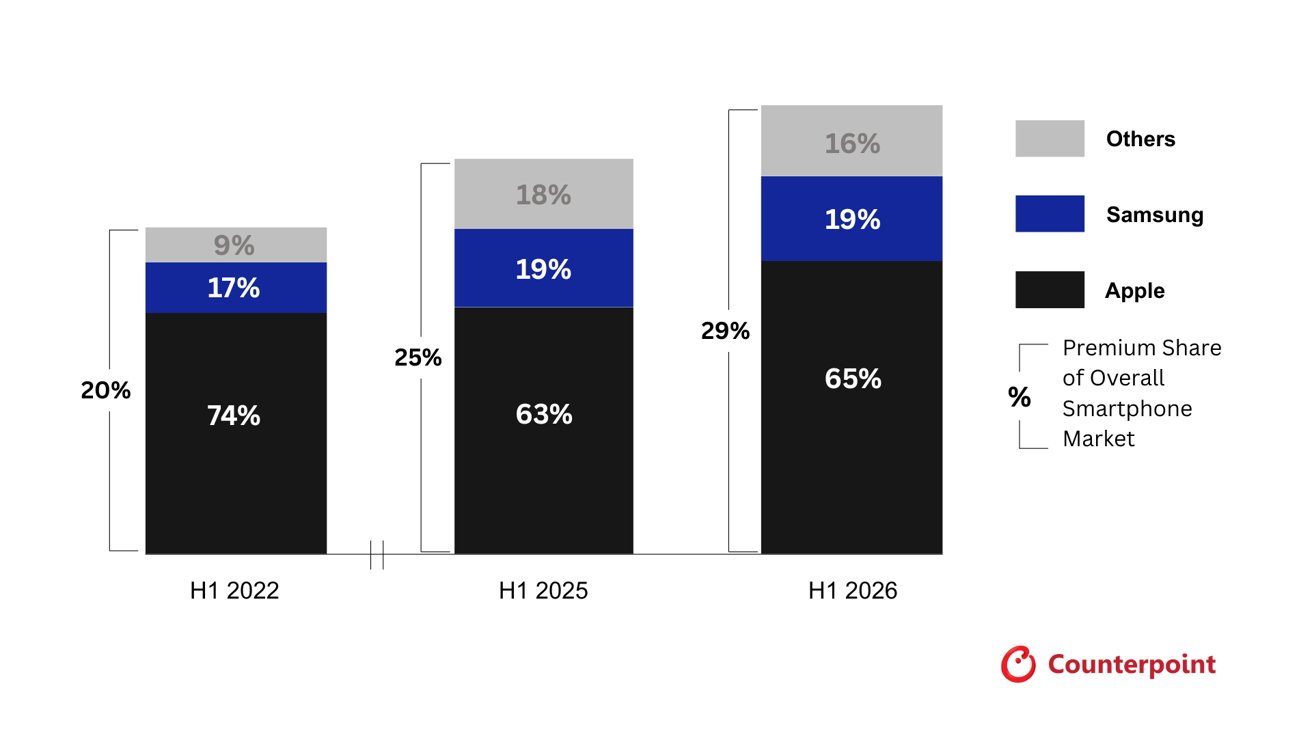
In the fast-paced world of technology, market dynamics are constantly shifting, yet some players consistently maintain their lead. A recent report from Counterpoint Research sheds light on the premium smartphone segment, revealing that Apple has once again demonstrated its formidable strength. In the first half of 2026, the tech giant commanded an impressive 65% of the global premium smartphone market. This incredible share underscores Apple's enduring appeal and dominant position at the high end of the market.
Simultaneously, the premium segment itself has seen remarkable growth, now accounting for a record 29% of all smartphone sales. This indicates a significant shift in consumer preferences, with more buyers opting for higher-end devices that offer advanced features, superior performance, and a premium experience. This trend of "premiumization" is reshaping the entire smartphone industry, pushing manufacturers to innovate and differentiate their flagship offerings.
Understanding the Premium Smartphone Market
Before diving deeper into the market shares and trends, it's essential to understand what defines the "premium smartphone market." According to Counterpoint Research's Handset Model Sales Tracker, this segment includes smartphones with a wholesale average selling price (ASP) of $600 or more. This price point typically encompasses devices that feature cutting-edge processors, advanced camera systems, high-quality displays, premium build materials, and innovative software functionalities. These are the phones that often define the technological aspirations of the industry.
The premium segment is not just about price; it's about the entire user experience. Consumers in this category are often looking for longevity, robust performance for demanding tasks like gaming or professional photography, and access to a rich ecosystem of services and accessories. The devices in this segment are typically seen as investments, with users expecting them to perform reliably for several years.
Apple's Enduring Dominance
Apple's impressive 65% share in the first half of 2026 is a testament to the immense loyalty and global appeal of its brand. The company's premium segment revenue grew a healthy 9% year-over-year during this period, a significant achievement in a competitive market. Counterpoint Research attributes this growth primarily to the strong sales performance of the latest iPhone 17 lineup, with particular emphasis on the base model. This suggests that even the standard iPhone models, positioned within the premium segment, resonate strongly with consumers seeking a high-quality, reliable, and feature-rich smartphone experience without necessarily opting for the 'Pro' or 'Ultra' variants.
The success of the iPhone 17 series can be attributed to several factors unique to Apple. Its integrated ecosystem, where hardware, software, and services seamlessly work together, creates a "sticky" experience that encourages users to stay within the Apple fold. Features like iMessage, FaceTime, iCloud, and the vast App Store contribute to this powerful ecosystem. Furthermore, Apple's strong brand value, perceived quality, and consistent user experience across its devices continue to be major drawcards for consumers worldwide, especially in developed markets where purchasing power is higher and brand prestige plays a significant role.
A Slight Shift in Share: Intensifying Competition
Despite its impressive market share, Apple has seen a slight dip compared to previous years. The company's premium segment share stood at 74% in the first half of 2022, meaning it has declined by 9 percentage points over four years. Counterpoint Research identifies the primary reason for this decline as intensifying competition, particularly in China. China is not just any market; it is the largest premium smartphone market globally, making it a critical battleground for top manufacturers.
In China, domestic brands like Huawei, Xiaomi, OPPO, and vivo have significantly sharpened their flagship offerings. These manufacturers have invested heavily in research and development, design, and marketing to create devices that can directly compete with, and in some cases, surpass international rivals in terms of features, camera technology, and industrial design. By offering compelling alternatives, these Chinese brands are successfully pulling more local consumers toward domestic premium options. This trend highlights the growing sophistication and competitiveness of Chinese smartphone makers, who are no longer content with just dominating the mid-range or budget segments but are now serious contenders in the high-end space.
This localized competition means that while Apple continues to excel globally, it faces specific challenges in regions where local brands have a deeper understanding of consumer preferences, stronger distribution networks, and a sense of national pride that can influence purchasing decisions. For example, Huawei, despite geopolitical challenges, has managed to rebuild its premium presence, especially within China, showcasing robust innovation and brand loyalty.
The Growing Allure of Premium Smartphones
The overall premium smartphone segment is experiencing robust growth, with unit sales climbing 5% year-over-year in the first half of 2026. This growth is part of a larger trend, as the segment's market share has steadily increased from 20% in the first half of 2022 and 25% in the first half of 2025 to its current record of 29%. This consistent upward trajectory indicates a fundamental shift in how consumers view and purchase smartphones.
Several factors contribute to this expanding appeal of premium devices, ranging from economic pressures affecting other market segments to evolving consumer desires for advanced technology and an elevated user experience.
Cost Pressures and the Narrowing Price Gap
One of the most interesting drivers behind the premium segment's recent gains, particularly in the first half of 2026, stems from rising memory and component costs. These cost increases, driven by global supply chain issues, inflation, and increased demand for advanced components, have impacted the entire smartphone manufacturing industry. However, Counterpoint Research notes that these rising costs have hit low- and mid-tier phones harder than flagship models.
The reason for this disproportionate impact lies in the differing margin structures of these segments. Low- and mid-tier phones operate on much tighter profit margins. When component costs rise, manufacturers of these devices have less room to absorb the increases. They are often forced to either raise their selling prices significantly, making their products less competitive, or compromise on components, which can degrade the user experience. Premium brands, including Apple, typically benefit from wider margins. This financial flexibility allows them to absorb higher component costs more effectively without drastically increasing prices or resorting to aggressive promotions that eat into profits. Consequently, premium devices remain more price-stable relative to their mid-tier counterparts, making them comparatively more attractive to consumers.
This dynamic leads to a narrowing price gap between mid-range Android smartphones and premium devices. As mid-tier phone prices creep upwards due to component costs, they begin to approach the price points of older or discounted flagship models. This makes the value proposition of a premium device—even if it's a slightly older generation—much stronger. Consumers might think, "Why buy a new mid-range phone for $550 when I can get last year's flagship for $650, which offers vastly superior performance and features?"
The Lure of Flagship Features: The Premiumization Trend
While component costs are a recent accelerant, the broader "premiumization trend" has been driving segment growth between the first half of 2022 and the first half of 2025. This trend reflects a deeper shift in consumer behavior, where buyers are increasingly willing to pay more for higher-end devices. This willingness is driven by several factors:
- Desire for Durability and Longevity: Premium smartphones are often built with higher quality materials (e.g., aerospace-grade aluminum, ceramic shields, sapphire glass) and robust designs that promise greater durability. Consumers expect these devices to last longer, making the higher upfront cost a worthwhile investment over several years.
- Superior Performance: Flagship phones pack the most powerful processors, more RAM, and optimized software, leading to seamless multitasking, fluid gaming, and faster app performance. As smartphones become central to our daily lives, from work to entertainment, consumers demand devices that can keep up with their needs.
- Advanced Camera Technology: Smartphone cameras have become sophisticated tools, often replacing standalone digital cameras for many users. Premium devices feature multiple lenses, larger sensors, advanced computational photography, and sophisticated video recording capabilities, appealing to those who prioritize high-quality imaging.
- Innovative Features and Design: From stunning edge-to-edge displays with high refresh rates to cutting-edge biometric security, haptic feedback, and unique design aesthetics, premium phones often introduce the latest innovations. Consumers are drawn to these novelties and the status associated with owning the newest technology.
- Ecosystem Benefits: As mentioned with Apple, premium brands often offer a comprehensive ecosystem of connected devices and services (smartwatches, tablets, earbuds, cloud storage, payment systems) that enhance the overall user experience. This integrated approach creates a powerful incentive for consumers to invest in a brand's premium offerings.
In essence, consumers are not just buying a phone; they are investing in a comprehensive technological experience that promises reliability, performance, and advanced capabilities for years to come. This perception of long-term value helps to justify the higher price point.
Making Premium Accessible: Financing and Trade-in Programs
To further support this shift towards premiumization and address the psychological barrier of a high upfront cost, smartphone manufacturers (OEMs) are actively expanding various affordability programs. Counterpoint Research highlights this crucial strategy:
As mid-segment Android smartphone prices rise, the price gap with premium devices, especially older or discounted flagship models, is narrowing. This trend makes flagship smartphones a better upgrade option for consumers. To support this shift, OEMs are expanding financing, trade-in and buyback programs to improve affordability. Samsung has also expanded its Galaxy Forever program to several markets to make flagship devices more accessible.
These programs play a vital role in democratizing access to premium technology. Financing options, often offered directly by carriers or through partnerships with financial institutions, allow consumers to spread the cost of a high-end phone over 12, 24, or even 36 months, making monthly payments more manageable. This effectively lowers the entry barrier for devices that might otherwise be out of reach for immediate outright purchase.
Trade-in programs are equally impactful. They allow consumers to exchange their old smartphones for a discount on a new premium model. This not only reduces the net cost of the upgrade but also provides a convenient way for users to dispose of their old devices. Buyback programs offer similar benefits, allowing consumers to return a device after a certain period (e.g., 1-2 years) and upgrade to the latest model, often with a guaranteed residual value. Samsung's "Galaxy Forever" program is a prime example of this, designed to keep customers on the latest flagship devices by offering attractive upgrade paths.
These initiatives are strategically important because they address the financial constraints that might prevent consumers from upgrading to a premium device. By making high-end smartphones more financially accessible, OEMs can sustain demand and encourage a continuous upgrade cycle, further fueling the growth of the premium segment.
The Global Battle: Samsung and the Chinese Challengers
While Apple holds a commanding lead, the premium smartphone market is by no means a one-horse race. Samsung remains Apple's closest competitor, and a cohort of Chinese brands are rapidly gaining ground, particularly within their home market.
Samsung's Steady Second Place
Samsung, a global smartphone powerhouse, holds the second position in the premium segment with a 19% market share. The company saw a respectable 3% year-over-year growth, even despite a later launch for its flagship Galaxy S26 series. Samsung's strategy often involves offering a wider range of premium devices, including its popular Galaxy S series and its innovative foldables like the Galaxy Z Fold and Z Flip. Its Android ecosystem offers a strong alternative to Apple's iOS, appealing to a broad segment of consumers who prefer the flexibility and customization options of Android.
Samsung's strength lies in its extensive global distribution network, strong brand recognition, and a relentless focus on hardware innovation, especially in display technology and camera capabilities. The Galaxy S series consistently pushes the boundaries of smartphone technology, while its foldable phones carve out a niche for early adopters and those seeking cutting-edge form factors. Its commitment to software updates and a growing ecosystem of smart devices also contributes to its steady performance in the premium space.
China's Local Powerhouses: Huawei, Xiaomi, OPPO, and vivo
Behind the two global leaders, Chinese brands are showing the sharpest growth, albeit from a much smaller base. This rapid expansion underscores their strategic focus on the premium segment and their ability to innovate and capture local market share.
- OPPO: This brand demonstrated an astounding 69% growth in the premium segment, driven largely by the strong performance of its Find X9 series. OPPO has been pushing boundaries with its camera technology, fast charging, and elegant design, making its flagships increasingly attractive to consumers looking for premium Android experiences. The Find X series is known for its high-quality displays, powerful processors, and sophisticated imaging capabilities, allowing OPPO to carve out a significant premium niche.
- vivo: Not far behind, vivo grew 20%, with its X300 series outperforming its predecessor. vivo has also invested heavily in camera innovation, often collaborating with established optics companies to enhance its imaging prowess. Its X series phones are renowned for their photography features, sleek designs, and strong performance, appealing to a demographic that values cutting-edge mobile photography and a refined user experience.
- Huawei: Despite facing significant international sanctions, Huawei has shown remarkable resilience and resurgence in its domestic market. With its strong R&D capabilities and patriotic consumer base, Huawei's premium devices, particularly those focusing on advanced camera systems and unique software features, have regained traction in China.
- Xiaomi: Known for its aggressive pricing in other segments, Xiaomi has also made significant strides in the premium market with its flagship Mi series. The company often packs top-tier specifications into its premium phones, offering excellent value for money and appealing to tech enthusiasts who want high performance without necessarily paying the absolute highest price.
These Chinese brands are not just competing on price; they are innovating in design, camera technology, charging speeds, and software experiences. Their deep understanding of local market preferences and strong marketing efforts within China have allowed them to effectively challenge the dominance of international players in the premium segment.
Looking Ahead: The Future of Premium Smartphones
Counterpoint Research anticipates that Apple will maintain its leading position in the premium smartphone market, alongside Samsung, for the foreseeable future. This confidence stems from Apple's inherent strengths: its deep penetration in developed markets, its robust and integrated ecosystem that fosters unparalleled user loyalty, and the enduring strength of its brand value which transcends mere specifications.
However, the research firm also acknowledges the significant potential for Huawei and Xiaomi to continue gaining market share, particularly within China. As these domestic brands mature and refine their premium offerings, they are likely to solidify their positions and potentially expand their influence in other regional markets.
A key takeaway from Counterpoint's analysis is the evolving strategic focus within the smartphone industry. The report explicitly states that "premiumization will be the key strategy in the smartphone industry as the focus shifts from shipment volumes to value and profit maximization." This is a crucial insight: in a maturing market where overall smartphone shipment volumes might fluctuate or even decline, profitability becomes paramount. By focusing on the premium segment, manufacturers can achieve higher average selling prices, larger profit margins, and a stronger brand image. This strategy allows them to capture more value from each sale, rather than chasing ever-higher unit volumes at lower margins.
This shift means we can expect continued innovation in flagship devices, with manufacturers vying to offer the most compelling features, designs, and user experiences. It also suggests that companies will increasingly invest in fostering brand loyalty, enhancing ecosystem services, and developing robust affordability programs to ensure their premium offerings remain accessible and attractive to a broad range of consumers.
Conclusion
The first half of 2026 clearly illustrates a dynamic and evolving premium smartphone market. Apple continues its reign as the undisputed leader, leveraging its powerful brand, integrated ecosystem, and strong product lineup like the iPhone 17 series. Yet, its slight decline in market share signals a significant challenge from aggressive Chinese competitors, especially in the crucial Chinese market.
The overall growth of the premium segment is a testament to consumer desire for higher-quality devices, exacerbated by rising component costs that make mid-tier phones less competitive. As the industry pivots towards "premiumization," we can anticipate even more innovation, fierce competition, and a continued focus on making high-end technology accessible through various financial programs. The future of smartphones looks set to be defined by value, profit, and the pursuit of the ultimate premium experience.
This article, "Apple Captures 65% of Global Premium Smartphone Market" first appeared on MacRumors.com
Discuss this article in our forums
from MacRumors
-via DynaSage
