
Nvidia Challenges Apple Silicon With New RTX Spark PC Chip
Nvidia Enters New Era: Unleashing RTX Spark to Revolutionize Consumer PCs with AI Power
A monumental shift is underway in the world of personal computing. Nvidia, a company long celebrated for its groundbreaking graphics cards, is making a bold entrance into the core of consumer PCs. With the unveiling of its new RTX Spark processor, Nvidia isn't just joining the competition; it's challenging the status quo and directly taking on industry giants like Apple. Nvidia's declaration is clear and ambitious: the RTX Spark is hailed as "the most efficient PC chip ever built." This isn't just another chip; it's a statement, signaling a future where artificial intelligence is not an add-on, but an intrinsic, always-on partner in our daily digital lives.
This strategic move marks a significant departure for Nvidia, which has historically focused on discrete graphics processing units (GPUs) – powerful add-on cards that enhance visual performance. By developing an integrated system-on-a-chip (SoC) for consumer PCs, Nvidia is stepping onto a playing field where comprehensive system design and power efficiency are paramount. The company is leveraging its deep expertise in AI and graphics to create a processor that promises to redefine what a personal computer can do, especially in the burgeoning era of artificial intelligence.
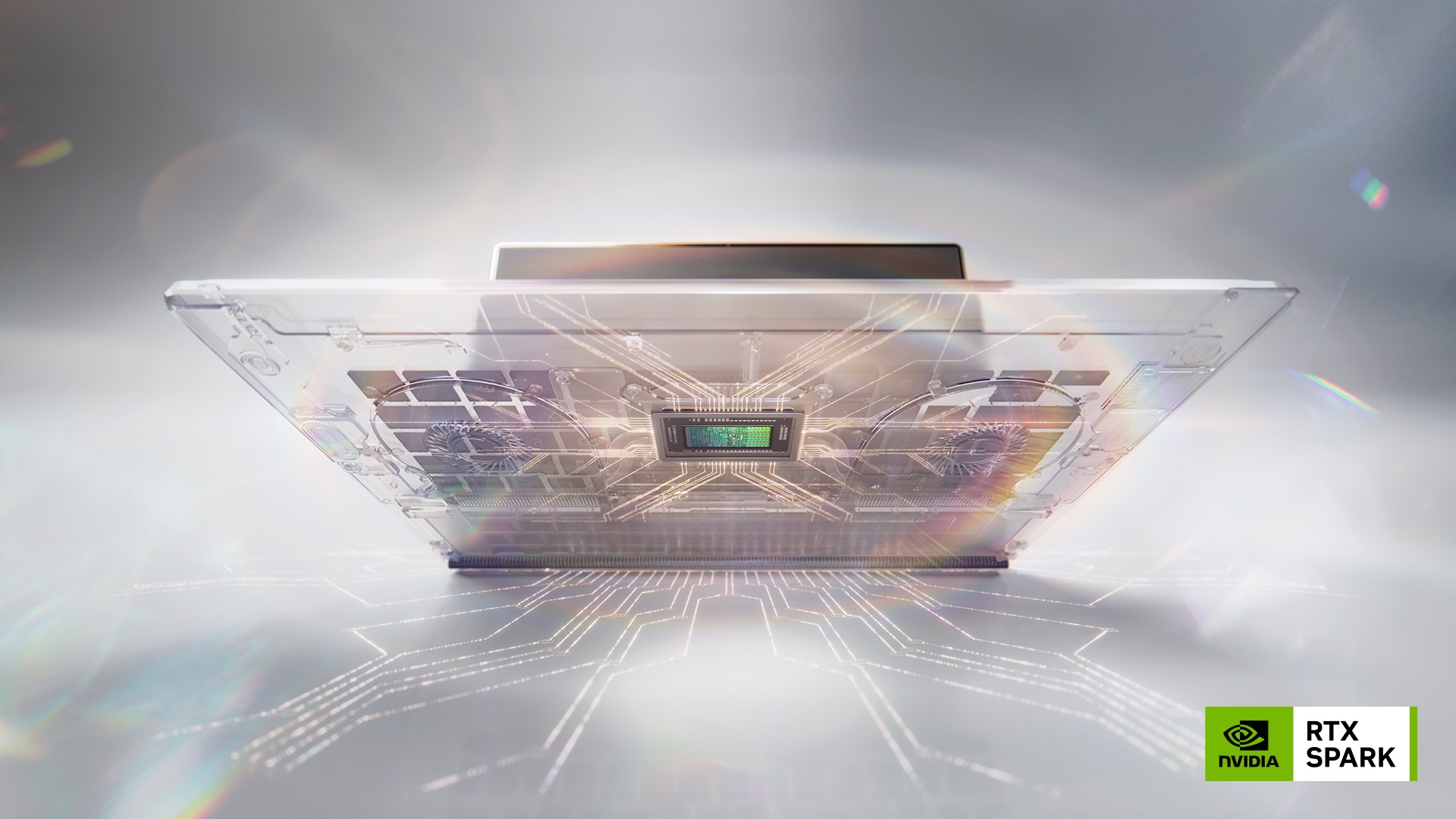
The Vision: AI Agents as Your Personal Teammate
At the heart of Nvidia's vision for the RTX Spark Superchip is the concept of "AI agents." Imagine a digital assistant far more sophisticated and proactive than anything you've experienced before. Nvidia describes these agents as tools purpose-built to work tirelessly across your applications, operating intelligently in the background as your personal "teammate." This isn't just about voice commands or simple automation; it's about a PC that anticipates your needs, streamlines complex tasks, and offers predictive assistance, freeing up your time and mental energy for more creative and strategic work.
These AI agents are designed to understand context, learn from your habits, and operate across various software environments. For instance, an AI agent might proactively organize your documents, summarize lengthy emails, suggest design improvements in a creative suite, or even assist with coding projects by debugging or suggesting optimal algorithms. The power of the RTX Spark lies in its ability to run these sophisticated AI models directly on the device, ensuring privacy, speed, and responsiveness that cloud-based solutions often cannot match. This on-device AI capability is a cornerstone of what the industry is now calling the "AI PC" – a new generation of computers fundamentally built around artificial intelligence.
Unleashing Unprecedented Performance Across All Workloads
Nvidia's claims for the RTX Spark are bold, painting a picture of a chip capable of handling the most demanding tasks with ease and efficiency. The company has provided a compelling list of capabilities that showcase the chip's versatility and raw power, catering to a wide spectrum of users from professional creators to hardcore gamers and AI developers.
Revolutionizing Creative Workflows
- Ultra-Large 3D Scene Rendering: With the RTX Spark, users can "render ultra-large 90GB 3D scenes with OptiX and DLSS." For 3D artists, architects, and product designers, rendering large, complex scenes has always been a bottleneck. A 90GB scene is massive, typically taking hours or even days on less powerful hardware. Nvidia's OptiX technology, an application programming interface (API) for ray tracing, combined with Deep Learning Super Sampling (DLSS), a groundbreaking AI rendering technology, significantly accelerates this process. DLSS uses AI to render frames at a lower resolution and then intelligently upscales them to a higher resolution, often producing image quality comparable to native resolution while dramatically boosting performance. This means faster iterations, more complex designs, and a smoother workflow for professionals.
- Cutting-Edge Video Editing: The chip allows for "editing 12K 4:2:2 video with the NVIDIA Blackwell decoder." 12K resolution is an incredible amount of detail, four times the resolution of 6K and sixteen times that of 4K. Editing such high-resolution footage, especially with 4:2:2 chroma subsampling (which preserves more color information), demands immense processing power. The dedicated NVIDIA Blackwell decoder is specifically engineered to handle these massive video streams efficiently, enabling real-time playback, scrubbing, and manipulation of ultra-high-definition video without lag or dropped frames. This is a game-changer for professional videographers, filmmakers, and content creators working with the most advanced cameras and formats.
Democratizing Advanced AI and Machine Learning
- On-Device Large Language Models (LLMs): One of the most exciting capabilities is the ability to "run 120-billion-parameter large language models with 1 million tokens context." To put this into perspective, many of the most advanced AI models today, like those powering sophisticated chatbots, are large language models. Running such a massive model (120 billion parameters) with an enormous context window (1 million tokens, representing a vast amount of text that the AI can "remember" and process at once) directly on a personal computer is unprecedented. Traditionally, these models require powerful cloud servers. The RTX Spark brings this capability to your desktop or laptop, enabling private, incredibly responsive AI interactions, advanced local coding assistance, complex document analysis, and much more, without needing an internet connection or incurring cloud service costs. This opens up new possibilities for developers, researchers, and general users to interact with and build upon powerful AI tools locally.
Elevating the Gaming Experience
- High-Performance AAA Gaming: For gamers, the RTX Spark promises to "play AAA games at 1440p resolution and over 100 frames per second with ray tracing, DLSS and Reflex." 1440p is a popular high-resolution standard, offering crisp visuals without the extreme demands of 4K. Achieving over 100 frames per second (FPS) ensures a silky-smooth, highly responsive gaming experience. More importantly, this performance is achieved with ray tracing enabled. Ray tracing is an advanced rendering technique that simulates the physical behavior of light, producing incredibly realistic shadows, reflections, and global illumination. Combined with DLSS, which boosts performance without sacrificing visual quality, and Nvidia Reflex, which reduces system latency, gamers can enjoy the most immersive and competitive experiences on a single, integrated chip. This means no compromises between stunning visuals and fluid gameplay.
The Official Announcement and Nvidia's Strategic Pivot
The RTX Spark chip was officially announced by Nvidia chief executive Jensen Huang during his keynote address at the Computex conference in Taipei. Computex is one of the world's largest computer trade shows, making it a fitting platform for such a significant reveal. Huang's presentation underscored Nvidia's strategic shift and its commitment to driving the next generation of computing.
This move is a monumental play for Nvidia. Historically, the company has dominated the market for discrete graphics cards, which are separate components added to a PC to handle graphics-intensive tasks. Moving into integrated silicon – chips that combine the central processing unit (CPU), graphics processing unit (GPU), and other crucial components onto a single piece of silicon – represents a profound evolution for the company. Integrated chips are the backbone of modern laptops and many compact desktops, celebrated for their power efficiency, smaller footprint, and often seamless performance. For Nvidia, this signifies a direct expansion from being a component supplier to becoming a core platform provider for consumer PCs.
A Direct Challenge to Apple Silicon
Nvidia's entry into the integrated consumer PC chip market immediately puts the RTX Spark on a "collision course" with Apple's highly successful M-series chips, known collectively as Apple Silicon. Apple's chips, beginning with the M1, have been widely praised for their groundbreaking performance-per-watt, especially in tasks involving artificial intelligence and machine learning executed on-device. They are often regarded as the benchmark for laptop chips in this domain.
Like Apple's innovative chips, the RTX Spark is built on the Arm architecture. Arm-based processors are known for their power efficiency, which makes them ideal for mobile devices and increasingly for laptops and even servers. By adopting Arm, Nvidia is aligning with a modern, efficient instruction set that differs fundamentally from the x86 architecture traditionally used by Intel and AMD. This shared foundation, however, sets the stage for a fascinating rivalry, as both companies now leverage Arm's efficiency alongside their unique intellectual property to deliver superior AI performance.
The RTX Spark combines an Nvidia Blackwell RTX graphics processor with a Grace CPU. The Blackwell architecture is Nvidia's latest generation of GPU technology, designed to push the boundaries of AI and accelerated computing. The Grace CPU, on the other hand, is Nvidia's own Arm-based central processing unit, optimized for high-performance computing and data-intensive workloads. Essentially, the RTX Spark is leveraging the powerful GB10 chip, which is the same foundational technology found in the DGX Spark – Nvidia's "personal AI supercomputer" released last year. This lineage indicates that the RTX Spark is bringing supercomputing-grade AI capabilities down to the consumer level, a testament to Nvidia's ambition to democratize powerful AI processing.
Microsoft Embraces the RTX Spark with Surface Laptop Ultra
One of the first devices to showcase the power of the integrated RTX Spark silicon will be Microsoft's new 15-inch Surface Laptop Ultra. This collaboration is highly significant, as it signals a strong endorsement from Microsoft, a key player in the PC ecosystem and a direct competitor to Apple in the premium laptop segment. The Surface Laptop Ultra is positioned as a flagship device, designed to highlight the full capabilities of the RTX Spark and Microsoft's vision for the AI PC.
The specifications of the Surface Laptop Ultra are impressive, designed to complement the powerful RTX Spark chip. It features a stunning mini-LED touchscreen, offering vibrant colors, deep blacks, and excellent contrast, ideal for creative work and media consumption. Microsoft has also fitted it with its largest haptic touchpad ever on a Surface device, providing precise and responsive control. Connectivity is robust, with a generous selection of ports including HDMI for external displays, versatile USB-C and USB-A ports, an SD card reader for easy media transfer, and a traditional headphone jack, addressing a wide range of user needs without requiring numerous dongles.
With configurations offering up to 128GB of unified memory, the Surface Laptop Ultra is poised to be an AI powerhouse. Unified memory is a critical component for high-performance computing, especially for AI tasks. Unlike traditional systems where the CPU and GPU have separate memory pools, unified memory allows both components to access the same high-speed memory, eliminating bottlenecks and dramatically increasing efficiency for AI models that frequently share data between CPU and GPU. This massive 128GB capacity directly supports the chip's ability to run AI models with up to 120 billion parameters locally, a staggering figure that Microsoft directly attributes to Nvidia's theoretical performance measurements. Microsoft proudly states that this makes the Surface Laptop Ultra the "most powerful Surface it has ever built," a clear indication of the performance leap enabled by the RTX Spark.
Broad Industry Adoption and Market Positioning
Nvidia's ambition extends far beyond a single device. The company has indicated that its RTX Spark chip will eventually be integrated into approximately 30 different laptop models and more than 10 desktop PCs. This widespread adoption is expected from major PC manufacturers, including industry leaders like Asus, HP, MSI, Lenovo, and Dell. This broad ecosystem support is crucial for the success of any new chip platform, ensuring that consumers will have a wide variety of choices across different form factors and price points.
While specific pricing for the Surface Laptop Ultra has not yet been announced, Microsoft has confirmed that the device will arrive later this year. Nvidia has suggested that this initial wave of RTX Spark machines will target the premium end of the market. This strategy makes sense; by launching with high-end, feature-rich devices, Nvidia can establish the RTX Spark's capabilities and value proposition to demanding users who prioritize cutting-edge performance for creative work, AI development, and high-fidelity gaming. As the technology matures and manufacturing scales, it's possible that RTX Spark chips could eventually filter down to more mainstream price points, making advanced AI capabilities accessible to an even wider audience.
The Future of Computing: The AI PC Revolution
Nvidia's entry into the consumer PC chip business with the RTX Spark represents more than just a new product launch; it signifies a pivotal moment in the evolution of personal computing. For decades, the PC has primarily been a tool for productivity, communication, and entertainment, with occasional bursts of innovation. The advent of powerful, efficient on-device AI capabilities, however, is poised to usher in a new era – the era of the AI PC.
The AI PC is not merely a computer with an AI button; it is a system fundamentally designed to harness artificial intelligence to enhance nearly every aspect of the user experience. From intelligently managing your digital life with proactive AI agents to providing instantaneous creative tools and powering the most immersive entertainment, the AI PC promises a more intuitive, powerful, and personalized interaction. Nvidia, with its deep roots in AI and graphics acceleration, is uniquely positioned to lead this revolution.
This competition with Apple, which has successfully demonstrated the power of integrated Arm-based chips for AI, will undoubtedly accelerate innovation across the industry. As both giants push the boundaries of performance, efficiency, and AI integration, consumers will ultimately benefit from more powerful, smarter, and more capable personal computers than ever before. The RTX Spark is not just a chip; it's a harbinger of a future where your PC is not just a device, but an intelligent partner, ready to assist and empower you in ways we are only just beginning to imagine.
This article, "Nvidia Challenges Apple Silicon With New RTX Spark PC Chip" first appeared on MacRumors.com
Discuss this article in our forums
from MacRumors
-via DynaSage
