
DuckDuckGo's 'No AI' Search Traffic Climbs as Users Reject Google's AI Overhaul
The digital landscape is constantly evolving, and at its core lies how we find information online. For years, Google has been the undisputed leader in search, continually innovating and shaping our online experience. However, a significant shift is currently underway, highlighting a growing tension between cutting-edge artificial intelligence (AI) and the fundamental desire for privacy and control over our digital lives. This tension came into sharp focus following Google's ambitious AI announcements in May, which, ironically, led to a massive surge in demand for a "No AI" alternative: DuckDuckGo's privacy-focused search engine.
Privacy-focused search engine DuckDuckGo has seen a surge in demand for its "No AI" search option in the wake of Google's May 19th I/O announcements. This isn't just a minor fluctuation; visits to DuckDuckGo's dedicated "No AI" search page more than tripled, marking a clear signal from users who are actively seeking a different path forward – one that prioritizes direct, unbiased information retrieval without the heavy hand of AI interpretation.
Google's Vision: An AI-Reimagined Search Experience
To understand the magnitude of this shift, it's crucial to first look at what Google presented during its I/O event. Google, a company synonymous with search, debuted a new "intelligent" search box reimagined with AI. This wasn't merely an incremental update; it represented a fundamental rethinking of how we interact with search engines. The new features aim to make search more intuitive, personal, and proactive, leveraging the power of advanced AI models.
Key among these innovations were several game-changing elements. Google's new search now features AI suggestions, acting as a highly sophisticated upgrade to the familiar autocomplete function. Instead of just completing your query, the AI tries to anticipate your next question or the deeper intent behind your initial search, offering immediate, AI-generated answers or directions. This moves search from simply providing links to offering synthesized information directly within the search results page, often above traditional links.
Furthermore, the new system boasts support for follow-up questions, turning a solitary search query into an ongoing conversation. Users can ask subsequent questions that build on previous ones, allowing the AI to maintain context and provide increasingly refined answers. This chat-like interface marks a significant departure from the classic "query-results page" model, pushing search towards an interactive, AI-driven dialogue.
Perhaps the most profound change, and one that has raised significant privacy eyebrows, is the expanded Personal Intelligence. This feature allows Google Search to connect with your personal data from other Google services, such as Gmail and Google Photos. Imagine asking Google to find "the best restaurant from my last trip" and it cross-references your flight details from Gmail, photos from Google Photos, and even calendar entries to provide a highly personalized recommendation. While seemingly convenient, this deep integration means that even more of your personal data becomes accessible and interconnected within Google's AI ecosystem, raising legitimate concerns about data aggregation and privacy implications.
Finally, Google also introduced the concept of Search agents – specialized AI tools designed to perform complex tasks on your behalf. These agents are envisioned to go beyond simple information retrieval, assisting with planning trips, organizing events, or even managing tasks by leveraging AI's ability to understand context and execute multi-step processes. This vision paints a future where Google Search is not just a tool for finding information, but an intelligent assistant deeply embedded in various aspects of your digital and real-world life.
The User Backlash: Why "No AI" is Resonating
Despite Google's innovative vision, the immediate aftermath of these announcements wasn't solely met with applause. DuckDuckGo told MacRumors that visits to its No AI search page more than tripled after Google's announcement. Traffic hit the 3x mark on May 28th, and has continued to climb. Visits have averaged around 84 percent above baseline consistently since May 19. These numbers are more than just statistics; they represent a significant segment of users actively rejecting the AI-first future Google is proposing, opting instead for a different kind of search experience.
Several key factors likely contribute to this growing demand for "No AI" search options:
1. Profound Privacy Concerns
For many, the most immediate and pressing concern revolves around privacy. DuckDuckGo has built its reputation on a steadfast commitment to not tracking users or collecting personal data. Google's expanded Personal Intelligence feature, which links search to Gmail and Google Photos, goes against this ethos. Users are increasingly wary of corporations having access to such a vast and intimate array of their personal information. The thought of an AI model sifting through emails and private photos to "personalize" search results can feel intrusive and raise red flags about data security and the potential for misuse. People want control over their digital footprint, and the deeper integration of AI into personal data feels like a step in the opposite direction.
The very nature of AI, which often thrives on vast datasets for training and operation, amplifies these privacy anxieties. Users worry about how their queries and interactions might contribute to AI models, who has access to that data, and how it might be used for profiling, targeted advertising, or even surveillance. The perceived trade-off between convenience and privacy is becoming increasingly unacceptable for a significant portion of the internet population.
2. The Desire for Unfiltered, Direct Information
Traditional search engines, at their core, are tools for finding links to information published on the web. Users navigate these links, evaluate sources, and synthesize information themselves. Google's new AI-driven search, with its AI-generated answers and summaries, fundamentally alters this dynamic. Instead of being presented with a list of potential sources, users might receive a single, AI-curated answer at the top of their results page. While this might seem efficient, it raises questions about transparency and objectivity.
Many users prefer to evaluate information directly from its source rather than relying on an AI's interpretation or summary. They want to see the various perspectives, the original context, and the full range of results without an intermediary AI acting as a gatekeeper or summarizer. This preference stems from a desire for agency and critical thinking – the ability to form one's own conclusions based on a diverse set of sources, rather than being fed a pre-digested answer.
3. Skepticism Towards AI Accuracy and Bias
The promises of AI are vast, but so are its limitations. AI models, particularly large language models that power conversational search, are known to "hallucinate" – meaning they can generate confident but entirely false information. They can also reflect biases present in their training data, inadvertently perpetuating stereotypes or providing unbalanced perspectives. For users seeking reliable and factual information, the risk of receiving an incorrect or biased AI-generated answer is a serious concern.
In fields where precision is paramount, such as health, finance, or legal research, users simply cannot afford to rely on potentially flawed AI summaries. They need direct access to primary sources, peer-reviewed articles, and expert opinions. The move to an AI-first search experience, where AI-generated answers are front and center, can erode trust in the search engine itself if those answers prove to be unreliable or opaque about their sources.
4. Overload and Complexity
While Google intends its AI features to simplify search, for some users, the opposite might be true. An "intelligent" search box with AI suggestions, follow-up questions, and chat interfaces can feel overwhelming and unnecessarily complex. Many users simply want a straightforward search bar to type in their query and receive a list of relevant links – a model that has worked reliably for decades. The introduction of more interactive and "smart" features can disrupt established habits and feel like an imposed change rather than a welcomed upgrade.
The desire for simplicity and a predictable search experience is a powerful motivator. Not everyone wants a conversational partner when they're looking for quick facts or specific websites. The "No AI" option appeals to those who appreciate a lean, efficient, and familiar interface without the added layers of AI interpretation and interaction.
5. Philosophical Resistance to Pervasive AI
Beyond practical concerns, there's a growing philosophical resistance to the pervasive integration of AI into every facet of digital life. Some users express discomfort with the idea of AI playing such a dominant role in mediating their access to information, fearing a future where AI systems increasingly control what we see, read, and think. This sentiment aligns with a broader movement advocating for human agency and ethical technology development.
Choosing "No AI" becomes a statement – an assertion of preference for human-created content, direct access to information, and a belief in the importance of human discernment over algorithmic curation. It reflects a desire to maintain a distinction between human intelligence and artificial intelligence, and to ensure that technology remains a tool for empowerment rather than a silent director of our experiences.
DuckDuckGo's "No AI" Solution: A Commitment to Unfiltered Search
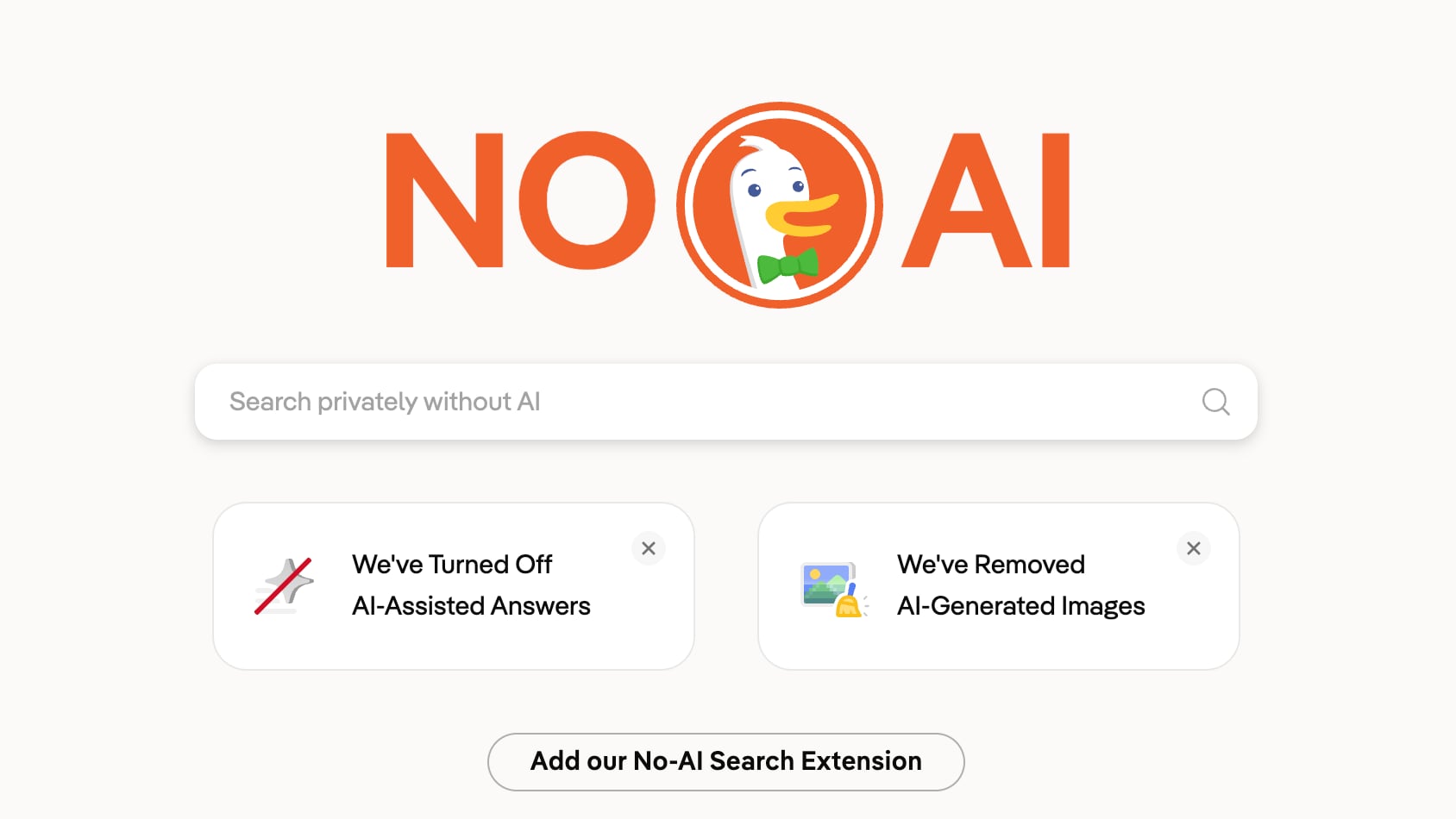
Amidst this backdrop, DuckDuckGo's "No AI" offering stands out as a clear counter-narrative. It directly addresses the concerns raised by Google's AI overhaul, providing a refuge for users who value privacy, control, and traditional search results. DuckDuckGo is embracing demand for No AI search options, and it is promoting new extensions available for Chrome and Firefox that set No AI search as the default.
What exactly does "No AI" search entail? It's quite simple and incredibly powerful in its simplicity:
- No AI-assisted answers: Unlike Google's new approach, DuckDuckGo's No AI option will not present you with AI-generated summaries or answers. It sticks to providing direct links to websites, allowing you to click through and explore the information yourself.
- No chat interface: The search experience remains a classic query-and-results model. There are no conversational elements, no follow-up questions managed by AI, just a straightforward input field and a list of relevant web pages.
- Fewer AI images: While the core DuckDuckGo engine might integrate some forms of AI for things like spam detection or improving search relevance (without tracking user data), the "No AI" experience specifically minimizes or excludes AI-generated imagery in results, focusing on authentic, human-created visual content.
DuckDuckGo has long championed user privacy, with its core promise of not tracking search history, personal data, or IP addresses. The "No AI" option extends this philosophy to the realm of artificial intelligence. It reassures users that their queries are not being fed into large language models for continuous training or personalization that could compromise their data or influence future results in ways they don't understand or control. DuckDuckGo can be set as the default search engine on Apple devices, but not the specific No AI page. This means users often need to manually navigate to the No AI portal or use the specialized extensions.
It's important to note that DuckDuckGo itself has developed its own AI tools. However, for people who choose the "No AI" experience, these internal AI tools are specifically turned off. This demonstrates a deep respect for user choice, allowing individuals to opt out of AI augmentation entirely if that aligns with their preferences for digital interaction. This modular approach contrasts sharply with Google's more integrated and pervasive AI rollout, offering a genuine alternative rather than a slightly diluted version of the same technology.
Looking ahead, DuckDuckGo plans to make accessing this choice even easier. They plan to add No AI search settings to its original extensions for Chrome, Firefox, Edge, and Opera in the near future. This upcoming integration will streamline the process for users across various browsers, making the "No AI" experience more accessible and a truly default option for those who seek it. This proactive step underscores DuckDuckGo's understanding of this growing user demand and its commitment to meeting it head-on.
Beyond DuckDuckGo: Other Privacy-Focused Alternatives Minimizing AI
While DuckDuckGo is currently leading the charge with its prominent "No AI" option, it's not alone in recognizing user preferences for privacy and control over AI-driven search. The market is slowly responding to this growing demand, offering users more choices in how they interact with information online. Along with DuckDuckGo, there are other privacy-focused search engine options that minimize AI results.
Paid search engine Kagi is one example, demonstrating a different business model built around user preferences. Kagi offers a premium search experience with no visible AI information unless you specifically opt for its AI tools. This approach empowers users by putting them in control of whether and how AI assists their search, rather than forcing it upon them as a default. Kagi’s design is clean, fast, and highly customizable, reflecting a philosophy that prioritizes user experience and agency.
Kagi operates on a subscription model, typically costing $5 per month for a limited number of searches, and $10 a month for unlimited searches. This paid structure is fundamental to its privacy promise. Because it is a paid search engine, it does not have ads and it does not collect and sell user data. This direct financial relationship with users eliminates the incentive to track, profile, and monetize personal information, which is often the business model for free, ad-supported search engines. For users who are deeply committed to privacy and willing to pay for it, Kagi represents a compelling alternative to both Google's AI-heavy approach and even DuckDuckGo's ad-supported (though privacy-respecting) model.
The existence of services like Kagi and DuckDuckGo's "No AI" option highlights a burgeoning market segment: users who are willing to seek out, and even pay for, search experiences that align with their values regarding privacy, transparency, and control. This indicates that the demand for alternatives to the dominant AI-driven paradigm is not a niche phenomenon but a significant trend that tech companies will need to acknowledge and address.
The Broader Implications: Redefining the Future of Search
The surge in DuckDuckGo's "No AI" traffic is more than just a fleeting trend; it represents a significant marker in the ongoing evolution of the internet and how we consume information. This user reaction to Google's AI overhaul speaks volumes about the evolving expectations and concerns of digital citizens globally. It forces us to ask critical questions about the future of search, the role of artificial intelligence, and the fundamental balance between innovation, convenience, and user autonomy.
One of the most profound implications is the re-evaluation of what constitutes a "good" search experience. For years, "more personalized" and "smarter" were unequivocally seen as positive advancements. However, the pushback against Google's AI features suggests that for a growing number of users, "smarter" doesn't necessarily mean "better" if it comes at the cost of privacy, transparency, or control. Users are increasingly valuing simplicity, directness, and the ability to interpret information themselves over AI-curated answers.
This movement could also have a significant impact on the ethical development of AI. As users vocalize their preferences for "No AI" options, it sends a clear message to developers and tech giants that the unbridled deployment of AI without considering user consent, privacy implications, and the potential for bias or inaccuracy is not a universally accepted path. It encourages a more thoughtful, user-centric approach to AI integration, where choice and transparency are paramount.
Furthermore, the rise of "No AI" search engines underscores the importance of a diverse internet ecosystem. When one company dominates a critical service like search, its decisions can shape the entire digital experience for billions. The availability and popularity of alternatives like DuckDuckGo and Kagi ensure that users have options, preventing a monoculture of AI-driven search and fostering healthy competition centered around different values and priorities. This competition ultimately benefits users by pushing all platforms to be more responsive to diverse needs.
The debate around AI in search also highlights a deeper societal discussion about the role of technology in mediating human experience. As AI becomes more sophisticated, it has the power to subtly influence opinions, filter information, and even shape worldviews. The choice for "No AI" can be seen as an assertion of intellectual independence – a desire to maintain critical thinking skills and direct engagement with information, rather than delegating that process to an algorithm. This isn't just about search; it's about digital literacy, critical engagement, and the fundamental right to access information without undue algorithmic influence.
In essence, the rejection of Google's AI overhaul by a substantial user base signals a maturation of internet users. They are no longer passive recipients of technological advancements but active participants who demand choice, transparency, and respect for their digital rights. The future of search, therefore, is unlikely to be a monolithic AI-powered landscape but rather a more diverse one, offering various levels of AI integration to cater to a spectrum of user preferences and values.
Making Your Choice: How to Embrace "No AI" Search
For those inspired by the movement towards privacy and unfiltered information, embracing a "No AI" search experience is straightforward. DuckDuckGo has made it increasingly easy for users to reclaim control over their search. The first step involves setting DuckDuckGo as your default search engine. This can typically be done through your browser's settings (Chrome, Firefox, Edge, Safari, Opera) or your device's system settings (iOS, Android). While this makes DuckDuckGo your primary search provider, to specifically access the "No AI" version, you have a few dedicated paths:
- Directly Visiting the "No AI" Page: You can always navigate directly to DuckDuckGo's "No AI" search page. This ensures that every search you perform through that specific URL will adhere to the "No AI" principles.
- Using Dedicated Browser Extensions: For a more seamless experience, DuckDuckGo has released specialized extensions for popular browsers. You can download the Chrome extension or the Firefox add-on. Once installed, these extensions will set "No AI" search as your default whenever you use the search bar within that browser.
- Anticipate Future Integrations: DuckDuckGo plans to integrate the "No AI" setting directly into its original, more comprehensive extensions for Chrome, Firefox, Edge, and Opera. Keep an eye out for these updates, as they will likely offer an even more convenient way to toggle between standard DuckDuckGo and the "No AI" experience within a single extension.
By taking these simple steps, you empower yourself to choose how you interact with the vast information highway of the internet. You decide whether you want an AI to interpret and synthesize information for you, or if you prefer direct access to sources, free from algorithmic intervention. This act of choice is not just about a search engine; it's about asserting your digital autonomy in an increasingly automated world.
Conclusion: The Enduring Value of Privacy and Unbiased Information
The events following Google's May I/O announcements have underscored a profound truth: while innovation is celebrated, it must always be balanced with user values and preferences. The dramatic surge in demand for DuckDuckGo's "No AI" search option is a clear and unequivocal message from users: privacy, control, and unfiltered access to information remain paramount, even in an age dominated by advanced artificial intelligence.
Google's vision for an AI-reimagined search experience, with its "intelligent" search box, AI suggestions, follow-up questions, and deeply integrated Personal Intelligence, aims for ultimate convenience. However, this convenience comes with perceived trade-offs in privacy, transparency, and the potential for information overload or algorithmic bias. Users are not passively accepting these trade-offs; they are actively seeking alternatives.
DuckDuckGo, with its unwavering commitment to privacy and its clear "No AI" offering, has emerged as a vital haven for these users. By providing a search experience free from AI-assisted answers, chat interfaces, and excessive AI-generated content, DuckDuckGo empowers individuals to engage with the web on their own terms. The statistics speak volumes: the tripling of traffic to its "No AI" page is a powerful testament to a growing desire for digital autonomy.
The broader implications of this trend extend beyond individual search engines. It challenges the tech industry to rethink the pervasive integration of AI, encouraging more ethical development, greater transparency, and a renewed focus on user choice. The existence of alternatives like Kagi, with its paid, privacy-first model, further reinforces the idea that there is a significant and diverse demand for search experiences that prioritize human agency over algorithmic convenience.
In a world increasingly shaped by AI, the ability to choose how we access and interpret information is more critical than ever. The enduring value of privacy, unbiased results, and direct control over our digital lives continues to resonate deeply. The "No AI" movement is not a rejection of progress, but a call for progress that respects human values and empowers individuals in the digital age. As the landscape of online search continues to evolve, the demand for options that prioritize privacy and user control will undoubtedly shape its future, ensuring that the internet remains a tool for empowerment rather than a system of algorithmic curation.
Discuss this article in our forums
from MacRumors
-via DynaSage
