
ChatGPT Can Now Connect to Your Financial Accounts for Budgeting Advice
Unlock Your Financial Potential: ChatGPT Now Connects to Your Bank Accounts for Personalized Budgeting and Advice
In a groundbreaking move that promises to redefine how we manage our money, OpenAI is introducing a powerful new personal finance feature to ChatGPT. Imagine having a smart, ever-present financial assistant that not only understands your spending habits but can also offer tailored advice based on your real-time financial situation. This vision is now a reality, as ChatGPT users can securely connect their financial accounts directly to the chatbot, opening up a world of personalized budgeting, expense tracking, investment insights, and much more.
This integration marks a significant leap forward in making sophisticated financial guidance accessible to everyone. Gone are the days of manually inputting transactions into spreadsheets or struggling to get a holistic view of your finances. With ChatGPT, intelligent money management is just a conversation away, designed to empower you to make smarter financial decisions and achieve your goals with greater ease and clarity.
The Power of Connection: Your Finances, Understood by AI
At the heart of this innovative feature is a strategic partnership with Plaid, a leading data transfer network that securely connects financial accounts to apps and services. Through this collaboration, ChatGPT users can safely link a wide array of their financial accounts, including bank accounts, credit cards, investment portfolios, and various other financial instruments. This comprehensive connection allows ChatGPT to gather a complete and accurate picture of your financial life, which is crucial for providing truly personalized advice.
OpenAI proudly states that ChatGPT supports connections with an impressive network of over 12,000 financial institutions. This vast compatibility means that whether you bank with a large national institution, a local credit union, or use various investment platforms, there's a very high chance your accounts can be linked. This extensive reach ensures that a broad spectrum of users can benefit from this cutting-edge financial assistant, making it a truly inclusive tool for personal finance management.
The beauty of this system lies in its ability to synthesize data from disparate sources into one cohesive view. Instead of logging into multiple apps and websites to check your bank balance, credit card statements, and investment performance, ChatGPT brings all this information together. This unified perspective eliminates the fragmentation that often makes personal finance management feel overwhelming and time-consuming.
Your Personalized Financial Command Center: The ChatGPT Dashboard
Once your financial accounts are securely connected, ChatGPT transforms into your personal financial command center. It provides a dynamic and intuitive dashboard that offers an instant, up-to-date overview of your financial health. This isn't just a static report; it's an interactive representation of your money flow, designed to highlight key areas and trends.
Imagine logging into ChatGPT and immediately seeing:
- How Your Money is Being Spent: A clear breakdown of your expenditures, categorized for easy understanding. You'll see exactly where your money is going, from groceries and utilities to entertainment and travel. This transparency is the first step towards better budgeting and identifying areas for potential savings.
- Up-to-Date Portfolio Performance: For those with investments, ChatGPT offers an immediate snapshot of your portfolio's performance. You can track gains and losses, understand asset allocation, and see how your investments are performing against your financial goals. This real-time insight helps you stay informed without needing to constantly check your brokerage accounts.
- Subscription Tracking: A detailed list of all your recurring subscriptions, often a hidden drain on finances. ChatGPT helps you identify services you might no longer use or need, empowering you to cut unnecessary expenses and save money effortlessly.
- Upcoming Payments: Never miss a bill again. The dashboard clearly outlines upcoming payments, helping you manage your cash flow, avoid late fees, and maintain a healthy credit score.
- Overall Financial Health Metrics: Beyond individual items, ChatGPT provides a comprehensive view of your total assets, liabilities, net worth, and other crucial financial indicators, giving you a complete picture of your economic standing.
This comprehensive, real-time dashboard serves as a powerful foundation, giving you the clarity and insights needed to manage your money more effectively. It turns complex financial data into actionable information, empowering you to take control of your financial destiny.
Interactive Financial Guidance: Asking the Right Questions, Getting Smart Answers
The true power of ChatGPT's financial feature extends far beyond a simple dashboard. It's the ability to engage in a natural conversation with an AI that understands your specific financial situation and can provide tailored advice and insights. OpenAI has provided several compelling examples of the types of finance-related questions ChatGPT will be able to answer, offering a glimpse into the future of personal financial planning:
-
Help me build a plan to buy a house in my area in the next 5 years
This query goes beyond simple budgeting; it delves into long-term financial planning. ChatGPT, with access to your income, savings, current expenses, and existing debts, can help you craft a realistic savings plan. It can estimate how much you need to save monthly to reach a specific down payment goal, considering your current financial capacity. While it won't be able to provide real estate listings or specific loan offers, it can model different saving scenarios, suggest where you might cut back on spending to accelerate your savings, and help you understand the financial implications of such a significant purchase over a five-year horizon. This transforms a daunting goal into a manageable, step-by-step financial roadmap.
-
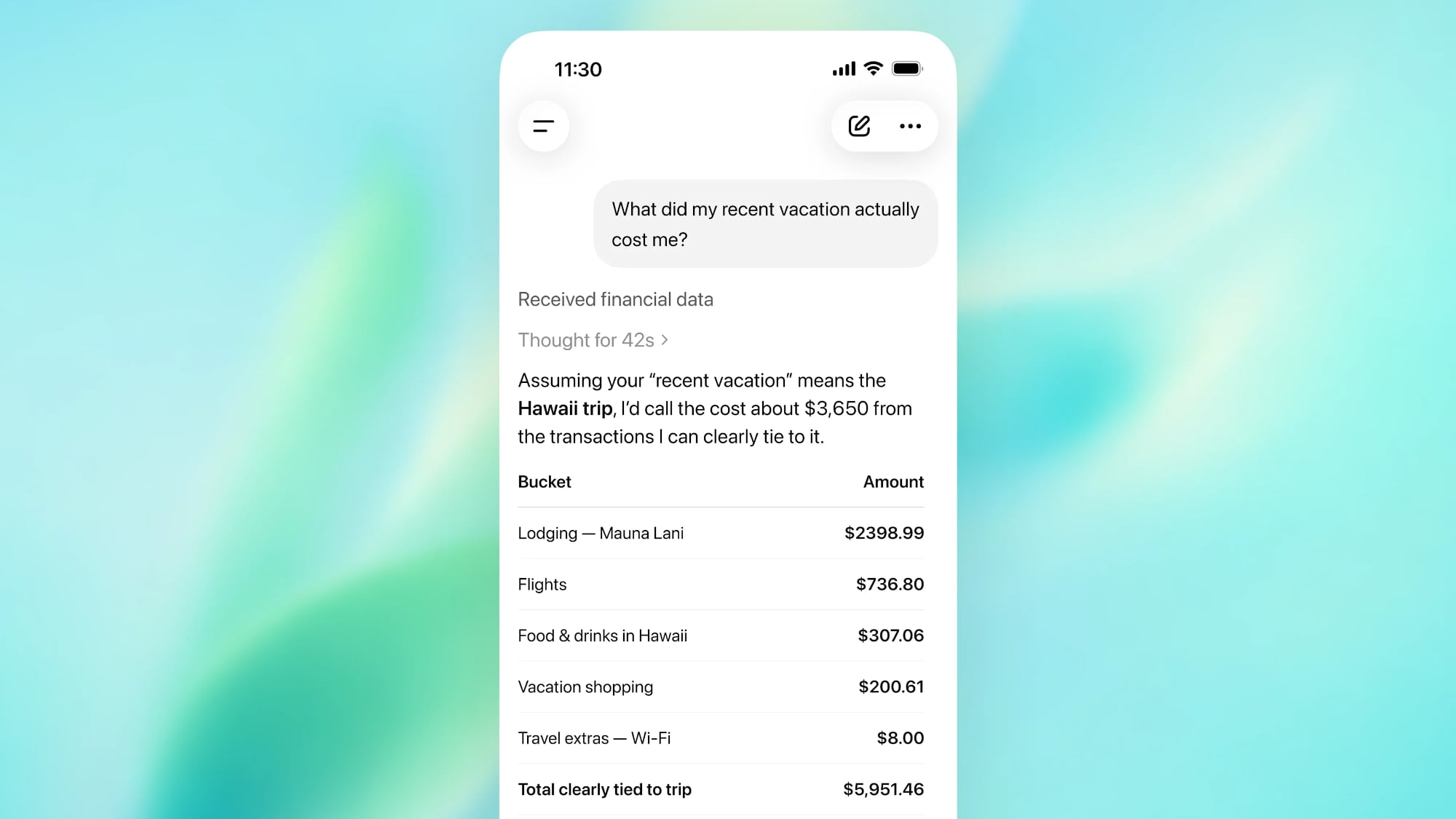
What did my recent vacation actually cost me?
Often, after a trip, we have a vague idea of the cost, but rarely a precise figure. ChatGPT can meticulously comb through your credit card and bank transactions from a specific period (e.g., the dates of your vacation) and itemize all related expenses. This includes flights, accommodation, dining, activities, and even smaller discretionary spending. It can then present you with a consolidated total, perhaps even categorizing expenses to show you where the bulk of your vacation budget went. This detailed post-mortem can be invaluable for planning future trips more efficiently and staying within a budget.
-
I feel like I've been spending more recently. Has anything changed?
This is a common sentiment that often indicates a subtle shift in spending habits. Instead of guessing, ChatGPT can analyze your spending patterns over different periods (e.g., this month vs. last month, or this quarter vs. the previous one). It can pinpoint specific categories where your expenditure has increased significantly, such as dining out more often, increased online shopping, or higher utility bills. By identifying these changes, ChatGPT provides concrete data that helps you understand the 'why' behind your feeling, enabling you to address the root cause of increased spending and regain control.
-
Can I afford to take a lower-paying job if it gives me more flexibility to be home with the kids?
Life's biggest decisions often have significant financial implications. This question is a perfect example of how ChatGPT can act as a personal financial modeler. By inputting the hypothetical lower salary, ChatGPT can re-calculate your budget, assess the impact on your disposable income, savings capacity, and ability to meet existing financial commitments. It can help you understand if such a career change is financially viable, perhaps suggesting areas where you would need to adjust your spending or if you have enough buffer in your current savings to absorb the income reduction. This analytical capability provides peace of mind and data-driven insights for major life choices.
-
What's the biggest risk in my portfolio?
For investors, understanding risk is paramount. While ChatGPT cannot provide financial advice in the traditional sense, it can analyze the composition of your investment portfolio. It can identify significant concentrations in specific stocks, sectors, or asset classes, which could represent a higher risk if those areas face a downturn. It might highlight a lack of diversification or an imbalance between growth and defensive assets, based on common financial principles. This information empowers you to have more informed conversations with a human financial advisor or make adjustments to mitigate potential risks, all based on an objective analysis of your holdings.
-
Look at my subscriptions and help me choose what to cancel
Subscription creep is real, and many people pay for services they rarely use. ChatGPT can list all your recurring subscriptions identified from your transactions. More importantly, it can help you make informed decisions. It might highlight subscriptions with infrequent usage (if it can infer usage from external data, though primarily it will rely on transaction frequency), or point out duplicate services. It can also categorize them and ask you questions like, "Do you still use this streaming service?" or "Is this fitness app still relevant to your goals?" This intelligent prompting helps you prune unnecessary expenses and free up cash for other priorities.
These examples illustrate how ChatGPT moves beyond mere data aggregation to provide actionable intelligence. By processing your unique financial data in real-time, it offers a personalized guidance experience that is both insightful and remarkably helpful, acting as a diligent financial co-pilot on your journey to financial well-being.
Security and Privacy: A Top Priority for Your Financial Data
When it comes to connecting sensitive financial information to an AI, security and privacy are naturally paramount concerns. OpenAI and Plaid have implemented robust measures to ensure your data remains secure and your privacy protected. It's crucial to understand what ChatGPT can and cannot do with your financial information.
What ChatGPT CAN See:
- Balances: Your current account balances across all linked accounts.
- Transactions: A detailed history of your spending and income.
- Investments: Information about your holdings, asset types, and portfolio performance.
- Liabilities: Details about your debts, such as credit card balances and loan amounts.
This level of visibility is essential for the AI to provide accurate analysis and personalized advice. Without this comprehensive data, the insights would be generic and less useful.
What ChatGPT CANNOT See or Do:
- Full Account Numbers: ChatGPT never has access to your full account numbers. Plaid's technology uses tokenization and encryption, meaning sensitive details are masked and not shared directly with OpenAI.
- Make Changes to Accounts: ChatGPT is strictly a read-only service. It cannot initiate transactions, transfer money between accounts, pay bills, or make any modifications to your financial accounts. Its role is solely to provide insights and advice based on your data.
The partnership with Plaid is a cornerstone of this security model. Plaid is renowned for its industry-leading security protocols, including encryption, multi-factor authentication, and continuous monitoring. When you connect your accounts via Plaid, you are providing read-only access, similar to how many popular budgeting apps or investment trackers function. Your credentials are never stored by ChatGPT, nor are they directly shared with OpenAI. Plaid acts as a secure intermediary, fetching and anonymizing the necessary transaction data before it's processed by the AI.
OpenAI also emphasizes its commitment to user data privacy. The data used for your financial insights is handled with strict confidentiality and is not used to train models for other purposes or shared with third parties for marketing. This dual layer of security from both Plaid and OpenAI ensures that you can utilize this powerful financial tool with confidence, knowing your sensitive information is protected.
Availability and What's Next on the Horizon
The rollout of this transformative personal finance feature is being conducted in phases, ensuring a refined and user-centric experience. Initially, this new capability is available to:
- Pro ChatGPT Users: Those who subscribe to the higher-tier ChatGPT Pro service are the first to gain access. This allows for early feedback from a dedicated user base, which is crucial for refining the feature.
- Located in the United States: The initial launch is focused on users within the U.S. market, likely due to regulatory and institutional compatibility considerations.
- Available on iOS and Web: Users can access this feature seamlessly whether they are interacting with ChatGPT through their mobile device (iOS app) or via a web browser.
While the integration currently relies on Plaid, OpenAI has already announced exciting plans for expansion. Intuit, the company behind popular financial software like QuickBooks and TurboTax, will be added as an integration partner soon. This will further broaden the range of financial institutions and data types that ChatGPT can access, enhancing its utility and reach.
Looking further ahead, support for ChatGPT Plus subscribers will be added in the future. This phased approach is a deliberate strategy by OpenAI to gather valuable feedback from its Pro users. This feedback loop is essential for identifying areas for improvement, ensuring the feature is robust, user-friendly, and provides maximum value before it's rolled out to a wider audience. This commitment to continuous improvement underscores OpenAI's dedication to delivering a high-quality and reliable personal finance tool.
The Broader Impact: How AI is Revolutionizing Personal Finance
The introduction of ChatGPT's financial feature isn't just an incremental update; it represents a significant shift in how individuals can manage and understand their money. The benefits of integrating AI into personal finance are multifaceted and transformative:
1. Democratization of Financial Advice
Historically, personalized financial advice has often been a luxury, accessible primarily to those with substantial assets or the means to pay for private planners. AI, particularly a conversational AI like ChatGPT, has the potential to democratize access to sophisticated financial insights. It can offer guidance that feels tailored and relevant to a much broader audience, regardless of their income level or financial complexity, making quality financial education and planning more equitable.
2. Proactive and Preventative Financial Management
Many traditional budgeting methods are reactive, looking at spending after it has occurred. ChatGPT, with its real-time data access and analytical capabilities, can enable proactive financial management. It can alert you to impending budget overruns, suggest ways to save before you overspend, or highlight potential risks in your investments before they become major problems. This shift from reactive to proactive can significantly improve financial outcomes.
3. Enhanced Financial Literacy and Empowerment
By making financial data clear, understandable, and interactive, ChatGPT inherently fosters greater financial literacy. Users can ask "why" questions about their spending patterns, investment performance, or debt levels and receive clear, easy-to-digest explanations. This empowerment comes from understanding the implications of financial decisions and having the tools to make more informed choices, leading to greater confidence and control over one's financial future.
4. Automation and Time Savings
Manual budgeting, tracking expenses, and monitoring investments can be incredibly time-consuming. ChatGPT automates much of this tedious work. By connecting directly to your accounts, it eliminates the need for manual data entry, categorization, and constant checking of various financial platforms. This frees up valuable time, allowing users to focus on higher-level financial planning or simply enjoy more of their lives.
5. Objective and Unbiased Insights
Human emotions often play a significant role in financial decisions, sometimes leading to impulsive or suboptimal choices. AI, by its nature, provides objective, data-driven insights, free from emotional bias. It can present facts and figures dispassionately, helping users to make rational decisions based on their actual financial situation rather than fear or excitement.
Considerations and the Human Element
While the advent of AI in personal finance is incredibly exciting, it's also important to approach it with a balanced perspective. ChatGPT is an exceptionally powerful tool, but it's essential to understand its role and limitations:
AI as a Tool, Not a Replacement
ChatGPT's financial feature is designed to be a highly intelligent assistant, not a replacement for a human financial advisor, especially for complex situations like estate planning, tax optimization, or retirement planning with intricate legal implications. A human advisor can offer empathy, understand nuanced life situations, and provide advice that integrates personal values and long-term relationships, which AI cannot replicate. For highly personalized, complex, or emotionally charged financial decisions, consulting with a certified human financial planner remains invaluable.
Data Accuracy and Interpretation
The quality of ChatGPT's insights is directly dependent on the accuracy and completeness of the data it receives. While Plaid ensures reliable data transfer, users should still periodically review their financial accounts to ensure everything is correctly categorized and reflected. While AI is excellent at processing data, the ultimate interpretation and decision-making still rest with the individual.
Understanding the "Why"
While ChatGPT can tell you *what* is happening with your money, users should still strive to understand the *why*. For instance, if ChatGPT points out increased spending in a certain category, digging into the reasons behind that increase (e.g., a lifestyle change, unexpected expense, or habit) is crucial for making sustainable behavioral changes. The AI provides the data; your critical thinking applies it to your life.
Getting Started with Your AI Financial Assistant
If you're a ChatGPT Pro user in the United States, getting started with this new feature is straightforward. Simply navigate to the relevant section within your ChatGPT interface on iOS or the web. You'll be guided through a secure process to connect your financial accounts via Plaid. Once connected, you can immediately begin exploring your financial dashboard and asking ChatGPT your most pressing financial questions.
Embrace this new era of personal finance management. Let ChatGPT help you uncover insights, optimize your spending, track your investments, and work towards your financial goals with unprecedented clarity and ease.
The Future of Finance is Here
The integration of personal finance features into ChatGPT marks a monumental step in the evolution of artificial intelligence and its practical applications. By combining the conversational intelligence of ChatGPT with the secure data access provided by Plaid, OpenAI has created a tool that makes sophisticated financial management accessible, intuitive, and highly personalized.
This isn't just about budgeting; it's about empowering individuals to take control of their financial narratives, to understand their money deeply, and to make informed decisions that align with their life goals. As AI continues to evolve, we can anticipate even more advanced features, deeper insights, and a more seamless integration of financial intelligence into our daily lives.
The journey towards financial well-being just got a powerful new co-pilot. Are you ready to unlock your financial potential with ChatGPT?
This article, "ChatGPT Can Now Connect to Your Financial Accounts for Budgeting Advice" first appeared on MacRumors.comDiscuss this article in our forums
from MacRumors
-via DynaSage
