
Apple Store Becomes Backdrop for Honor's Brazen Hong Kong Ad Stunt
A Bold Challenge: Honor Takes on Apple with a Daring Marketing Stunt in Hong Kong
In the fiercely competitive world of smartphones, brands are constantly looking for innovative and attention-grabbing ways to stand out. Recently, a striking example of this intense rivalry unfolded on the bustling streets of Hong Kong, capturing the immediate attention of tech enthusiasts and general public alike. Photos circulated widely across Chinese social media platforms showcasing an audacious marketing move by Honor, a prominent smartphone manufacturer. The scene was set directly outside Apple's prestigious Canton Road retail store, a prime location known for its high foot traffic and iconic status.
A large, Honor-branded advertising truck was strategically parked, its illuminated display prominently featuring the company's latest flagship device, the Honor 600 series smartphone. This direct placement wasn't just a coincidence; it was a deliberate and confrontational act of marketing, designed to challenge Apple on its own turf. The sheer audacity of the stunt immediately sparked conversations, highlighting the escalating competition in the global smartphone market, particularly in the premium segment where Apple traditionally reigns supreme.
The image itself tells a powerful story, showing the stark contrast and direct challenge being posed:
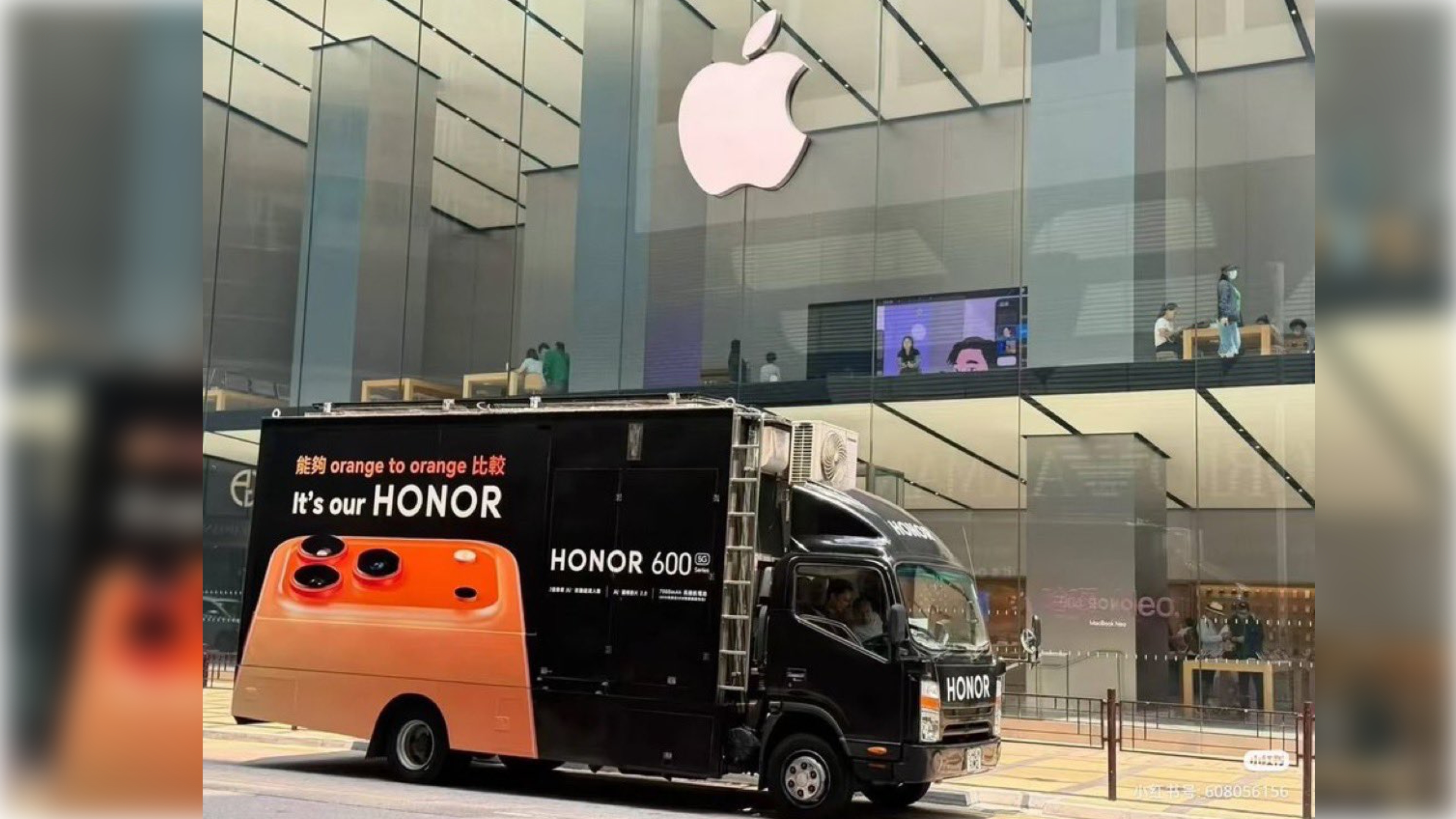
This provocative display wasn't merely about showcasing a new phone; it was a carefully orchestrated statement, imbued with layers of meaning and strategic intent. The choice of location, the messaging, and even the aesthetic details of the advertisement all played a crucial role in Honor's bold gambit to carve out a larger share of the global smartphone conversation and market.
Setting the Scene: Apple's Iconic Canton Road Store
To fully grasp the significance of Honor's marketing stunt, it’s essential to understand the backdrop against which it unfolded. Apple's Canton Road store in Hong Kong is more than just a retail outlet; it's a landmark, a symbol of premium technology, and a hub for consumers seeking the latest innovations from Cupertino. Located in the vibrant Tsim Sha Tsui district, Canton Road is renowned for its luxury boutiques, high-end shopping experiences, and a constant stream of both local and international visitors.
For any brand looking to make a statement, positioning itself directly in front of such an iconic location is a calculated move. Apple stores, by design, are built to attract attention, convey a sense of exclusivity, and offer an immersive brand experience. By choosing this specific spot, Honor was not just advertising to passersby; it was directly engaging with Apple's ecosystem, its customers, and its brand identity. It was a clear declaration: "We are here, we are a competitor, and we are challenging the established order."
Hong Kong itself holds strategic importance in the tech world. As a major international financial center and a gateway to mainland China, it's a critical market for global brands. Its sophisticated consumer base is highly attuned to global trends and discerning about technology. A marketing stunt that generates buzz in Hong Kong is likely to reverberate throughout the greater Asia-Pacific region and beyond, amplifying its impact significantly. The choice of location was, therefore, an integral part of Honor's strategy to maximize visibility and create a memorable impression.
Who is Honor? A Story of Resilience and Rebirth
The company behind this audacious act, Honor, has a fascinating and complex history that adds another layer of intrigue to the situation. Originally founded in 2013 as a sub-brand of Huawei, Honor was positioned to target a younger, more budget-conscious demographic with its range of affordable yet feature-rich smartphones. For years, it operated successfully under Huawei's umbrella, leveraging its parent company's vast research and development capabilities, supply chain, and global marketing reach.
However, Honor's destiny took a dramatic turn in 2020. Huawei, its parent company, found itself embroiled in a geopolitical standoff, facing severe trade restrictions and sanctions from the U.S. government. These sanctions effectively cut Huawei off from crucial American technology, including essential components like semiconductors and, critically, access to Google Mobile Services (GMS) – the suite of apps and services that power most Android phones outside China. This had a devastating impact on Huawei's smartphone business, including Honor.
To ensure Honor's survival and allow it to continue competing in the global market, Huawei made the difficult decision to sell off the brand. In November 2020, Honor was acquired by a consortium of over 30 agents and dealers, along with Shenzhen Smart City Development Group Co., Ltd., a state-owned enterprise. This sale was a strategic maneuver, designed to completely separate Honor from Huawei's sanctioned entity. The move proved successful: once independent, Honor regained access to vital U.S. technologies, including GMS, and was able to re-establish partnerships with key suppliers like Qualcomm and MediaTek.
Since its separation, Honor has embarked on a remarkable journey of rebirth and resurgence. It has aggressively expanded its product portfolio, moving beyond its budget roots to increasingly challenge the premium segment dominated by players like Samsung and Apple. The company has invested heavily in R&D, focusing on innovation in areas such as camera technology, display quality, and charging speeds. Its ambition is clear: to become a leading global smartphone brand, capable of competing head-to-head with the industry's giants. This marketing stunt in Hong Kong is a testament to that ambition, signaling Honor's readiness to directly confront even the most formidable competitors.
The Honor 600 Series: A Challenger Emerges
At the heart of Honor's bold advertisement was the promotion of its new Honor 600 series smartphone. While specific details about this particular model (as the linked page might evolve or refer to a different series) suggest it's Honor's latest flagship, designed to showcase the company's technological prowess and compete directly with premium devices like the iPhone Pro models. Typically, Honor's flagship series pack a punch with cutting-edge processors, advanced camera systems, vibrant displays, and sleek designs.
The strategic choice to promote the "600 series" in such a prominent fashion indicates Honor's confidence in this device as a true contender in the high-end market. For a phone to be worthy of being placed head-to-head against an iPhone in such a public manner, it must embody Honor's best work – combining powerful performance with sophisticated aesthetics and a compelling user experience. Honor's recent flagships, in general, have focused on delivering strong camera capabilities, often featuring advanced computational photography and versatile lens setups, alongside impressive battery life and fast charging solutions. They also typically run on the latest Android versions, customized with Honor's MagicOS interface, offering a blend of smooth performance and unique features.
By contrasting the Honor 600 series directly with the iPhone, Honor aims to convey several messages. Firstly, it positions its device as an equivalent, if not superior, alternative in terms of features and quality. Secondly, it seeks to attract consumers who might be considering an iPhone but are open to exploring other premium options, especially those who appreciate the Android ecosystem and potentially more competitive pricing or specific feature sets offered by Honor. This direct comparison is a deliberate attempt to shift perceptions and elevate Honor's brand image in the minds of consumers, moving it from a perceived "alternative" to a "leading choice."
Decoding the Message: "Orange to Orange" and "It's Our Honor"
The slogans displayed on the Honor truck were meticulously crafted to deliver a powerful, multi-layered message. The phrase "It's our HONOR" is a clever play on words, simultaneously asserting brand identity and implying a sense of pride, integrity, or even a claim to victory. It suggests that the spotlight, the achievement, or perhaps even the future, belongs to Honor. This statement serves to inject the brand's name into a broader context of accomplishment and significance, making it more than just a product but a concept.
Even more intriguing was the slogan "orange to orange," a clear and unmistakable play on the common English idiom "apples to apples." The original idiom refers to making a fair and valid comparison between two items that are truly alike or belong to the same category, ensuring that the comparison is meaningful and accurate. By twisting this idiom into "orange to orange," Honor was overtly inviting a direct, head-to-head comparison between its new 600 series smartphone and Apple's latest iPhone. The implication is crystal clear: "Our phone is on par with the iPhone; don't compare us to lesser devices. Compare us directly to the best."
This linguistic stunt is highly effective because it immediately draws a parallel to Apple, without explicitly naming them. It leverages the universally recognized "apple" imagery associated with the tech giant, subtly yet powerfully positioning Honor as the equivalent "orange" – a distinct but equally premium fruit within the same orchard. This approach is designed to resonate with consumers who are familiar with tech comparisons and are looking for genuine alternatives in the high-end segment. It's a bold rhetorical move that challenges consumers to reconsider their preconceived notions about brand hierarchies and open their minds to Honor's offerings.
The Psychology of Color: Cosmic Orange and Design Imitation
Beyond the clever wordplay, Honor's stunt also delved into the powerful psychology of color and design. The specific finish of the Honor phone featured on the truck bore more than a "passing resemblance" to the iPhone 17 Pro's Cosmic Orange. This choice of color is far from arbitrary; it's a deliberate psychological tactic aimed at drawing an immediate, subconscious connection to Apple's premium aesthetic.
Color plays a crucial role in brand identity and product appeal. Apple, in particular, has a history of introducing distinctive, often vibrant, colors that become instantly recognizable and trend-setting. When other brands adopt strikingly similar hues, it can create a sense of familiarity or even an aspiration to mimic the market leader's prestige. For Honor, showcasing their phone in a near-identical "Cosmic Orange" was a direct attempt to tap into the allure and sophistication that Apple's color palette often evokes.
The original text described this design similarity as "arguably a shameless copy." This raises important questions about innovation versus imitation in the tech industry. While design trends often converge, and certain colors gain popularity, a direct replication, especially in the context of a confrontational marketing stunt, can be seen as an aggressive strategy. It can be interpreted in several ways: as a tribute, as a challenge, or indeed, as a sign of a lack of original design direction. However, from a marketing perspective, it achieves its goal of sparking debate and making the Honor phone immediately relevant in the context of Apple's flagship.
By mimicking the iPhone's signature color, Honor aims to achieve several objectives: to make their product appear equally fashionable and premium, to directly invite aesthetic comparison, and to subtly suggest that consumers can achieve a similar high-end look and feel without necessarily opting for the Apple brand. This deliberate visual parallelism is a core component of Honor's "orange to orange" message, creating a coherent strategy that combines visual cues with linguistic challenges.
Guerrilla Marketing in the Tech World
Honor's Hong Kong stunt is a classic example of "guerrilla marketing" – a marketing strategy that uses unconventional and often low-cost tactics to achieve maximum impact and buzz. Instead of traditional large-scale advertising campaigns, guerrilla marketing relies on surprise, creativity, and direct interaction with the target audience in unexpected places. Its primary goal is to generate word-of-mouth, social media chatter, and free media coverage.
In the highly saturated smartphone market, where advertising budgets can run into billions, guerrilla tactics offer a way for challenger brands to cut through the noise. Parking an advertising truck directly in front of a competitor's flagship store is a bold, highly visible, and relatively inexpensive way to create a memorable impression. It's designed to be shareable content, tailor-made for viral spread on platforms like Weibo, TikTok, and Twitter, where the images quickly gained traction.
The tech industry has a long history of such confrontational marketing. Rivalries between brands like Apple and Microsoft, or Samsung and Apple, have often played out in advertisements that directly or indirectly mock or challenge competitors. Samsung, for instance, famously ran a series of ads that highlighted perceived shortcomings of iPhones while promoting their Galaxy devices. These campaigns aim to chip away at the market leader's dominance, stir consumer interest, and present the challenger as an equally (or more) innovative and desirable option.
For Honor, this stunt is particularly effective because it aligns with their narrative of being a re-emergent, independent brand eager to shake up the established order. It positions them as a fearless competitor, willing to take risks and challenge the status quo. While some might view it as aggressive or even disrespectful, it undeniably creates attention and makes Honor a talking point in a way that a conventional billboard ad might not.
Apple's Calculated Silence: The Strategy of Non-Response
Despite the provocative nature of Honor's stunt, Apple is "unlikely to make a big stink about such guerrilla marketing," as the original text rightly points out. This calculated non-response is a common strategy employed by market leaders when faced with direct provocations from rivals. There are several compelling reasons why Apple would choose to remain silent rather than engage in a public dispute.
Firstly, responding to such a stunt would only "amplify it." Any public statement, legal threat, or even a subtle acknowledgment from Apple would inadvertently give Honor's campaign more visibility and legitimacy. It would turn a localized marketing gimmick into a global news story, effectively doing Honor's marketing for them. Apple, as a premium brand with a carefully cultivated image, prefers to control its narrative and focus on its own innovations rather than engaging in tit-for-tat exchanges with competitors.
Secondly, market leaders often operate from a position of confidence. Apple’s brand loyalty, extensive ecosystem, and consistent innovation mean it has a robust customer base that is unlikely to be swayed by a single advertising stunt. Engaging in a public spat could be perceived as a sign of weakness or insecurity, suggesting that Apple feels threatened. Instead, maintaining a dignified silence reinforces its position as the undisputed leader, above the fray of such competitive theatrics.
Thirdly, the legal grounds for action against such a stunt are often murky and difficult to enforce. While there might be arguments about design infringement or unfair competition, pursuing a lawsuit is costly, time-consuming, and can generate negative public relations. Apple has previously pursued legal action against companies like Samsung for patent infringement, but the scope and nature of this particular stunt likely fall into a gray area of marketing competition rather than clear-cut intellectual property theft that would warrant immediate legal intervention.
Finally, the old adage, "imitation is the sincerest form of flattery," often holds true in these situations. From Apple's perspective, a competitor going to such lengths to compare themselves to the iPhone, even by mimicking its color, can be seen as an implicit acknowledgment of Apple's leadership and influence. It reinforces the idea that Apple sets the trends, and others follow. By letting the stunt play out without comment, Apple implicitly maintains its position of superiority, allowing Honor to highlight the very comparison Apple is confident it will win.
The Broader Implications: A Global Smartphone Battleground
This single marketing stunt in Hong Kong is a microcosm of the larger, ongoing battle in the global smartphone market. The industry is characterized by intense competition, rapid innovation, and a constant struggle for market share. While Apple and Samsung have long dominated the premium segment, a new generation of Chinese brands, including Honor, Xiaomi, and Huawei (through its remaining domestic efforts), are increasingly challenging this duopoly.
The Chinese market, in particular, is a critical battleground. It is the world's largest smartphone market and a key driver of global trends. For Apple, success in China is crucial for its overall revenue and growth. For Chinese brands like Honor, securing a strong domestic base is foundational for their international expansion ambitions. The direct confrontation in Hong Kong underscores the significance of this market and the lengths to which companies will go to capture consumer attention there.
The rise of brands like Honor also highlights a shift in the global tech landscape. These companies, once often seen as fast followers, are now investing heavily in R&D, developing their own unique technologies, and pushing the boundaries of smartphone innovation. While they may occasionally draw "inspiration" from market leaders, they are also bringing their own unique value propositions to the table, often at more competitive price points or with specific features that cater to evolving consumer demands.
Ultimately, this intensified competition benefits consumers. It drives innovation, leads to more diverse product offerings, and often results in more competitive pricing. Brands are pushed to constantly improve, differentiate, and deliver compelling reasons for consumers to choose their products over rivals. Honor's stunt is not just about one company challenging another; it's a visible symbol of this dynamic and ever-evolving global smartphone battleground.
The Future of Competition: Innovation vs. Provocation
Looking ahead, the tactics displayed by Honor in Hong Kong raise questions about the future of competition in the tech industry. Will we see more such direct, in-your-face marketing stunts, or will brands revert to more traditional methods of showcasing their products? It's likely a combination of both. As the digital landscape becomes increasingly crowded and consumers suffer from information overload, provocative marketing that generates genuine buzz is likely to remain a valuable tool for challenger brands.
However, sustained success in the premium smartphone market will always ultimately hinge on genuine innovation and a compelling user experience. While stunts can grab headlines, they rarely build lasting brand loyalty or justify higher price points unless the underlying product truly delivers. For Honor, the challenge will be to ensure that the Honor 600 series (and future flagships) lives up to the audacious claims made in its marketing. It needs to demonstrate that it's not just "orange to orange" in color, but "orange to orange" in performance, quality, and user satisfaction.
Apple, on the other hand, will continue to rely on its established strengths: its powerful ecosystem, integrated hardware and software, strong brand perception, and a relentless focus on design and user privacy. Its response to such provocations will likely remain one of quiet confidence, allowing its products and user experience to speak for themselves. The company understands that its long-term success is built on consistent delivery of quality and innovation, not on engaging in public spats.
This interplay between bold marketing and foundational product excellence will continue to define the smartphone market. Brands will seek new ways to disrupt, differentiate, and engage consumers, but at the core, the devices themselves must still deliver. The Hong Kong stunt serves as a fascinating snapshot of this ongoing tension.
Conclusion: A Spectacle in Hong Kong
The sight of an Honor advertising truck directly challenging an Apple Store in the heart of Hong Kong was more than just a marketing stunt; it was a potent symbol of the intense competition and shifting dynamics within the global smartphone industry. Honor, a brand reborn from the ashes of geopolitical challenges, demonstrated its fierce ambition to reclaim its place among the tech giants, daring to go "orange to orange" with the undisputed market leader.
The clever slogans, the strikingly similar "Cosmic Orange" hue, and the strategic location all combined to create a memorable and highly shareable moment, generating significant buzz across social media. While Apple is expected to maintain its characteristic silence, confident in its market position and unwavering customer loyalty, the incident served as a powerful reminder that no brand, however dominant, is immune to direct challenges.
This bold act by Honor underscores a critical truth in today's tech landscape: innovation alone is not always enough. Brands must also be adept at capturing attention, sparking conversation, and strategically positioning themselves in the minds of consumers. As the smartphone battle continues to unfold across the globe, stunts like this will likely become more frequent, serving as fascinating indicators of which brands are hungry for market share and willing to challenge the status quo.
Ultimately, the spectacle in Hong Kong offers a glimpse into the vibrant, competitive spirit that drives the tech industry forward, constantly pushing the boundaries of both product development and marketing creativity. It's a reminder that even in a world dominated by established titans, there's always room for a challenger to make a bold statement and vie for its own slice of the spotlight.
This article, "Apple Store Becomes Backdrop for Honor's Brazen Hong Kong Ad Stunt" first appeared on MacRumors.com
Discuss this article in our forums
from MacRumors
-via DynaSage
