
Apple Accidentally Leaks 'MacBook Neo'
Apple's Big Reveal: The 'MacBook Neo' — A Glimpse into the Future of Affordable Computing
The tech world is buzzing with anticipation as Apple, a company renowned for its tightly guarded secrets, appears to have inadvertently pulled back the curtain on its next big thing: a rumored lower-cost MacBook. What's even more exciting is the seemingly accidental reveal of its name – the "MacBook Neo." This unexpected leak has set the stage for what promises to be one of Apple's most intriguing product announcements in recent memory, expected to unfold this Wednesday.
For years, consumers have yearned for a more accessible entry point into the macOS ecosystem. While the MacBook Air has served as Apple's gateway laptop, its price point can still be a barrier for many. The "MacBook Neo" suggests a bold new direction, potentially offering the Apple experience at an even more budget-friendly price, opening the doors to a wider audience, from students to users seeking a reliable, portable device for everyday tasks. This isn't just about a new model; it's about a strategic shift that could redefine Apple's position in the fiercely competitive budget laptop market, making the power and elegance of a Mac available to a broader demographic than ever before.

The Accidental Unveiling: How 'MacBook Neo' Surfaced
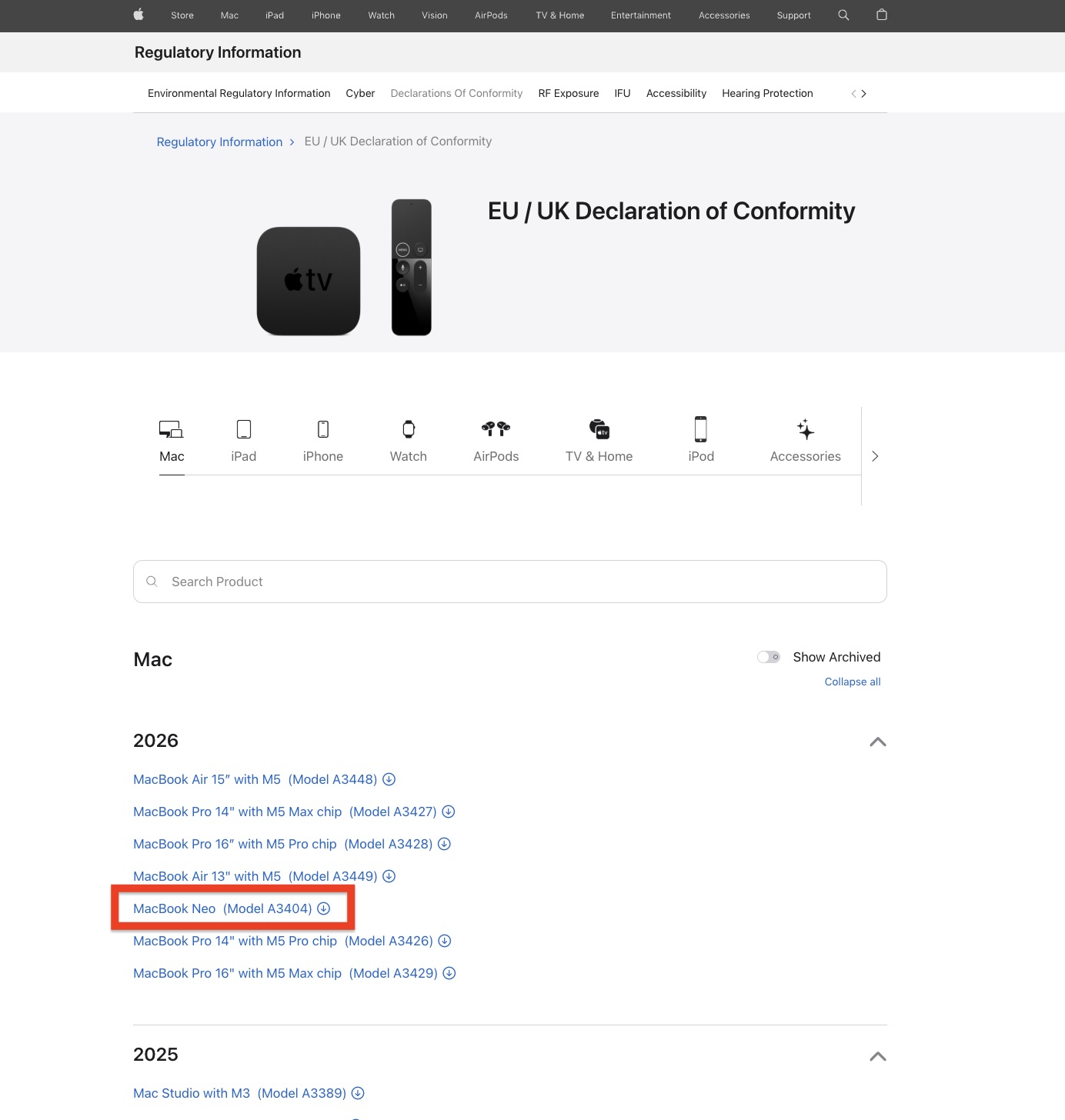
The story of the "MacBook Neo's" premature debut reads like something out of a tech thriller. Apple, known for its meticulous control over product information, seems to have slipped up on its own official channels. A regulatory document pertaining to a mysterious new device, identified by the model number A3404, briefly appeared on Apple's website. While the PDF file itself didn't explicitly bear the "MacBook Neo" moniker, the name briefly surfaced within a direct link on Apple's regulatory website, specifically for EU compliance purposes. This kind of administrative oversight, though rare for Apple, often becomes a golden nugget for tech journalists and enthusiasts, providing an early peek at what's coming.
This is a common, yet often embarrassing, occurrence in the tech world. Companies must submit detailed information about new electronic devices to regulatory bodies across different regions before they can be sold. These documents ensure compliance with safety, electromagnetic compatibility, and other standards. While the content of these documents is usually technical and devoid of marketing names, the filenames or associated links can sometimes inadvertently reveal upcoming products. In this instance, the fleeting presence of "MacBook Neo" in the URL was enough to send ripples of excitement and speculation across the internet, sparking conversations about what a new, potentially lower-cost MacBook could mean for the market.
The rapid removal of the "MacBook Neo" link shortly after its discovery only served to confirm its authenticity. This swift action by Apple underscores the sensitive nature of the information and suggests that the company was not yet ready to share this detail with the world. Such a quick disappearing act often signals that a significant announcement is imminent, building further anticipation for what Apple has in store for this Wednesday's unveiling. The leak, though accidental, has effectively generated a significant amount of pre-launch buzz, turning heads and sparking conversations about Apple's potential return to a more budget-focused laptop strategy, a move that many have been clamoring for.
Understanding the 'Neo' Philosophy: A Fresh Take on MacBooks
The name "MacBook Neo" itself is quite intriguing. "Neo" typically means "new" or "a new and revived form of something." This suggests that Apple isn't just releasing another iteration of an existing product line; they might be introducing a fundamentally different kind of MacBook. This could signify a fresh approach to design, performance, and most importantly, pricing, setting it apart from the established MacBook Air and MacBook Pro series. It hints at a rebirth, a reinterpretation of what an entry-level Mac can be, possibly prioritizing accessibility and specific use cases over raw power.
Targeting a Broader Audience with Affordability
One of the most compelling aspects of the "MacBook Neo" is its rumored price point. Estimates place its starting price in the range of $599 to $799. To put this in perspective, the current MacBook Air typically starts around $999 or more. This significant price reduction would make the "MacBook Neo" directly competitive with a vast segment of the laptop market currently dominated by Chromebooks and entry-level Windows PCs. This pricing strategy is a strong indicator that Apple is seriously committed to making macOS more accessible, reaching users who might previously have considered Macs out of their budget.
This aggressive pricing strategy suggests Apple is seriously targeting the education sector, students, and consumers in developing markets who might find current Mac pricing prohibitive. It could also appeal to users who primarily need a laptop for web browsing, email, word processing, streaming media, and light productivity tasks, without requiring the professional-grade power of an M-series chip found in higher-end Macs. By offering a true Mac experience at a lower cost, Apple aims to expand its ecosystem and capture a larger market share, potentially introducing a whole new generation of users to the macOS platform and solidifying their loyalty to the Apple brand from an early stage.
Positioning in the Apple Ecosystem: Below the Air
The "MacBook Neo" is expected to slot in below the MacBook Air in Apple's Mac lineup. This creates a clear hierarchy: the MacBook Neo for ultimate affordability and basic tasks, the MacBook Air for a balance of portability and mainstream performance, and the MacBook Pro for demanding professional workloads. This tiered approach allows Apple to cater to a wider array of user needs and budgets without cannibalizing sales of its existing, more premium devices. It’s a smart segmentation strategy that broadens appeal without diluting the brand perception of its higher-end offerings.
Historically, Apple has experimented with various price points for its laptops. The original MacBook, introduced in 2006, often served as a more affordable option before the MacBook Air took over that role. The 12-inch Retina MacBook, launched in 2015, also aimed for extreme portability and efficiency, albeit at a premium price. The "MacBook Neo" could be seen as a spiritual successor to these efforts, but with an even stronger emphasis on cost-effectiveness, bringing the Mac experience to a truly mass market. It represents a pivot, not just in pricing, but potentially in the underlying philosophy of what a MacBook can be, focusing on essential functionality and the core macOS experience.
A Radical Shift: The iPhone Chip Inside a MacBook
Perhaps the most revolutionary aspect of the "MacBook Neo" is its rumored heart: an iPhone chip, specifically the A18 Pro or A19 Pro, rather than the M-series chips (M1, M2, M3) that power all other modern Macs. This represents a significant departure from Apple's current strategy, which has seen its M-series chips redefine performance and efficiency in personal computing. This shift opens up a fascinating discussion about performance, efficiency, and market segmentation, suggesting a strategic recalculation for specific market segments.
Why an A-Series Chip? Strategic Advantages
Integrating an A-series chip, typically found in iPhones and some iPads, into a MacBook offers several compelling advantages for a low-cost device:
- Cost Efficiency: A-series chips are likely more cost-effective to produce in high volumes compared to the more complex and specialized M-series chips. This directly contributes to the "MacBook Neo's" anticipated lower price point, making it feasible to hit that crucial sub-$800 bracket. Apple can leverage its massive production scale for iPhone chips to benefit this new laptop line.
- Exceptional Power Efficiency: A-series chips are designed from the ground up for mobile devices, prioritizing incredible power efficiency to deliver long battery life in compact form factors. This could translate into a MacBook Neo with truly all-day battery performance, potentially exceeding 15-20 hours on a single charge, making it an ideal companion for students or frequent travelers who need to stay productive without constantly searching for power outlets.
- Sufficient Performance for Everyday Tasks: While not as powerful as M-series chips for heavy-duty video editing, 3D rendering, or intensive coding, an A18 Pro or A19 Pro chip is still incredibly potent. For common tasks like web browsing, email, word processing (Pages, Word), spreadsheets (Numbers, Excel), presentations (Keynote, PowerPoint), streaming video, and even light photo editing, these chips offer snappy, responsive performance. Many users simply don't need the raw power of an M3 chip, and the A-series can handle their daily needs with ease, providing a seamless macOS experience for the target audience.
- Potentially Fanless Design: The high efficiency and lower thermal output of A-series chips might allow for a completely fanless design, making the "MacBook Neo" silent, thinner, and lighter than even the passively cooled MacBook Air M1. This would be a huge boon for portability and quiet operation, perfect for libraries, classrooms, or quiet workspaces. A fanless design also means fewer moving parts and potentially greater durability.
- Ecosystem Synergy: Using an A-series chip could further blur the lines between Apple's mobile and desktop operating systems, potentially simplifying app development or enabling even tighter integration between macOS and iOS/iPadOS features. It could lead to a more unified software experience where apps designed for iPhone and iPad run natively and smoothly on the MacBook Neo, expanding the available software library for the device.
Comparing A-Series to M-Series: Understanding the Nuance
It's important to understand the distinction between Apple's A-series and M-series chips to appreciate the "MacBook Neo's" unique position. The M-series chips (M1, M2, M3, and their Pro/Max/Ultra variants) are custom-designed for Mac computers, emphasizing maximum performance for professional applications while maintaining excellent efficiency. They feature powerful CPU and GPU cores, advanced Neural Engines, and dedicated media engines, making them ideal for tasks like 4K video editing, software development, and graphic design. These chips are built for sustained, high-performance workloads.
The A-series chips, on the other hand, are the workhorses of the iPhone and iPad lines. While sharing much of the same underlying architecture with the M-series (both are based on ARM), they are typically optimized for different thermal envelopes and power budgets, prioritizing burst performance and ultra-low power consumption for mobile use cases. An A18 Pro, for instance, would likely be a cutting-edge chip for an iPhone, offering incredible speed for mobile gaming, AI features, and camera processing. Transplanting this into a MacBook allows Apple to leverage existing, highly optimized silicon for a different use case, without incurring the development costs of an entirely new, lower-tier M-series chip. This strategy allows for rapid iteration and cost savings.
For the average user targeted by the "MacBook Neo," the difference might be negligible in daily use. The macOS operating system is remarkably well-optimized, and an A18 Pro chip, even with its mobile heritage, would deliver a fluid and enjoyable user experience for most common applications. The real test will be how Apple optimizes macOS specifically for this A-series architecture on a laptop, and what compromises, if any, users might encounter with particularly demanding desktop applications. However, for a device aimed at affordability and basic productivity, the A-series chip represents a smart and capable choice, ensuring a responsive Apple experience without the premium price tag of an M-series machine.
Design, Display, and Delightful Colors
Beyond the internal chip, the "MacBook Neo" is rumored to sport features that align with its "fun" and "affordable" positioning, making it an attractive option for a broader demographic. These design choices are crucial for making the device stand out in a crowded market and appealing to its target audience.
A Compact 12.9-inch Display
The rumored 12.9-inch display size suggests a highly portable form factor. This size sits comfortably between Apple's current MacBook Air models (13.6-inch and 15.3-inch) and the largest iPad Pro (also 12.9-inch). A 12.9-inch screen offers a good balance: large enough for comfortable productivity and media consumption, yet small enough to be incredibly light and easy to carry in a backpack or even a larger handbag. It harks back to the ultra-portable niche, providing a compact workspace without feeling cramped, ideal for on-the-go computing without sacrificing usability. This size would also differentiate it clearly from the Air line, creating its own distinct niche.
A Splash of Color: Echoing the iMac
One of the most exciting design rumors is the availability of fun color options. Speculation points to colors like yellow, green, blue, and/or pink. This strategy mirrors the successful introduction of vibrant colors for the M1 iMac, which revitalized the desktop line and resonated particularly well with younger audiences and those looking for a device that expresses personality. This move shows Apple is not afraid to inject playfulness into its product lines when it makes strategic sense, moving beyond the traditional silver, space gray, and gold of its more premium laptops.
The "MacBook Neo" name itself perfectly complements this colorful approach. It evokes a sense of newness, freshness, and a departure from the more staid aesthetics of professional Macs. Imagine a student pulling out a bright yellow MacBook Neo in a lecture hall, or a creative professional enjoying a pop of color in their workspace. These aesthetic choices are deliberate, designed to attract a specific segment of the market that values both functionality and personal expression in their technology, making the laptop not just a tool, but a reflection of their individual style.
Expected Portability and Battery Life
Given the A-series chip and 12.9-inch display, the "MacBook Neo" is almost certainly designed for maximum portability. We can expect it to be exceptionally thin and light, perhaps even surpassing the MacBook Air in these metrics, making it incredibly easy to slip into any bag. The A-series chip's power efficiency, combined with Apple's software optimizations, should translate into phenomenal battery life, potentially offering users a full day or more of usage on a single charge. This would be a major selling point for anyone constantly on the go, reducing the anxiety of battery drain and the need to carry a charger everywhere.
While specific details on ports are scarce, it's reasonable to expect at least one or two versatile USB-C ports, likely supporting charging and data transfer. Full Thunderbolt support, while desirable, might be a feature reserved for M-series Macs to maintain differentiation and higher price points. A standard Apple keyboard and a spacious Force Touch trackpad are almost certainly included, ensuring a familiar and premium input experience that Apple users have come to expect, even at a lower price point. A high-quality FaceTime HD camera would also be a given, essential for remote learning and video calls.
The Big Reveal: What to Expect This Wednesday
With all the rumors and accidental leaks, the anticipation for Wednesday's announcement is palpable. However, potential buyers and tech enthusiasts should manage their expectations regarding the format of the reveal. This won't be a typical grand Apple event, but rather a more focused unveiling for specific audiences.
"Apple Experience" Gatherings for the Media
Instead of a grand, live-streamed keynote event typically associated with major product launches like new iPhones or flagship Macs, Apple is reportedly opting for more intimate "Apple Experience" gatherings. These exclusive media events are scheduled to be held in key global cities: New York, London, and Shanghai, all commencing this Wednesday at 9 a.m. Eastern Time. This approach suggests a more focused rollout, allowing journalists and industry experts to get hands-on time with the "MacBook Neo" and experience it firsthand, rather than just seeing it on a screen. For a product designed to hit a specific price point and market segment, a direct, tactile experience can be more impactful than a broad broadcast.
The choice of multiple locations ensures global press coverage and allows Apple to control the narrative by providing carefully curated experiences. For a product like the "MacBook Neo," which might represent a new category or a significant departure from existing lines, direct interaction with the device can be crucial for conveying its unique value proposition. Journalists will be able to test its performance, evaluate its design, and assess its overall user experience, providing detailed insights to the wider public through their initial reviews and impressions. This format also allows Apple to directly answer media questions and address specific points about its new strategic direction.
A Press Release, Not a Live Stream
Crucially, there will be no public live stream for this launch. Instead, Apple will disseminate the official information through a press release published on the Apple Newsroom website. This method is often used for product updates or new, less "flagship" devices, or for products that are highly segmented. While it lacks the spectacle and fanfare of a live keynote, it allows Apple to present all the essential details – specifications, pricing, availability, and key marketing messages – in a concise and easily digestible format, directly to consumers and the press without the theatrics.
Those eager for the official details should keep a close eye on Apple's Newsroom website promptly at 9 a.m. ET this Wednesday. This press release will be the definitive source of information, confirming or refuting the numerous rumors surrounding the "MacBook Neo." Expect to see high-resolution images, detailed feature lists, and potentially even initial reviews from media who attended the "Apple Experience" gatherings. The swift removal of the "MacBook Neo" link earlier today further underscores the importance of this upcoming press release, as it will finally provide the full, authorized picture of Apple's newest laptop, answering all the questions that have been bubbling since the accidental leak.
The Broader Impact: Apple's Strategy and Future Outlook
The introduction of a "MacBook Neo" with an A-series chip and an aggressive price point could have profound implications for Apple's market strategy and the broader personal computing landscape. It signals a new chapter in Apple's journey to make its technology accessible to an even wider user base, while also adapting to evolving market demands.
Expanding Apple's Market Reach and Ecosystem Lock-in
A more affordable MacBook directly addresses a long-standing demand from consumers. By entering the $599-$799 price segment, Apple positions itself to capture a significant share of the market that has historically gravitated towards cheaper Windows laptops or Chromebooks. This move is not just about selling more units; it's about drawing new users into the tightly integrated Apple ecosystem, which includes services like iCloud, Apple Music, Apple TV+, and features like Handoff, AirDrop, and Universal Control that seamlessly connect Macs with iPhones and iPads. Once a user is in the ecosystem, they are more likely to stay, creating long-term customer loyalty and revenue streams that extend far beyond the initial hardware purchase. It's a strategic long game, investing in future generations of Apple loyalists.
Challenging the Competition in the Budget Segment
The "MacBook Neo" will undoubtedly send shockwaves through the budget laptop market. Chromebooks have thrived by offering low-cost, web-centric computing, particularly in education. Entry-level Windows laptops, while more versatile, often struggle with performance, inconsistent build quality, and shorter update cycles at lower price points. Apple's entry, even with an A-series chip, promises premium build quality, robust software support, guaranteed updates for many years, and a user experience often unmatched in its price bracket. This could force competitors to innovate further or lower their own prices, benefiting consumers across the board by raising the bar for affordable computing. Apple is not just competing; it's setting a new standard for what a budget laptop can deliver.
The Future of A-Series Macs and Platform Diversification
If the "MacBook Neo" proves successful, it could signal the beginning of a new line of A-series powered Macs. We might see an "iMac Neo" or even a "Mac mini Neo" in the future, offering even cheaper desktop solutions for light users, educational institutions, or dedicated kiosks. This diversification of chip architecture within the Mac lineup allows Apple greater flexibility in addressing different market segments without compromising the high-performance reputation of its M-series machines. It shows a willingness to experiment and tailor hardware specifically for different user needs, rather than a one-size-fits-all approach.
However, it also raises questions about software compatibility and developer effort. While macOS is incredibly adaptable, optimizing applications for both M-series and A-series architectures, especially as they evolve, will be a task for developers. Apple's track record of smooth transitions (like PowerPC to Intel, and Intel to Apple Silicon) suggests they are well-equipped to handle this, but it will be a dynamic to watch. The success of Universal apps already bodes well for this potential split in chip architectures, ensuring broad software compatibility.
A Step Towards Full Platform Unification?
The use of an A-series chip could also be seen as another step towards an even deeper integration between macOS and Apple's mobile operating systems. With developers already building apps that run on both iOS/iPadOS and macOS (thanks to Catalyst and universal binaries), a common chip architecture, even if different series, could streamline development further and potentially lead to new cross-platform features or even a more unified app store experience in the long run. It's a tantalizing glimpse into a future where the lines between Apple's devices are increasingly blurred, offering a seamless and consistent user experience across all its platforms, making switching between devices almost imperceptible.
The "MacBook Neo" is more than just a new laptop; it's a statement. It signals Apple's intent to broaden its appeal, challenge existing market dynamics, and redefine what an "entry-level" personal computer can be. It promises to deliver the core Apple experience – elegance, ease of use, and a robust ecosystem – to a whole new generation of users, making the magic of macOS more accessible than ever before. All eyes will be on Wednesday's announcement to see if the "MacBook Neo" lives up to the immense anticipation it has already generated.
This article, "Apple Accidentally Leaks 'MacBook Neo'" first appeared on MacRumors.com
Discuss this article in our forums
from MacRumors
-via DynaSage
