
iPhone 18 Pro's Redesigned Vapor Chamber Triples Cooling Surface Area
Apple has officially unveiled a redesigned thermal system for the iPhone 18 Pro and iPhone 18 Pro Max, centered around a next-generation vapor chamber that delivers up to a 40% boost in sustained performance. By tripling the cooling surface area and adopting side-by-side silicon packaging, the system allows the A20 Pro chip to maintain peak power under demanding workloads without thermal throttling.
When flagship smartphones execute complex tasks like high frame rate gaming or continuous high resolution video recording, heat buildup becomes a major engineering bottleneck. Modern processors produce significant thermal energy under load. Without efficient heat dissipation, system safety features kick in to throttle performance and prevent hardware damage. Apple today announced an upgraded thermal infrastructure specifically designed to solve this issue in its latest Pro devices.
The centerpiece of this thermal overhaul is the iPhone 18 Pro redesigned vapor chamber. Built to handle intense computational demands, this advanced liquid cooling system works in tandem with restructured silicon architecture. By completely re-engineering how heat moves from the main processor die to the outer chassis, Apple ensures that power users can tap into maximum processing capability for far longer periods.
Rather than relying on incremental design tweaks, Apple redesigned both the physical cooling chamber and the fundamental silicon layout inside the phone. This integrated approach marks one of the most substantial upgrades to iPhone thermal management in years, establishing a new baseline for mobile performance consistency.
How the Next-Generation iPhone 18 Pro Redesigned Vapor Chamber Works
Vapor chamber technology operates on the principle of liquid vapor phase change heat transfer inside a sealed, vacuum controlled chamber. Unlike conventional solid graphite sheets or narrow heat pipes, a planar vapor chamber spreads thermal energy evenly across two dimensions. This multi directional heat spreading prevents concentrated hotspots from forming directly beneath the logic board.
The updated chamber integrated into the new flagship models is built around three core engineering upgrades. First, Apple expanded the physical footprint of the chamber significantly. Second, engineers implemented a dynamic liquid loop utilizing ultra pure deionized water. Third, the chamber surface interfaces directly with the processing package for rapid thermal conductivity.
The Role of Deionized Water and Liquid Phase Cycling
Inside the sealed chamber, deionized water serves as the active working fluid. Deionized water is ideal for precision microelectronics thermal control due to its exceptionally high latent heat of vaporization. This property allows a microscopic volume of liquid to absorb a massive amount of thermal energy as it transitions from liquid to gas.
When the high performance processor generates heat under load, the deionized water at the internal contact plate absorbs the heat and vaporizes. The expanding steam travels rapidly toward the cooler perimeter of the chamber. As it strikes the cooler surfaces, the vapor condenses back into liquid water, releasing its latent heat across a wide surface area.
A specialized internal capillary wick structure then draws the condensed water back toward the primary heat source. This continuous evaporation, transportation, condensation, and return loop operates passively and silently. By constantly cycling deionized water throughout the system, the vapor chamber provides relentless cooling performance during prolonged computational tasks.
Tripling the Cooling Surface Area Compared to iPhone 17 Pro
Surface area is the single most critical factor in passive heat dissipation inside small electronic enclosures. The redesigned vapor chamber in the new flagship hardware features three times the surface area of the cooling component found in the iPhone 17 Pro. This massive increase in surface area transforms how thermal energy moves through the device chassis.
In previous designs, smaller thermal spreaders meant heat accumulated rapidly in a localized area around the main system chip. By tripling the surface area, thermal energy spreads instantly across a broad expanse, accelerating heat exchange into the outer casing and surrounding air. This expansive area prevents thermal saturation, enabling the cooling system to manage continuous heat output far more effectively.
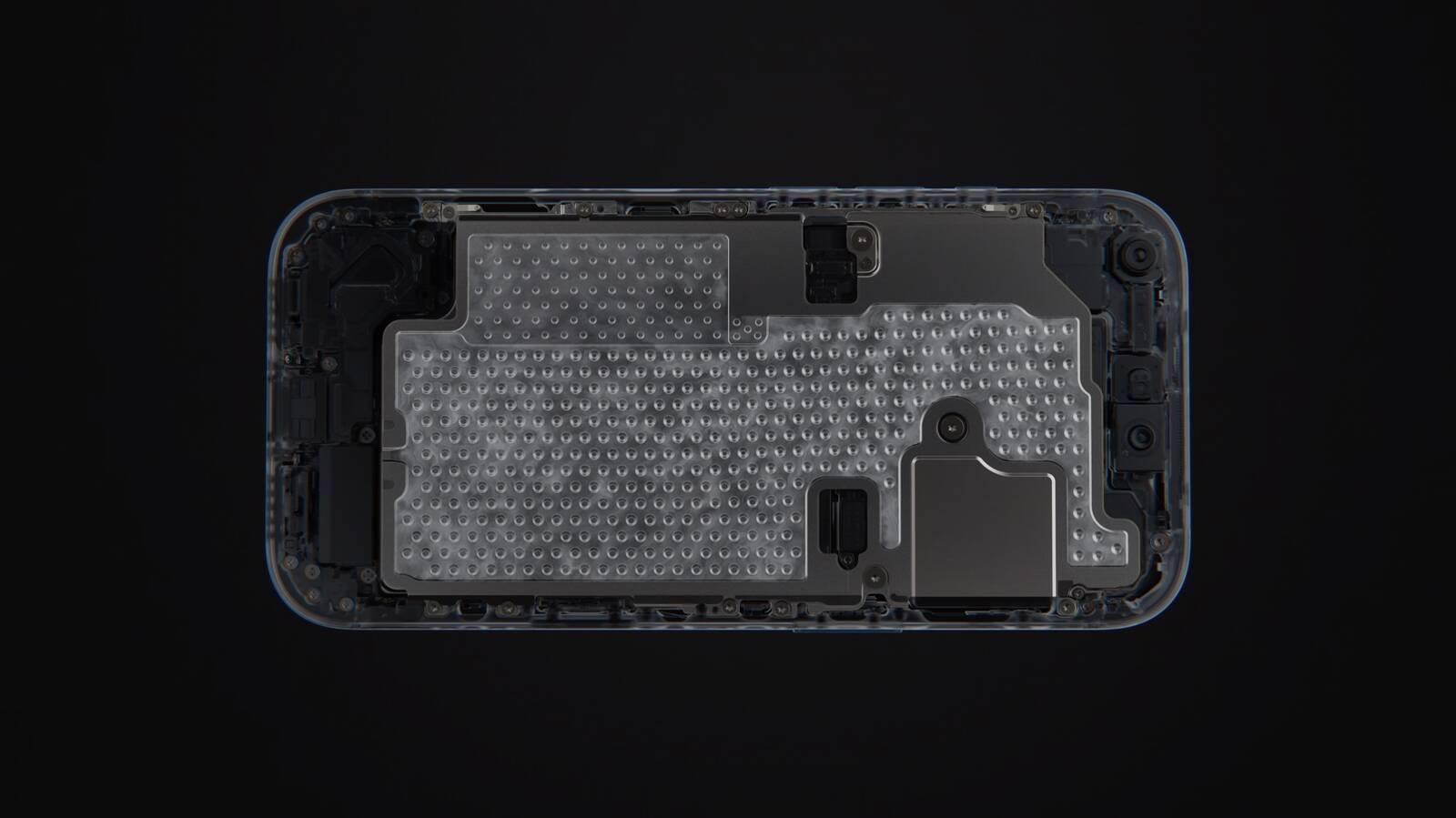
As depicted in the internal component diagram, the vast vapor chamber spans a dominant portion of the internal layout. This direct spatial coverage ensures that every major thermal source on the logic board benefits from immediate liquid phase cooling.
Side-by-Side Silicon Packaging Inspired by Apple M-Series Chips
A larger vapor chamber alone cannot deliver peak efficiency if internal hardware barriers block heat transfer from the processor. In traditional mobile system on chip designs, dynamic RAM modules are stacked directly above the main silicon processing die. Known as Package on Package architecture, this stacked structure saves precious logic board space but creates a severe thermal bottleneck.
In stacked configurations, heat produced by the silicon processing cores must pass through the top memory module before reaching any external cooling layer. Conversely, heat from the memory module radiates directly back into the processor die. This mutual thermal interference restricts peak performance and speeds up thermal saturation.
To overcome this limitation, Apple completely redesigned the silicon packaging with custom packaging inspired by its desktop class M-series chips. Engineers placed the silicon die and memory side by side on the substrate rather than stacked directly on top of each other. This architectural layout fundamentally reshapes the thermal pathways inside the smartphone.
Removing Memory from the Thermal Path
Placing the silicon die and memory side by side effectively removes the memory from the chip's direct thermal path. The RAM modules no longer act as an insulating blanket sitting directly on top of the central processing unit and graphics cores. Instead, each component occupies its own distinct physical region on the logic board substrate.
By separating these primary heat generators, the overall thermal load is split into separate physical zones. Memory operations no longer raise the baseline operating temperature of the processor cores, and continuous computational bursts from the processor no longer expose the system RAM to extreme thermal stress. This separation improves system stability and component durability overall.
Direct Chip-to-Vapor Chamber Thermal Interface
The most important benefit of side-by-side silicon packaging is that it clears the physical space directly above the processing core. With the memory moved alongside, the main silicon die can connect directly to the copper surface of the vapor chamber. This direct hardware contact removes intermediate packaging layers that previously impeded heat flow.
Thermal energy generated by transistor switching flows instantly into the vapor chamber's contact plate without delay. By establishing a direct physical bridge between the chip die and the liquid cooling loop, heat is extracted the exact millisecond it is generated. This immediate heat transfer stops temperature spikes before they can trigger processor throttling.
What Up to 40% Higher Sustained Performance Means for Users
Peak performance metrics measure short bursts of speed lasting only a few seconds, such as opening an app or rendering a web page. However, sustained performance measures how fast a device runs during continuous, long duration processing tasks. Apple states that combining the new side-by-side silicon packaging, advanced thermal materials, and the enlarged vapor chamber delivers up to a 40% gain in sustained performance over the previous generation.
Apple describes this achievement as the highest sustained performance ever delivered in an iPhone. For everyday users and demanding creative professionals alike, a 40% sustained speed increase provides concrete real world advantages across numerous applications.
- Extended High Frame Rate Mobile Gaming: Modern mobile games feature detailed three dimensional graphics that strain GPU resources. The expanded thermal headroom allows demanding games to run at continuous high frame rates without stuttering or sudden drop-offs in fluid motion.
- Continuous On-Device Artificial Intelligence Processing: Complex machine learning tasks and generative AI algorithms generate continuous computational demands. Enhanced heat dissipation enables artificial intelligence workloads to process continuously without thermal slowdowns.
- Professional High Resolution Video Capture and Editing: Processing 4K or 8K video feeds in real time generates substantial heat output. The upgraded cooling architecture prevents slowdowns during long camera recording sessions and speeds up multi track video exports.
- Complex 3D Rendering and Augmented Reality: Spatial computing applications and continuous 3D asset manipulation require sustained GPU output. Stable thermal management ensures continuous performance during extended design sessions.
- Intensive Multitasking and Mobile Productivity: Running resource heavy professional applications simultaneously requires consistent background processing power without system wide thermal degradation.
Comparing iPhone 17 Pro vs iPhone 18 Pro Thermal Infrastructure
Comparing the structural thermal characteristics of consecutive flagship generations highlights the massive leap forward engineered into the new hardware. The previous generation offered efficient everyday cooling, but sustained peak workloads eventually exceeded thermal capacity.
The following detailed breakdown outlines how the thermal infrastructure has evolved across key components:
- Vapor Chamber Surface Area: The new cooling chamber delivers three times the total surface area compared to the cooling element in the previous model.
- Silicon Packaging Layout: Transitioned from stacked Package on Package memory layout to a side-by-side layout inspired by desktop M-series silicon.
- Processor Thermal Interface: Updated from indirect thermal contact through stacked memory to direct connection between the processing die and the cooling plate.
- Thermal Working Medium: Continuous liquid phase cycling of deionized water through an optimized capillary wick network.
- Sustained Heavy Workload Performance: Delivers up to a 40% improvement in sustained performance under long duration maximum load conditions.
Why Thermal Efficiency Matters for Long-Term Device Health
While performance benchmarks highlight immediate speed improvements, superior thermal management also plays a crucial role in extending overall smartphone hardware longevity. Persistent high operational temperatures accelerate electronic wear and degrade delicate components over time.
Continuous excessive heat places stress on lithium ion chemical structures, delicate logic board solder points, and silicon transistor gates. By maintaining lower average operating temperatures during high load processing, the upgraded iPhone 18 Pro vapor chamber reduces structural thermal fatigue across all internal components.
Additionally, effective thermal distribution directly improves user ergonomics. Devices that overheat during intensive gaming or camera use can become uncomfortable to hold. By distributing thermal energy across a broad plane and dissipating it smoothly through the outer chassis, external hotspots are eliminated, keeping the phone comfortable in hand.
Advanced Hardware Integration and Material Design
Adapting custom packaging inspired by Apple M-series chips into a compact smartphone form factor required breakthroughs in micro engineering. Laptop and desktop computers benefit from larger internal volumes and active mechanical fans. Bringing that level of sustained performance into a fanless mobile chassis required complete optimization of space and materials.
By placing the silicon die and memory side by side, engineers minimized physical height within the logic board sandwich. This saved vertical space, allowing the larger vapor chamber to fit within the sleek chassis profile without increasing overall device thickness.
Furthermore, new custom thermal interface materials are applied between the silicon die, memory modules, and cooling plates. These materials fill microscopic surface irregularities, ensuring maximum thermal conductivity and near zero heat transfer resistance across interfaces.
Frequently Asked Questions About iPhone 18 Pro Thermals
What is the main benefit of the redesigned vapor chamber?
The primary advantage is a 3x increase in cooling surface area and continuous deionized water cycling, enabling up to a 40% improvement in sustained performance under heavy workloads without thermal throttling.
How does side-by-side silicon packaging help prevent overheating?
By placing memory alongside the silicon die instead of stacking it on top, memory is removed from the chip thermal path. This enables direct physical contact between the A20 Pro processor and the cooling chamber.
Does the upgraded thermal system work automatically?
Yes, the liquid vapor chamber operates entirely passively through sealed evaporation and capillary condensation cycles, requiring no extra battery power or mechanical moving parts.
Which device models include this redesigned thermal architecture?
Apple implemented this next-generation thermal system, featuring the enlarged vapor chamber and side-by-side silicon packaging, in both the iPhone 18 Pro and iPhone 18 Pro Max.
Conclusion: A New Era for iPhone Thermal Efficiency
The official announcement of iPhone 18 Pro's Redesigned Vapor Chamber Triples Cooling Surface Area marks a fundamental milestone in smartphone thermal engineering. By combining a triple sized liquid vapor chamber cycling deionized water with custom M-series inspired side-by-side silicon packaging, Apple has unlocked unprecedented sustained processing capabilities. The A20 Pro chip can now maintain its maximum performance output for longer periods than ever before.
This article first appeared on MacRumors.com. Interested in learning more or sharing your thoughts on the latest thermal hardware upgrades? Discuss this article in our community forums!
from MacRumors
-via DynaSage
