
Anthropic Adds 'Reflect' Feature to Claude for Tracking Your Usage
Reflect with Claude: A New Way to Understand Your AI Journey
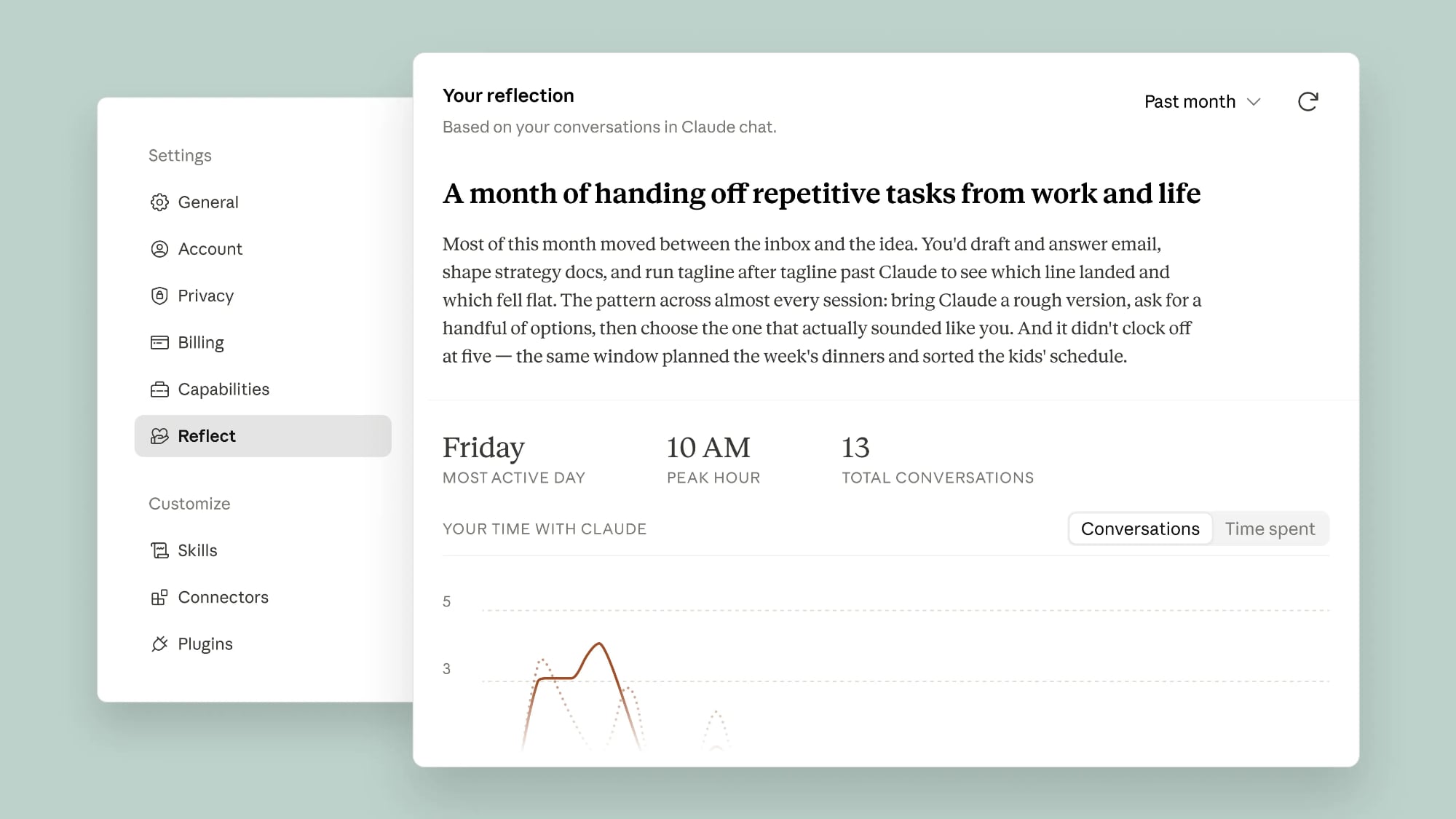
Anthropic, the creators of the advanced AI assistant Claude, have introduced an exciting new feature called "Reflect." This innovative tool is designed to give users a comprehensive overview of how they've been interacting with Claude, offering insights similar to popular year-in-review summaries like Spotify Wrapped. Reflect allows you to take a step back and examine your usage patterns, helping you understand the valuable role Claude plays in your daily life, work, and creative processes. It's an invitation to explore your digital habits with AI and optimize your future interactions for even greater efficiency and insight.
What Exactly Does Claude's Reflect Feature Show You?
At its core, Reflect provides a personalized summary of your Claude usage. It's not just about how long you've spent chatting, but also about the quality and nature of those interactions. The feature incorporates several key areas to give you a holistic view:
- Key Topics: Discover the most frequent subjects you discuss with Claude. Have you been diving deep into coding, brainstorming marketing strategies, exploring complex scientific theories, or simply seeking creative inspiration? Reflect will highlight these dominant themes, showing you what areas you most frequently lean on Claude for help.
- Usage Patterns: Understand when and how you typically engage with Claude. Do you use it for quick bursts of information gathering during your morning routine, long drafting sessions in the afternoon, or perhaps as a consistent companion throughout your workday for various tasks? This helps you identify your natural rhythms of AI interaction and where it fits best into your schedule.
- Type of Tasks: Reflect categorizes the kind of work you accomplish with Claude. This could include generating creative content, summarizing lengthy documents, assisting with detailed research, debugging programming code, learning new complex concepts, or even simply engaging in conversational exploration for personal interest.
- Interaction Duration: While currently showing usage over specific timeframes, Anthropic plans to add a more precise view of the total time you've spent using Claude in the near future. This will offer an even deeper understanding of your engagement levels, helping you quantify your investment in AI-assisted activities.
You can review your Claude activity over various periods: the past 1 month, 3 months, 6 months, or even a full year. This flexibility allows you to spot both recent trends and long-term shifts in your AI usage, providing valuable context for your personal and professional development journey with artificial intelligence. By looking back, you gain foresight.
Why Reflect is a Game-Changer for AI Users
The introduction of Reflect goes beyond mere data tracking; it's a significant step towards fostering more mindful and effective human-AI collaboration. Here's why this feature is incredibly important for anyone using Claude, from casual users to power users:
1. Empowering Self-Reflection and Growth
Just as a journal helps you understand your thoughts and feelings, Reflect helps you understand your interaction with AI. It invites you to pause and consider the tangible impact Claude has on your life. Are you delegating tasks effectively to free up your time? Are you using Claude to actively learn new skills or explore unfamiliar domains? Are there areas where you could leverage its capabilities more fully, or perhaps areas where you might be over-relying? This self-assessment is crucial for personal and professional growth in an increasingly AI-driven world, helping you integrate AI intentionally rather than passively.
2. Optimizing Productivity and Efficiency
By identifying your most common usage patterns and task types, Reflect can highlight precisely where Claude provides the most value. Perhaps you realize you consistently use Claude for brainstorming initial ideas for projects, saving significant time in the early stages of creative work. Or maybe you discover that you frequently ask Claude to summarize lengthy articles or reports, indicating a strong need for efficient information synthesis in your workflow. These concrete insights can help you intentionally integrate Claude into your workflow in ways that maximize your productivity and allow you to focus on higher-level tasks.
3. Guiding Better Prompting and Interaction
Understanding how you've used Claude in the past can directly inform how you interact with it in the future. If Reflect shows you've been asking very broad or vague questions, and then spending a lot of time refining the output, it might prompt you to try more specific and detailed prompts to get better results from the outset. If you notice you're often refining Claude's output or engaging in many back-and-forth conversations, it could indicate areas where your initial descriptions or context might be improved for more accurate first-pass responses. It's a powerful feedback loop that helps you become a more skilled and efficient AI communicator.
4. Balancing Automation with Personal Involvement
One of the profound questions Reflect encourages you to ask is, "What's one thing you want to keep doing yourself, even if Claude could do it faster?" This question touches on the delicate balance between automation and essential human involvement. While AI can undoubtedly speed up many tasks and handle routine operations, some activities contribute significantly to our learning, skill development, creative fulfillment, and overall sense of accomplishment. Reflect helps you consciously decide where to draw that line, ensuring you maintain and develop essential human skills, foster creativity, and remain actively engaged in processes that matter most to you.
Deep Dive: Questions to Consider with Reflect's Insights
Reflect is not just about showing data; it's about sparking introspection. Anthropic has designed it to surface thoughtful questions that encourage you to evaluate your relationship with AI. Beyond the example provided, here are several profound questions you might consider as you review your Reflect report, designed to deepen your understanding and refine your AI strategy:
- Where did Claude save me the most significant amount of time or effort this past month or quarter? Pinpointing these specific areas can help you double down on effective delegation and integration, ensuring you're leveraging Claude where it makes the biggest difference.
- What new skills or knowledge did I acquire or practice *because of* my interactions with Claude? This highlights Claude's role as an educational tool and a catalyst for personal and professional development, showing tangible learning outcomes.
- Are there tasks I consistently delegated to Claude that I should perhaps do myself for deeper learning, critical thinking, or skill development? This encourages a critical evaluation of when to automate versus when to engage personally for growth and mastery.
- Conversely, are there tasks I'm currently doing myself that Claude could easily handle, freeing up my time for more complex, creative, or strategic endeavors? This helps identify untapped potential for AI assistance, unlocking more capacity in your schedule.
- How has Claude influenced my creative process? Has it helped me overcome creative blocks, generate entirely new ideas, or refine existing ones into a better form? Understanding this impact can help you leverage Claude more effectively in creative and innovative pursuits.
- What kind of information do I most frequently seek from Claude? Does this align with my current learning goals, professional responsibilities, or personal curiosities? This offers insight into your information consumption habits and potential areas for focused learning.
- In what specific scenarios or projects do I find Claude most invaluable and indispensable? Identifying these high-impact use cases can guide future AI application and help you articulate Claude's value to others.
- What were the top three topics I discussed with Claude this quarter? How do these topics relate to my overarching personal or professional goals and priorities? This provides a bird's-eye view of your focus and can indicate alignment or divergence from your objectives.
- How has my trust in AI, specifically Claude, evolved based on my consistent usage and the quality of its assistance? This delves into the psychological aspect of human-AI collaboration and how your confidence in AI is built over time.
- Are there any recurring patterns in my usage that suggest a need for a break, a different approach to prompting, or further training on how to interact effectively with AI? This ties into mindful usage and a commitment to continuous improvement in your AI fluency.
Enhancing Mindful AI Usage with New Settings
Alongside Reflect, Anthropic is introducing new settings designed to promote healthier and more intentional engagement with Claude. These features emphasize digital well-being, helping users maintain a balanced and sustainable relationship with their AI assistant, preventing potential burnout or over-reliance:
- Quiet Hours: This setting allows you to designate specific times when you prefer not to receive notifications or actively engage with Claude. Just as you might set quiet hours for your phone to ensure uninterrupted rest or focus, applying this to Claude encourages disconnecting from the digital realm and focusing on other activities. This feature helps prevent potential AI fatigue, ensures you're not constantly "on call" for AI interactions, and supports a better work-life balance. It reinforces the idea that AI serves as a tool, not a constant demand, allowing you to control your attention and energy.
- Scheduled Nudges for Breaks: You can now schedule reminders to take a break from using Claude after a certain amount of time. This proactive feature is invaluable for preventing digital burnout and promoting regular pauses throughout your work or study sessions. Whether you're deeply engrossed in a complex project that requires sustained focus with AI assistance, or simply exploring various topics, these nudges serve as gentle, automatic reminders to step away, stretch, rest your eyes, and re-energize before returning. This promotes sustained productivity, protects your mental well-being, and encourages a healthy rhythm of work and rest.
These thoughtful additions underscore Anthropic's commitment to not only developing powerful AI capabilities but also ensuring its responsible and healthy integration into users' lives. They empower individuals to control their interaction with technology, fostering a more sustainable, beneficial, and ultimately human-centric relationship with AI.
The 4D AI Fluency Framework: A Guide to Smarter Collaboration
Anthropic suggests using the insights gleaned from Reflect in conjunction with their innovative 4D AI Fluency Framework. This framework offers a structured approach to expanding and refining how you work with Claude across four crucial categories: Delegation, Description, Discernment, and Diligence. By applying Reflect's data to this framework, you can pinpoint specific areas for improvement and transform your AI interactions from basic exchanges into highly effective collaborations.
1. Delegation: Empowering Claude to Handle Tasks
What it means: Delegation involves entrusting Claude with specific tasks, allowing it to perform actions that free up your time and mental energy. This could range from generating initial drafts of emails, summarizing lengthy reports, brainstorming creative ideas, structuring outlines for presentations, or even performing preliminary data analysis. Effective delegation requires a clear understanding of Claude's capabilities, its strengths, and its current limitations. It's about knowing what Claude can do well so you don't have to.
How Reflect helps: Your Reflect report will highlight the types of tasks you most frequently delegate. Do you always ask Claude to write headlines or social media posts? Or perhaps to explain complex scientific concepts? By seeing these patterns, you can assess if you're under-utilizing Claude for other suitable tasks where it could genuinely save you time, or if you're consistently delegating tasks that you might personally enjoy, learn from, or develop skills by doing yourself. Reflect can reveal if your delegation strategy is optimal or if it needs adjustment to maximize your time and growth.
Practical suggestions for improvement:
- Identify New Delegation Opportunities: Regularly review your daily or weekly routine. Are there repetitive writing tasks, basic research summaries, data organization efforts, or content generation needs that Claude could effectively assist with, allowing you to focus on more strategic work?
- Start Small and Test: Begin by delegating low-stakes tasks or portions of larger tasks to build confidence in Claude's abilities and understand its performance. This reduces risk while you learn.
- Provide Clear Constraints: When delegating, don't just give a task. Specify output length, desired tone, target audience, preferred style, and any key information Claude absolutely needs to include or exclude to deliver a useful result.
2. Description: Crafting Precise and Effective Prompts
What it means: Description is all about how well you articulate your needs and expectations to Claude. It's the art of prompt engineering – providing clear, comprehensive, and context-rich instructions that enable Claude to generate the most relevant, accurate, and high-quality responses. The better and more detailed your description, the more likely Claude's output will precisely match your requirements, saving you time in revisions.
How Reflect helps: Reflect can indirectly show you the results of your descriptions. If you find yourself consistently needing to refine Claude's outputs through multiple follow-up prompts, or if your projects with Claude often require many turns of conversation to get to the desired outcome, it might indicate that your initial descriptions could be more precise, detailed, or well-structured. Conversely, if Claude consistently hits the mark on the first or second try for certain task types, those are prime examples of excellent descriptive prompting that you can learn from and replicate.
Practical suggestions for improvement:
- Be Specific, Not Vague: Instead of "write an email," try "write a polite and professional email to John Doe, apologizing for the slight delay in sending the Q3 financial report. State that the report will be sent by the end of today, and kindly ask for his understanding."
- Provide Ample Context: Give Claude all necessary background information relevant to your request. What's the ultimate goal? Who is the intended audience? What tone is appropriate (e.g., formal, casual, enthusiastic, empathetic)? What constraints exist?
- Use Examples and Formats: If you have a specific style, structure, or format in mind, provide an example for Claude to emulate. For instance, "Follow the structure of this previous report I sent you."
- Iterate and Refine: Don't be afraid to adjust your prompts based on Claude's initial responses. Learning how Claude interprets your language and how to guide it effectively is an iterative process that improves over time.
3. Discernment: Critically Evaluating Claude's Output
What it means: Discernment is the ability to critically evaluate and judge the information and content Claude generates. It involves carefully checking for accuracy, identifying potential biases, assessing relevance, and evaluating the overall quality and appropriateness of the output. While Claude is a powerful and sophisticated AI, it is not infallible. Users must remain the ultimate arbiters of truth, quality, and appropriateness, especially for important tasks.
How Reflect helps: Reflect can't directly tell you if you've been discerning, but it can highlight areas where discernment is most crucial. If your reports show heavy reliance on Claude for factual information, complex analysis, or original content creation, it underscores the need for robust verification and critical thinking habits on your part. If you consistently use Claude for creative writing or brainstorming, your discernment might focus more on stylistic quality, originality, and ethical considerations rather than strict factual accuracy. Reflect helps you identify high-stakes interactions.
Practical suggestions for improvement:
- Fact-Check All Critical Information: Always verify critical information, especially statistics, dates, names, figures, and any medical, legal, or financial advice, using trusted, independent external sources. Do not take Claude's word as the final authority.
- Question Underlying Assumptions: Claude sometimes makes implicit assumptions based on its training data or the way a prompt is phrased. Be aware of these and actively challenge them if they seem off, incomplete, or potentially misleading.
- Check for Bias and Nuance: Be mindful of potential biases in Claude's responses, particularly on sensitive topics, cultural issues, or complex social dynamics. Look for missing perspectives or oversimplified arguments.
- Refine, Edit, and Personalize: Treat Claude's output as a highly sophisticated first draft, not a final product. Always review, edit, fact-check, and personalize it to fit your specific needs, your unique voice, and the precise context of your use.
4. Diligence: Sustained Engagement and Continuous Learning
What it means: Diligence refers to consistent effort, persistence, and a steadfast commitment to continuous learning in your interactions with Claude. It involves returning to Claude with new challenges, refining your approach over time based on experience, and actively seeking to improve your AI fluency. It's about treating AI collaboration not as a one-off task, but as an ongoing skill development journey that requires consistent practice and adaptation.
How Reflect helps: Your Reflect report can offer valuable insights into your diligence. Are you consistently engaging with Claude over time, or do you have sporadic interactions that lack continuity? Do your usage patterns show an evolution in the complexity or sophistication of tasks you undertake with Claude, indicating growth in your AI fluency and confidence? Reflect can highlight your commitment to sustained interaction and whether you're actively exploring Claude's capabilities or sticking to familiar routines. It can reveal if you're truly nurturing your AI partnership.
Practical suggestions for improvement:
- Regular Practice: Make using Claude a regular and integrated part of your workflow, even if it's for short, specific tasks. Consistent engagement builds familiarity and expertise.
- Experiment with New Use Cases: Don't stick to just one or two types of tasks. Actively explore and experiment with different ways Claude can assist you across various domains, pushing the boundaries of your current usage.
- Track Your Progress Over Time: Use Reflect to periodically check how your usage patterns, key topics, and task types evolve. Look for signs of increasing complexity in your queries, greater efficiency in your outcomes, or broader application of Claude across your activities.
- Learn from Others and Share: Engage with communities or forums where users share their Claude experiences, innovative prompting techniques, and successful AI collaboration strategies. Learning from a diverse user base can rapidly accelerate your own diligence.
Privacy and Data Security: Trust in Reflect
Anthropic understands that personal usage data is sensitive, and they have implemented robust privacy measures specifically for the Reflect feature. Building and maintaining user trust is paramount in responsible AI development, and these safeguards ensure that your insights remain private and are used solely for your benefit:
- Exclusion of Incognito Chats: Any conversations you conduct in incognito mode (or similar private browsing settings) are explicitly excluded from Reflect's data. This ensures that truly private, sensitive, or temporary interactions remain unrecorded and do not contribute to your usage summary, respecting your choice for ephemeral conversations.
- No Underlying Files from Connected Tools: If you use Claude with connected tools that access your personal files or documents (e.g., cloud storage, productivity apps), Reflect does not draw information from these underlying files. The insights provided are derived solely from your direct text interactions within the Claude interface itself, not the content of linked external documents or data sources. This maintains a clear boundary between your AI conversations and your broader digital ecosystem.
- Health Integration Tool Conversations Excluded: For users who might interact with Claude concerning health-related topics or via any health integration tools, these highly sensitive conversations are specifically and automatically left out of the Reflect insights. This is a critical privacy measure designed to protect your most personal data and ensure compliance with health data privacy standards.
- Information Not Used for Other Purposes: Anthropic explicitly states that the information displayed in the Reflect option is not used for any other purposes. This means it will not be used for training future AI models, for targeted advertising, or for any other commercial or developmental activities beyond providing you with your personal usage summary. Its sole function is to empower your self-reflection and personal improvement, giving you full control over your data's intent.
These comprehensive measures collectively demonstrate Anthropic's deep commitment to user privacy, data security, and responsible AI practices. They ensure that Reflect is a valuable tool for personal insight and growth, built on a foundation of trust, rather than a means of data exploitation.
How to Access Your Reflect Report
Accessing your personalized Reflect report is straightforward, provided you meet a few simple criteria to ensure the feature can function correctly and gather your historical interaction data:
- Eligibility: Reflect is currently available in beta for a wide range of Claude users, specifically those on the Free, Pro, and Max plans. This inclusive approach means that many users can take advantage of this new feature to understand their AI habits.
- Memory Turned On: A crucial prerequisite for Reflect to work is that you must have Claude's "memory" feature turned on in your settings. Claude's memory allows it to remember past conversations and context, which is absolutely essential for Reflect to aggregate, analyze, and present your usage patterns effectively. If the memory feature is off, Claude cannot recall your historical interactions, and thus Reflect will not have the necessary data to display a meaningful report.
Once these conditions are met, you can generate your report by following these simple, intuitive steps:
- Open your Claude application. This can be either on the web through your browser or via the dedicated desktop application.
- Navigate to the "Settings" section within the Claude interface. This is typically found in a menu or as an icon (often a gear or cog).
- Within the Settings section, look for and select the "Reflect" tab. This tab is specifically designed to house the features related to your AI usage insights.
- Within the Reflect tab, you will find options to generate your personalized report. Here, you may also be able to select the desired timeframe for your report (e.g., the past 1, 3, 6, or 12 months) to focus on specific periods of your interaction with Claude.
Since Reflect is currently in its beta phase, Anthropic may continue to refine and expand its functionalities based on valuable user feedback. This presents an exciting opportunity for early adopters to explore the feature, provide input, and contribute to its future development and evolution.
The Future of Personal AI Analytics
The introduction of Reflect by Anthropic is more than just a new feature; it's a significant glimpse into the future of how we will interact with, understand, and ultimately master our AI tools. As AI becomes increasingly integrated into every facet of our lives – from work and education to personal organization and creativity – the ability to analyze and reflect on these interactions will become not just valuable, but essential. We can imagine future iterations of Reflect, and similar features from other AI providers, offering even deeper and more actionable insights:
- Efficiency Metrics Beyond Time: Beyond just time spent, imagine metrics that show precisely how much time Claude saved you on specific tasks, or a quantifiable 'return on investment' for your prompts, demonstrating tangible gains.
- Learning Gains Tracking: Features that track the new information you've learned through Claude, or how your understanding of complex topics has improved and expanded over time with its continuous help and explanation.
- Sentiment Analysis of Interaction: Insights into the emotional tone and complexity of your prompts and Claude's responses, helping you understand the subtle emotional landscape of your human-AI collaboration and how it evolves.
- Skill Development Tracking: Observing how your overall 'AI fluency' and prompting skills improve over time, perhaps correlating with your application of the 4D framework or similar models, showing tangible progress.
- Goal-Oriented Summaries: If you set specific personal or professional goals with Claude, future Reflect features could summarize your progress towards those goals, highlighting how AI assistance contributed to their achievement.
Ultimately, personal AI analytics tools like Reflect will empower us not just to passively use AI, but to truly understand, strategically leverage, and ultimately master it. They will transform AI from a powerful but often opaque black box into a transparent and introspective partner, helping us understand our own cognitive processes, optimize our workflows, and continuously learn and adapt in an ever-evolving digital landscape. This level of self-awareness, facilitated by AI itself, promises a more productive, creative, and balanced future for human-AI collaboration, where we are actively shaping our relationship with technology.
Conclusion: A Smarter Way to Engage with Claude
Anthropic's new "Reflect" feature for Claude marks a significant milestone in personal AI management. By offering a clear, insightful summary of your usage, it moves beyond simple interaction to meaningful introspection. Whether you're aiming to boost productivity, refine your prompting skills, ensure a healthy and balanced relationship with technology, or simply understand how artificial intelligence fits into and shapes your life, Reflect provides the crucial data and the thoughtful prompts for thought to guide you on this journey. Coupled with the new mindful usage settings (like quiet hours and break nudges) and the transformative 4D AI Fluency Framework, Reflect empowers you to become a more deliberate, effective, and balanced user of AI. Take the opportunity to explore your unique AI journey with Reflect and unlock new levels of efficiency, understanding, and personal growth in your ongoing collaboration with Claude.
This article, "Anthropic Adds 'Reflect' Feature to Claude for Tracking Your Usage" first appeared on MacRumors.com
Discuss this article in our forums
from MacRumors
-via DynaSage
