
Apple's Latest Vision Pro Tool Contains Traces of Defunct Game Engine 'The Machinery'
The Hidden Engine: How a Defunct Game Project Might Be Powering Apple's Vision Pro Future
In an exciting and somewhat mysterious turn of events, the latest beta version of Apple's Reality Composer Pro 3, a crucial tool for creating immersive experiences on the Apple Vision Pro, appears to hold the digital fingerprints of "The Machinery." This ambitious game development project, which vanished without a trace in 2022, now seems to be living a new life within Apple's innovative spatial computing framework. This discovery is a fascinating tale of innovation, unexpected resurfacing, and the profound impact of advanced development tools on the future of technology.
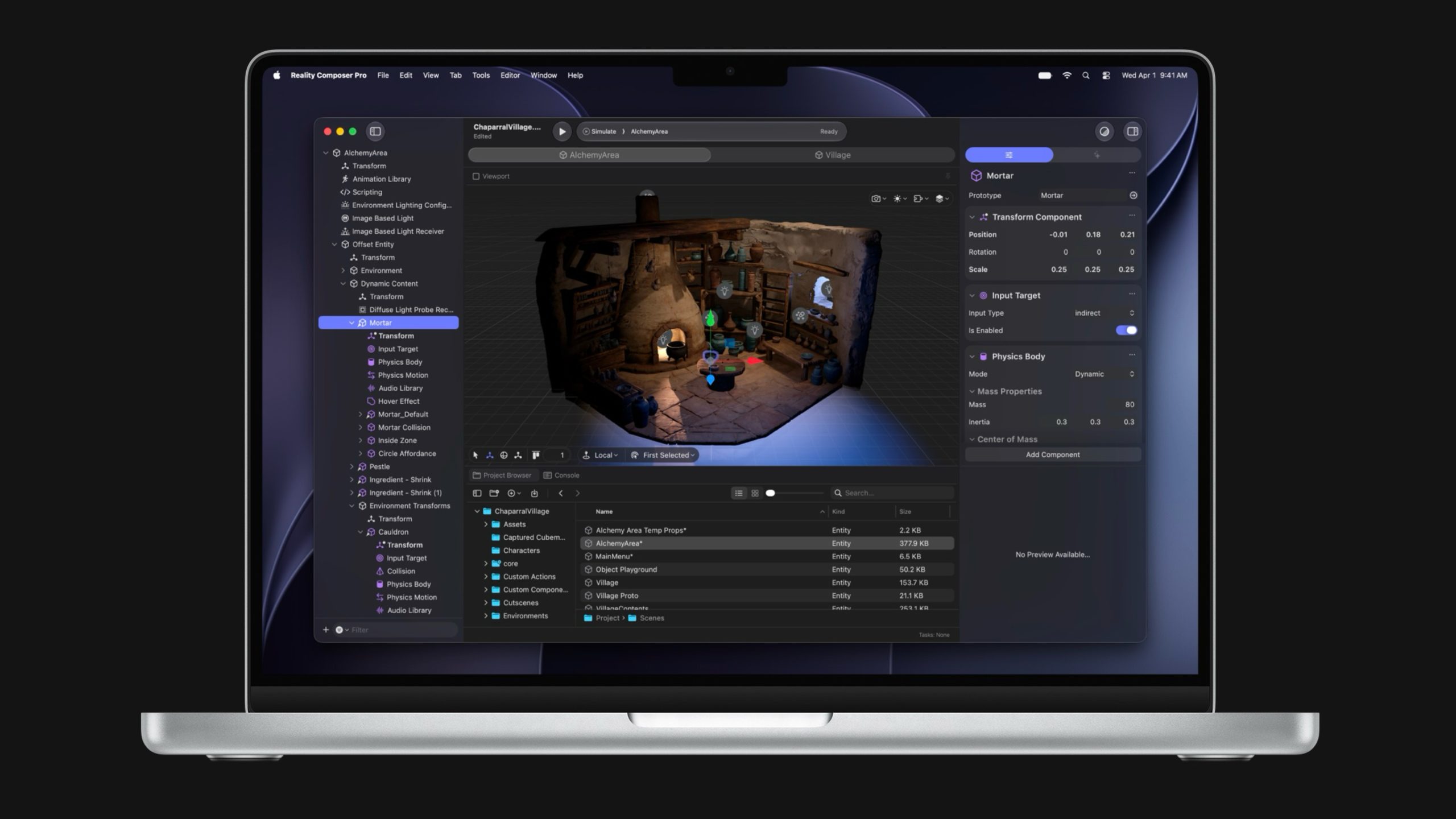
The Digital Trail: Uncovering "The Machinery" in Apple's Code
The initial spark of this revelation came from Nicolás Alvarez, a sharp-eyed observer who delved into the code of Reality Composer Pro 3 beta. What he found, and what MacRumors later confirmed independently, was remarkable. Within the "binaries" – the compiled code that makes software run – of Apple's new tool, there are at least 40 distinct mentions of phrases like "the machinery" or "our machinery."
But these aren't just random words. The code structure, how assets (like 3D models, textures, and sounds) are managed, and the overall design of the database architecture within Reality Composer Pro show striking similarities to what was known about "The Machinery." For those unfamiliar, binaries are the fundamental building blocks of software. Finding specific, repeated identifiers and structural parallels within them is akin to finding a very specific brand of brick and a unique architectural blueprint within a new building that someone claimed was entirely new. It strongly suggests a direct link or shared origin.
This isn't merely a coincidence. The specific ways in which Reality Composer Pro handles content creation workflows – the steps and processes developers use to build their spatial experiences – mirror the distinctive philosophy that "The Machinery" was famous for. This profound connection hints at a deeper integration, suggesting that core components or foundational ideas from the defunct game engine have been woven into the fabric of Apple's latest developer tool. The implications for Apple Vision Pro content creation are significant, potentially providing developers with a highly optimized and sophisticated foundation that might otherwise have taken years to build from scratch.
The Rise and Sudden Fall of "Our Machinery"
To truly appreciate the significance of this discovery, we need to understand "The Machinery" itself. This project was developed by a company called Our Machinery, formed by a group of highly respected veterans from the Bitsquid game engine. Bitsquid was known in the gaming world for its robust design and efficient performance, earning a loyal following among game programmers who valued its pragmatic approach to engine development. When these experienced developers formed Our Machinery, the industry took notice.
"The Machinery" quickly garnered a devoted following for its "unconventional approach to content creation workflows." In the complex world of game development, creating content—from designing levels to animating characters and programming interactions—can be a fragmented and time-consuming process. Traditional game engines often separate these tasks, requiring developers to switch between different tools, deal with slow compilation times, and manually manage dependencies between various parts of a project.
"The Machinery" aimed to revolutionize this. Instead of a patchwork of disparate systems, it envisioned a unified environment where every piece of a project, from the smallest texture to the largest level, was interconnected and dynamically managed. This promised faster iteration, fewer errors, and a more intuitive creative process. For engine programmers, who often grapple with the intricacies of building robust and flexible tools, "The Machinery's" vision was both inspiring and highly practical. It represented a new paradigm, a fresh way of thinking about how games and interactive experiences could be built, pushing the boundaries of what was considered efficient and elegant in game development.
And yet, despite its innovative promise and growing community, "The Machinery" disappeared without a trace in 2022. The project was abruptly shut down, leaving many developers puzzled and disappointed. Its sudden demise was a significant blow to those who had followed its progress, admired its unique approach, and hoped to leverage its capabilities for their own projects. The absence of any clear explanation for its cancellation only added to the mystery, making its reappearance within Apple's ecosystem all the more surprising and intriguing.
"The Truth": A Database-Driven Revolution for Spatial Content
At the heart of "The Machinery's" innovative design was a system known as "The Truth." This wasn't just a catchy name; it represented a fundamental shift in how development projects could be managed. "The Truth" was a database-driven architecture designed to unify every aspect of a project: assets, objects, dependencies, and the editor's current state. Imagine a single, interconnected brain for your entire creative project, where every piece of information is stored, linked, and instantly accessible.
This concept is incredibly powerful, especially for complex, interactive experiences like those built for the Apple Vision Pro. Many of the same powerful concepts from "The Truth" are now showing up in Apple's latest Reality Composer Pro release, which was unveiled during WWDC 2026. Let's break down some of these key ideas and why they are so valuable for spatial computing development:
Reusable Prototypes: Building Blocks for Efficiency
Reusable prototypes are like advanced templates or blueprints. Instead of creating every single item from scratch, developers can design a "prototype" – for example, a virtual chair with specific materials and interactive properties – and then use that prototype repeatedly throughout their scene. If they later decide to change the color of the chair or add a new interaction, they only need to modify the prototype, and every instance of that chair in the entire project updates automatically. This saves an enormous amount of time and ensures consistency across large, intricate spatial environments. For Vision Pro developers, this means faster level design, easier asset management, and the ability to experiment with different variations of objects without starting over each time.
Live Editing: Instant Feedback, Faster Creation
Live editing means that changes made in the development environment are immediately visible in the virtual or augmented world, without needing to compile or restart the application. This is a game-changer for spatial computing. Imagine moving a virtual object in your Reality Composer Pro scene and instantly seeing it shift in the Vision Pro's simulated environment. Or adjusting a light source and immediately observing its effect on the shadows and reflections. This instant feedback loop dramatically speeds up the creative process, allowing developers to fine-tune placements, animations, and interactions with unprecedented fluidity. It transforms development from a series of discrete steps into a continuous, flowing creative act, which is particularly crucial for crafting experiences that need to feel intuitive and natural in three dimensions.
Asset Dependency Tracking: Keeping Your Project Organized
In any complex project, assets depend on other assets. A 3D model might use specific texture files, and an animation might rely on a character rig. Asset dependency tracking automatically keeps track of these relationships. If a texture file is updated or moved, the system knows exactly which 3D models it affects. This prevents broken links, missing assets, and countless headaches for developers. For Vision Pro experiences, where scenes can contain hundreds or thousands of interconnected elements, robust dependency tracking is essential for maintaining project integrity, simplifying updates, and collaborating effectively within a team. It's the difference between a meticulously organized library and a chaotic pile of books.
Rapid Iteration Workflows: Experimentation at Speed
When combined, reusable prototypes, live editing, and asset dependency tracking create what are known as rapid iteration workflows. This means developers can quickly try out new ideas, make changes, see the results, and refine their work in a continuous cycle. Instead of spending hours or days on a single change, they can experiment with different designs, interactions, and layouts in minutes. This speed of iteration is critical for any emerging platform, especially spatial computing, where best practices are still being established. It empowers developers to be more experimental, innovative, and ultimately, to create higher-quality and more engaging experiences for Apple Vision Pro users.
The fact that these concepts, which align so closely with "The Machinery's" core philosophy, are appearing in Reality Composer Pro, alongside direct code references, strongly confirms the connection. It suggests that Apple has not just adopted a few ideas, but potentially a foundational architectural approach that could significantly enhance the power and flexibility of its spatial computing development tools.
The Human Element: Tricia Gray's Journey to Apple
The links between "The Machinery" and Apple's Reality Composer Pro aren't just confined to lines of code; they extend to the people behind the innovation. A significant piece of this puzzle is Tricia Gray, who served as the co-founder and CEO of Our Machinery. Her leadership was instrumental in shaping "The Machinery's" vision and guiding its development.
Today, Tricia Gray holds a prominent position on Apple's spatial computing developer tools team. This fact is clearly visible on her LinkedIn profile, providing a direct human connection that reinforces the technical findings. It’s one thing for code patterns to be similar; it’s another entirely when key personnel responsible for creating that original code are now working on the project that exhibits those similarities.
This personnel link offers a strong indication that the transfer of knowledge and expertise might have been a deliberate strategy. Bringing in individuals with deep experience in innovative content creation workflows and a unique engine architecture could provide Apple with an invaluable advantage. Tricia Gray's presence suggests that Apple isn't just borrowing fragments but potentially integrating the very thought process and design philosophy that made "The Machinery" so groundbreaking. This kind of talent acquisition is a common way for large technology companies to rapidly advance their capabilities in new and complex domains, and spatial computing is certainly one such frontier. Her insights into building a highly efficient, unified content creation pipeline would be directly applicable to developing robust tools for the Apple Vision Pro.
Unraveling the Mystery: Licensing, Acquisition, or Inheritance?
While the connection between "The Machinery" and Reality Composer Pro 3 beta seems undeniable, the exact nature of how this technology found its way into Apple's hands remains unclear. There are several possibilities, each with its own implications:
Licensing the Technology
One possibility is that Apple licensed the technology from Our Machinery, or from whoever held the intellectual property after the company ceased operations. Licensing means Apple would pay a fee to use "The Machinery's" code, patents, or core ideas without fully owning them. This is a common practice in the tech industry, allowing companies to integrate specialized solutions without having to develop them from scratch. If this is the case, it suggests Apple recognized the inherent value and sophistication of "The Machinery's" architecture and sought to legally incorporate it into their own tools. This would imply a strategic decision to leverage proven, cutting-edge technology for the demanding requirements of spatial computing.
Acquiring the Company or Its Assets
Another, more substantial, possibility is that Apple acquired Our Machinery or its core assets. An acquisition would mean Apple fully bought the company, its intellectual property, patents, and potentially even retained some of its key talent. This would explain not only the presence of the code traces but also Tricia Gray's subsequent employment at Apple. Acquiring the assets would grant Apple complete ownership and control over "The Machinery's" innovations, allowing for deeper integration and bespoke modifications without ongoing licensing agreements. For a project as ambitious and foundational as Reality Composer Pro, a full acquisition of valuable IP could be a very appealing strategy for Apple to accelerate its development. This scenario also provides a more complete explanation for the abrupt shutdown of "The Machinery" itself, suggesting that the project might not have truly "ended" but rather transitioned into a new phase under Apple's wing.
Inheriting Through Talent Acquisition
A third, more subtle, explanation involves inheritance through talent acquisition. Even if Apple didn't license or acquire "The Machinery" outright, bringing key personnel like Tricia Gray onto the spatial computing developer tools team could naturally lead to the adoption of certain architectural patterns, design philosophies, and even specific code snippets or methodologies that these individuals were intimately familiar with. When experienced engineers and architects join a new project, they often bring with them the best practices and innovative solutions from their previous work. In this scenario, the traces of "The Machinery" might represent the natural evolution and application of its groundbreaking ideas by its original creators within a new environment. This would still be incredibly valuable to Apple, as it imports not just code but institutional knowledge and a proven approach to complex development challenges.
Regardless of the exact mechanism, the consistent presence of "The Machinery's" identifiers throughout Apple's code strongly suggests that at least some of the project's foundational ideas, if not large portions of its architecture, have found a new home within Apple's spatial computing development toolset. This represents a significant endorsement of "The Machinery's" original vision and its potential to shape the future of immersive content creation.
Why This Discovery Matters for Apple Vision Pro and Spatial Computing
The integration of "The Machinery's" DNA into Reality Composer Pro is a monumental development for the Apple Vision Pro ecosystem and the broader field of spatial computing. Building experiences for devices like Vision Pro presents unique challenges that traditional 2D app development simply doesn't encounter. Developers must craft seamless, interactive 3D environments that feel natural and responsive to users in real space. This demands highly efficient tools capable of handling complex geometry, dynamic lighting, realistic physics, and sophisticated user interactions, all while maintaining high performance.
"The Machinery's" focus on unified content management, rapid iteration, and efficient workflows directly addresses these challenges. By adopting these advanced content creation workflows, Apple is essentially giving Vision Pro developers a powerful head start. They can leverage tools that are designed for maximum efficiency and flexibility, allowing them to:
- Achieve Higher Visual Fidelity: The ability to manage complex assets and dependencies cleanly means developers can create more detailed and visually stunning virtual worlds without getting bogged down by technical debt.
- Enhance Performance: A well-engineered underlying architecture can lead to more optimized applications, ensuring smooth performance on the Vision Pro, which is crucial for preventing motion sickness and providing truly immersive experiences.
- Accelerate Development Cycles: Live editing and rapid iteration workflows mean developers can test ideas, make changes, and refine their experiences far more quickly than before. This is vital in a rapidly evolving field like spatial computing, where innovation is key.
- Foster Greater Creativity: When technical hurdles are minimized, developers are freed to focus more on creative design and innovative interactions, pushing the boundaries of what's possible in spatial computing.
- Facilitate Collaboration: A unified, database-driven approach to content management simplifies team collaboration, allowing multiple developers and artists to work on the same project more efficiently and with fewer conflicts.
In essence, this move could significantly lower the barrier to entry for creating high-quality spatial content while simultaneously raising the ceiling for what professional developers can achieve. It demonstrates Apple's commitment to providing best-in-class tools for its platform, recognizing that the success of the Apple Vision Pro hinges not just on the hardware, but on the richness and quality of the experiences available to users. By integrating the innovative spirit of "The Machinery," Apple is signaling that it intends for Vision Pro to be a platform for truly groundbreaking spatial applications.
The Abrupt End and Unexpected Rebirth of a Vision
The story of "The Machinery" is, in many ways, a testament to the unpredictable nature of the technology industry. Its development ended so suddenly in 2022, catching many developers off guard. The project had a vocal and passionate community, and its cancellation was met with widespread disappointment. Developers who had invested time in learning its unique philosophy or were eager to use it for their own projects found themselves facing an abrupt dead end, often told to delete all source code, which further intensified the sense of loss and finality.
For a project with such promise and a devoted following to simply vanish was a blow to the indie game development scene and the broader engine community. It felt like a truly innovative vision had been extinguished prematurely, leaving behind a void of "what could have been."
This discovery, therefore, acts as an unexpected rebirth. It transforms what seemed like a definitive end into a surprising continuation, albeit in a new form and under a new banner. The spirit of "The Machinery" has not been lost; instead, its foundational principles and possibly even its core technology have been re-contextualized for a new frontier: spatial computing. It’s a compelling narrative of how innovation can persist and evolve, even when the original project faces an unforeseen conclusion. The ideas that were once celebrated but then lost are now resurfacing within one of the most exciting and talked-about new technological platforms, carrying the potential to influence a new generation of developers and a whole new category of digital experiences. This kind of unexpected resurrection adds a layer of intrigue to Apple's spatial computing strategy, suggesting that they are willing to look beyond conventional solutions and incorporate truly visionary approaches to achieve their goals.
Looking Ahead: The Future of Reality Composer Pro and Spatial Experiences
The integration of "The Machinery's" innovative concepts into Reality Composer Pro paints an exciting picture for the future of Apple Vision Pro and spatial computing. Developers can anticipate a more robust, efficient, and creatively empowering toolset. This isn't just about making development easier; it's about enabling the creation of truly groundbreaking spatial experiences that were previously difficult, if not impossible, to achieve with less sophisticated tools.
What can we expect from Reality Composer Pro and the Vision Pro ecosystem in the coming years?
- Sophisticated Applications: The underlying architecture could support more complex scenes, richer interactions, and more persistent virtual content within real-world spaces, pushing the boundaries of what an "app" can be.
- Faster Innovation Cycles: With rapid iteration workflows, developers will be able to experiment and innovate at a much quicker pace. This will lead to a faster evolution of spatial design patterns and user experiences, creating a dynamic and rapidly improving platform.
- Higher Quality Experiences: More efficient tools mean developers can dedicate more time to polish, optimization, and creative details, resulting in higher quality, more engaging, and more comfortable experiences for users.
- Competitive Edge for Apple: By providing developers with arguably one of the most advanced content creation toolsets in the spatial computing space, Apple strengthens its position against competitors. A strong developer ecosystem is crucial for the long-term success of any platform, and cutting-edge tools are a powerful magnet for talent.
- Evolving Best Practices: The philosophical underpinnings of "The Machinery" – a unified, data-driven approach – could influence how spatial content is conceptualized and built across the industry, potentially setting new standards for efficiency and robustness in AR/VR development.
The implications extend beyond just game development; this is about empowering creators across all industries – from education and design to entertainment and enterprise solutions – to build truly compelling spatial applications. Apple is not just building a device; it is meticulously crafting an entire ecosystem, and powerful developer tools like Reality Composer Pro, infused with the DNA of a visionary project like "The Machinery," are absolutely central to that strategy. The journey of "The Machinery" from an ambitious, independent project to a hidden force within a tech giant's cutting-edge platform is a fascinating narrative, underscoring the enduring value of innovation and expertise.
Conclusion: A New Chapter for a Visionary Project
The discovery of "The Machinery's" traces within Apple's Reality Composer Pro 3 beta is much more than a technical curiosity. It's a compelling story of innovation, disappearance, and a surprising rebirth. It highlights Apple's strategic approach to spatial computing, demonstrating a willingness to integrate proven, cutting-edge technologies to accelerate the development of its Vision Pro platform.
For developers, this means Reality Composer Pro likely comes with a highly sophisticated and efficient foundation, inheriting the pioneering ideas that made "The Machinery" so admired. Concepts like reusable prototypes, live editing, and robust asset dependency tracking are not just buzzwords; they are powerful features that streamline workflows and unlock new creative possibilities for building the immersive experiences of tomorrow.
As Apple continues to push the boundaries of spatial computing with the Vision Pro, the hidden legacy of "The Machinery" promises to play a significant role. It ensures that the tools available to creators are not only intuitive but also deeply capable, setting the stage for a new era of digital interaction and immersive content. The mystery of "The Machinery's" sudden end now finds a compelling resolution, as its innovative spirit lives on, helping to build the future, one spatial experience at a time.
This article, "Apple's Latest Vision Pro Tool Contains Traces of Defunct Game Engine 'The Machinery'" first appeared on MacRumors.com
Discuss this article in our forums
from MacRumors
-via DynaSage
