Apple's Claris Testing 'Harbor' App for Local AI on Macs
The Apple Claris Harbor app is an innovative new application designed to turn Apple silicon Macs into private, local artificial intelligence servers. By using high-speed Thunderbolt 5 connections and unified memory pooling, this software lets users download and run large open-weight AI models locally without relying on cloud services.
Artificial intelligence is transforming how individuals and businesses process information. However, sending sensitive personal or corporate data to cloud-based servers creates potential security risks and ongoing operational costs. The Apple Claris Harbor app offers a compelling local alternative for hardware built on Apple silicon.
What Is the Apple Claris Harbor App?
Apple's subsidiary Claris is currently testing an app called Harbor, which converts an Apple silicon Mac into a dedicated, private AI inference server. Instead of sending processing requests across the internet to distant data centers, all compute tasks take place directly on the local machine.
The primary advantage of this architecture is total data privacy. When running local AI workloads through Harbor, your data never leaves your hardware, and nothing reaches the cloud. This provides peace of mind for privacy-conscious users, developers, and corporate entities.
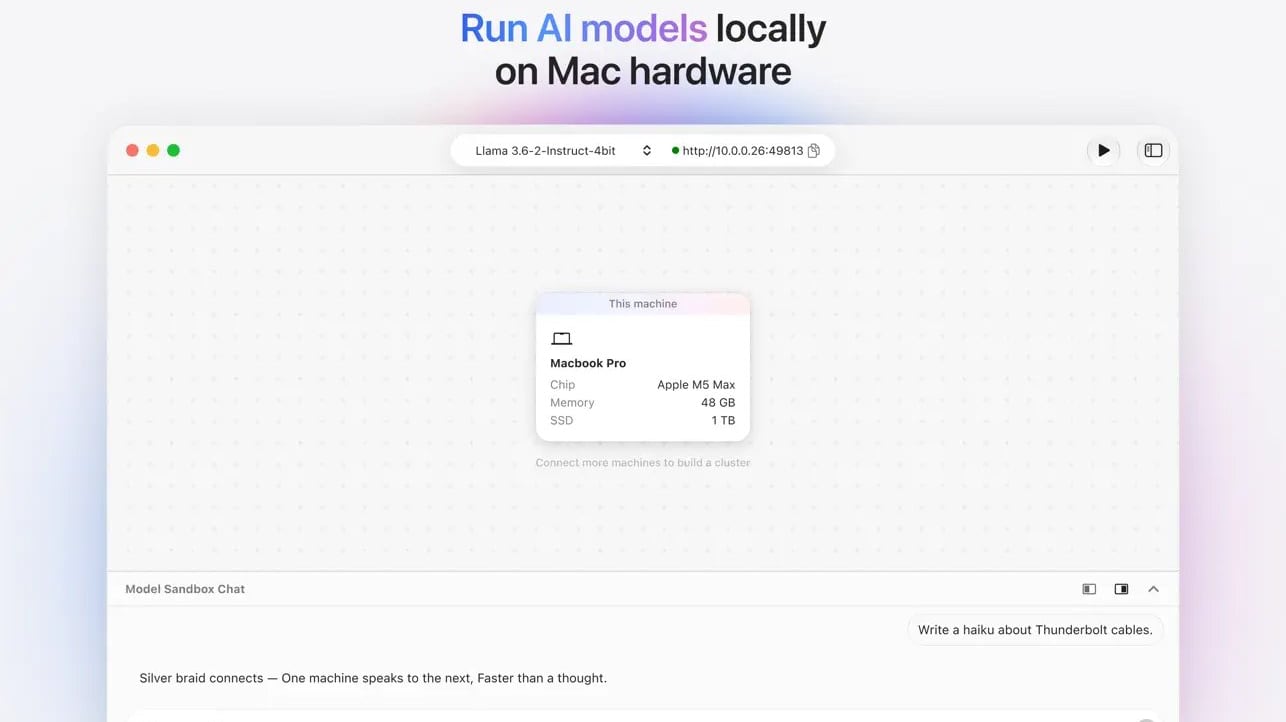
While Harbor operates effectively on a single Mac computer, its real strength lies in its ability to cluster multiple systems together. By connecting two or more Macs over high-speed physical cables, the application pools hardware resources to handle tasks that would normally overload a single machine.
This capability is made possible through Thunderbolt 5 technology. Apple added Remote Direct Memory Access (RDMA) over Thunderbolt 5 starting with macOS Tahoe 26.2, significantly boosting hardware cluster speeds and reducing data transfer latency between connected machines.
Key Features of Apple's Local AI Server Software
The Apple Claris Harbor app is designed to remove the technical hurdles usually associated with self-hosting open-source artificial intelligence. Historically, running local language models required terminal commands, complex python environments, and manual hardware configuration. Harbor replaces all of that with a clean graphical user interface.
- Instant Cluster Setup: Automatically detects devices linked via Thunderbolt 5 to form a multi-Mac cluster instantly.
- Unified Memory Pooling: Combines the unified RAM of multiple Apple silicon computers into one large inference pool.
- Integrated Model Store: Allows users to browse, download, and execute open-weight AI models directly inside the app interface.
- Zero Cloud Reliance: Ensures all processing operations stay strictly on local hardware to guarantee maximum data security.
- No Infrastructure Expertise Needed: Works straight out of the box with zero command-line input or advanced server management required.
According to documentation from Claris, the goal of Harbor is to streamline complex network hardware setup into a fast process that takes minutes rather than hours. Users can simply plug in their machines, start the software, and begin running AI workloads immediately.
Harbor turns your Mac into a private AI inference server. Run open-weight models locally on Apple silicon - your data never leaves your hardware, and nothing reaches the cloud. Connect multiple Mac computers over Thunderbolt 5 to pool unified memory, enabling large models and higher concurrency than a single computer can handle alone.
Set up in minutes, not hours. Harbor automatically detects your devices over Thunderbolt 5 to form a cluster. Plug in, start, and you are running - no manual configuration, no command line, no infrastructure expertise required.
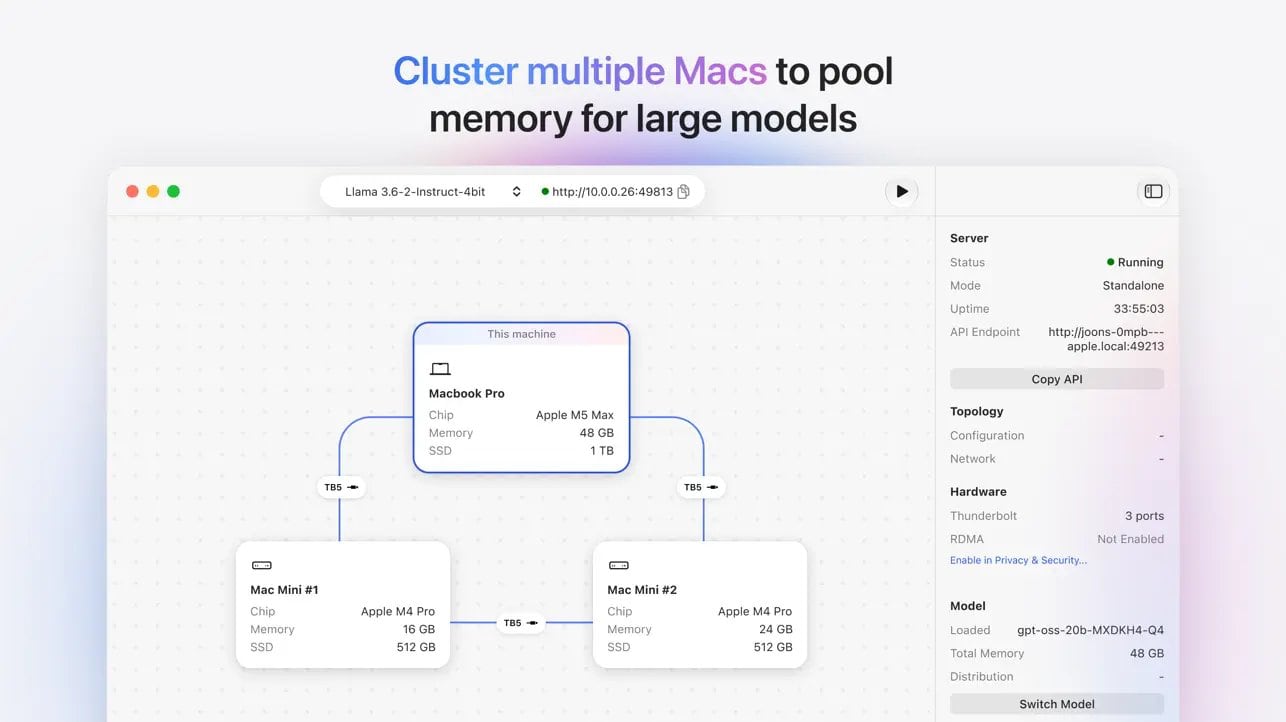
Download and run models directly. Browse, download, and load open-weight models from within the app. Harbor handles model management so you can focus on the work, not the setup.
Cluster for scale. Connect two or more Thunderbolt 5-capable Mac computers and Harbor pools their unified memory into a single inference resource. Run models that exceed any single computer's capacity, or serve more concurrent requests across your cluster.
How Thunderbolt 5 Mac Clustering Works
To understand why the Apple Claris Harbor app is significant, it helps to examine how hardware clustering operates. Running complex artificial intelligence models requires massive amounts of random-access memory (RAM) and heavy graphics processing power. When a model's size exceeds the available memory of a single computer, the system slows down or fails to load the model completely.
Apple silicon utilizes a unique unified memory architecture, where the CPU, GPU, and Neural Engine share access to the exact same memory pool. By pairing this high-bandwidth internal architecture with Thunderbolt 5, Harbor takes memory sharing standard step further by bridging memory across independent systems.
Thunderbolt 5 delivers bandwidth speeds up to 120 Gbps, enabling rapid data transfers between physical host devices. When combined with RDMA functionality introduced in macOS Tahoe 26.2, connected Mac computers can bypass unnecessary software layers and access each other's memory space directly with extremely low overhead.
Understanding Remote Direct Memory Access (RDMA)
RDMA is a high-performance networking technology that allows one computer to access the memory of another computer without involving the operating system's kernel on either side. This drastically reduces CPU overhead and cuts network transfer latency dramatically.
By bringing RDMA over Thunderbolt 5 to macOS Tahoe 26.2, Apple enabled high-speed device-to-device memory communication. Harbor takes full advantage of this operating system enhancement, linking physical hardware into a unified compute platform that behaves like a single enterprise server.
Benefits of Unified Memory Pooling for Local AI Workloads
Pooling memory across several Mac computers resolves two major limitations of local artificial intelligence hardware: model scale and request concurrency.
- Running Larger AI Models: Advanced open-weight models with tens or hundreds of billions of parameters require vast quantities of VRAM. Linking multiple Macs aggregates their memory, allowing users to run extra-large models locally that would otherwise require expensive cloud server infrastructure.
- Handling Higher Concurrency: When multiple users or applications query an AI server simultaneously, processing speed degrades rapidly on single-machine setups. Memory pooling across a cluster distributes incoming inference requests across multiple compute nodes, ensuring smooth response speeds even under heavy workloads.
Streamlined Model Management and Ease of Use
In addition to hardware clustering, the Apple Claris Harbor app simplifies how users interact with open-source artificial intelligence. The app contains a built-in search and management tool that simplifies how open-weight models are acquired and loaded onto hardware.
Open-weight models are artificial intelligence models whose trained weights and architecture parameters are freely published for public download. While these models offer incredible flexibility, finding, downloading, configuring, and updating them manually can be overwhelming for non-technical users.
Harbor abstracts these technical complexities completely away. Users simply open the software built-in browser, select the desired open-weight model, click download, and initiate inference services. Harbor handles file storage, memory allocation, execution scripts, and cluster distribution automatically behind the scenes.
This automated approach removes traditional technical friction entirely. Users no longer need to spend hours installing Python libraries, configuring CUDA or Metal drivers, setting up virtual environments, or managing terminal flags manually.
Who Is Claris and What Does This Signal About Apple's AI Strategy?
Claris is a long-standing subsidiary of Apple best known for developing FileMaker, an enterprise database software platform designed for business productivity. Because Claris creates products primarily aimed at corporate and enterprise workflows, Harbor's development under the Claris brand provides important hints regarding its target market.
While standard consumer utilities are typically released under Apple's direct branding, enterprise and business-focused tools occasionally originate from Claris. The sign-up page for Harbor explicitly asks users to supply a company name, reinforcing the idea that this software is tailored toward commercial environments, development teams, and corporate IT infrastructure.
At present, it remains unclear how Apple and Claris intend to market the software long-term. Questions remain regarding whether Harbor will be offered as a free software utility bundled with macOS, a stand-alone enterprise purchase, or a subscription service tied to FileMaker database subscriptions.
Regardless of the ultimate pricing model, the development of Harbor demonstrates Apple's growing commitment to local compute power. By encouraging businesses to build private, on-premise AI clusters using Mac hardware, Apple is positioning its silicon desktop lineup as a viable alternative to expensive enterprise cloud subscriptions.
Comparing Harbor to Existing Local AI Solutions
The local AI landscape already features several software choices for Apple silicon Mac owners. To understand where the Apple Claris Harbor app fits into the market, it helps to compare it against existing tools like LM Studio and Exo.
LM Studio: Excellent for Single Macs
LM Studio is a popular, free desktop application that enables users to run local open-weight AI models on single computers. It features a sleek user interface, built-in model search capabilities, and local API server hosting options.
However, LM Studio is limited primarily to single-machine deployments. It lacks native multi-machine clustering features over Thunderbolt connections, meaning users are constrained strictly by the unified RAM of their single computer.
Exo: Open-Source Clustering for Power Users
Exo is an open-source tool built specifically to connect multiple Apple silicon Macs into a unified AI cluster. It lets users combine memory across hardware to run larger AI models without buying high-end enterprise servers.
While Exo is powerful and highly effective, setting it up typically requires command-line interaction, manual configuration, and technical networking setup. This makes it less accessible for standard business users or non-technical enterprise teams.
Harbor: The Best of Both Worlds
The Apple Claris Harbor app effectively combines the smooth graphical user interface of LM Studio with the distributed hardware clustering power of Exo. It bridges the gap between simplicity and raw hardware scaling.
- User Interface: Offers an easy-to-use graphical interface comparable to LM Studio, eliminating command-line complexity.
- Scalability: Provides automatic multi-device clustering like Exo, fully utilizing hardware speed enhancements in macOS Tahoe 26.2.
- Enterprise Focus: Built by Claris with corporate deployments, local security compliance, and zero configuration management in mind.
Current Status and How to Access Harbor
As of right now, Harbor is in early access testing and is not broadly available to the general public. During its initial discovery, an official listing for Harbor appeared briefly on the Mac App Store, though it has since been removed by Apple and Claris.
Access to the early preview is currently gated through a private sign-up page on the Claris web domain. Interested users and organization managers must request early access directly through Claris by providing company details and hardware usage plans.
Because the app relies heavily on features built into recent operating system updates—most notably RDMA over Thunderbolt 5 introduced in macOS Tahoe 26.2—users looking to build local Mac clusters will need modern Apple silicon hardware running updated software releases.
For more ongoing details, original coverage, and community discussions regarding the app, you can read the original article, "Apple's Claris Testing 'Harbor' App for Local AI on Macs" on MacRumors.com, or Discuss this article in their community forums.
Conclusion: The Future of Local AI Servers on Apple Silicon
The Apple Claris Harbor app represents a major leap forward for local artificial intelligence deployments on Mac hardware. By unifying user-friendly open-weight model downloading with Thunderbolt 5 memory pooling, Claris has created a powerful bridge between accessible desktop applications and enterprise computing hardware.
As privacy concerns and cloud hosting fees continue to grow, the ability to effortlessly link Apple silicon Macs into private local AI servers will prove immensely valuable for businesses and creators alike. Whether Harbor releases as a standalone business solution or an integrated part of Apple's enterprise ecosystem, its technology paves the way for scalable, completely private local AI processing.
from MacRumors
-via DynaSage

Post a Comment