M5 vs. M6 Chip Buyer's Guide: How Much Better Really Is M6?
Apple M6 Chip: A Deep Dive into the Next Generation of Apple Silicon
Yesterday, Apple unveiled its groundbreaking M6 chip, marking a significant milestone as its first processor built using the cutting-edge 2-nanometer (2nm) manufacturing process. This new chip also breaks new ground by being the first Apple Silicon design to incorporate three distinct types of CPU cores. But how does this revolutionary M6 chip truly stack up against its predecessor, the M5, which was introduced just last year?
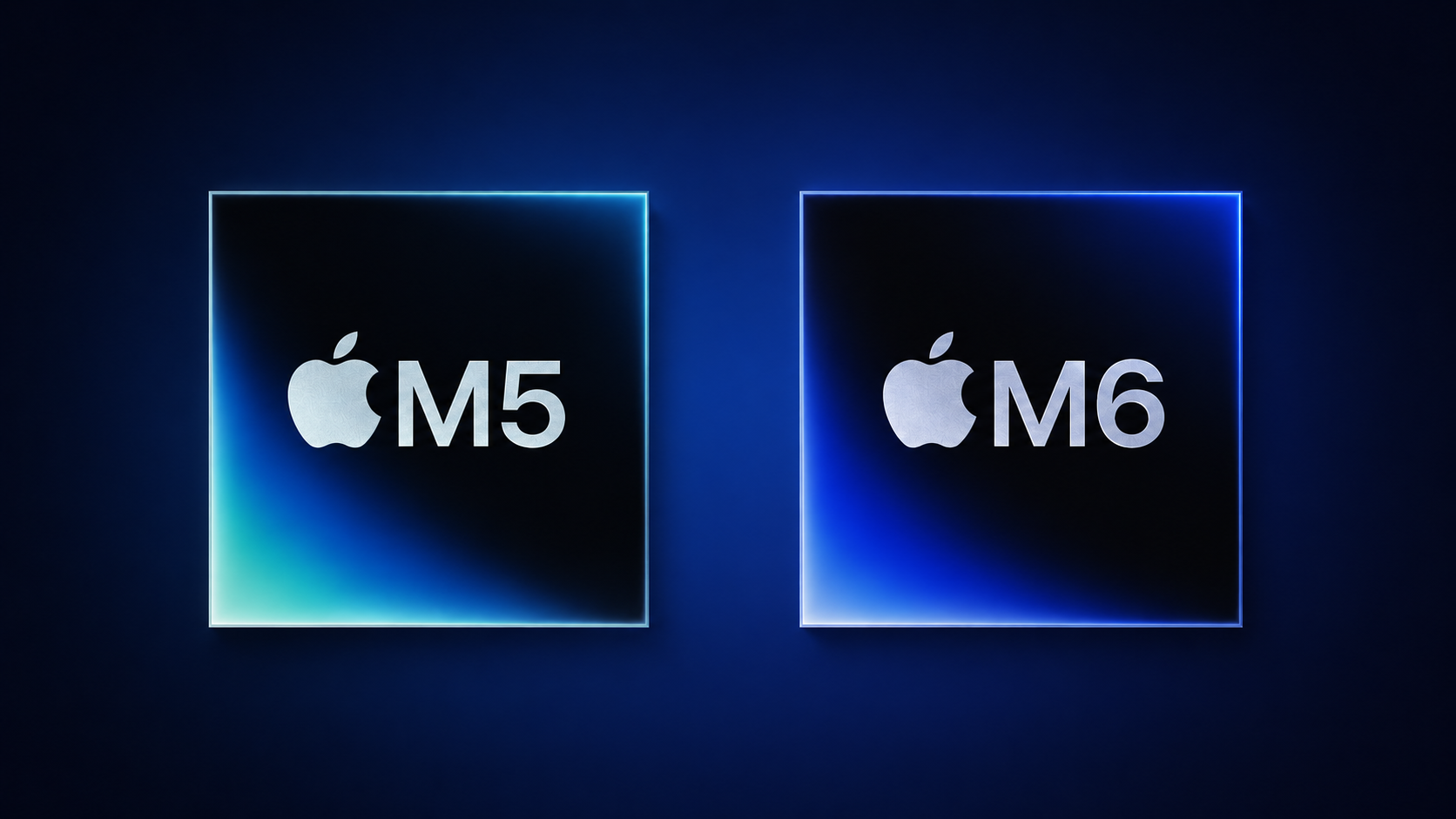
M6 vs. M5: The Performance Leap Explained
When we look at the raw numbers provided by Apple, the M6 chip, launched in August 2026, brings some impressive advancements compared to the M5 chip, which debuted in October 2025. These improvements span across various critical areas, from general processing power to specialized AI tasks and graphics rendering. Understanding these figures helps us grasp the real-world impact of the M6.
- Up to 1.2x Faster Multithreaded CPU Performance: This means that for tasks that can utilize multiple processing cores at once – such as video editing, complex software compilation, or running multiple applications simultaneously – the M6 chip can handle them up to 20% faster than the M5. This isn't a monumental leap, but a solid improvement for demanding workloads.
- Nearly 30% Higher Peak GPU Compute for AI: The Graphics Processing Unit (GPU) in the M6 sees a substantial boost in its ability to handle Artificial Intelligence (AI) calculations. This is crucial for applications that leverage machine learning models, like advanced photo and video editing features, AI-powered productivity tools, and local large language models (LLMs). A 30% increase indicates a significant improvement for these emerging AI-centric workflows.
- Up to 2x Peak Neural Engine Compute: The Neural Engine is Apple's dedicated hardware for machine learning and AI tasks. A doubling of its peak compute power means that AI operations, especially those related to on-device processing like speech recognition, image analysis, and real-time AI effects, can be performed twice as fast. This is a game-changer for enhancing the responsiveness and capability of AI features directly on your device.
- 50% Higher Geometry Rates for Complex Graphics: Geometry rates refer to how quickly a GPU can process the shapes and structures that make up 3D graphics. A 50% increase means the M6 can render more complex scenes, handle more detailed models, and display more intricate visual effects much faster. This directly benefits gaming, professional 3D design, and augmented reality (AR) applications, making experiences smoother and more immersive.
- 10% Higher Unified Memory Bandwidth: Unified memory is a core strength of Apple Silicon, allowing the CPU, GPU, and Neural Engine to access the same pool of high-speed memory efficiently. A 10% increase in bandwidth means that data can flow between these components faster. This reduces bottlenecks and improves overall system responsiveness, especially when dealing with large files or memory-intensive applications. It ensures that all parts of the chip can get the data they need without delay, contributing to a smoother user experience across the board.
Real-World Performance: Benchmarks Beyond Direct Comparison
While Apple provided direct comparison figures against the M5 for specific capabilities, they chose not to release head-to-head real-world benchmarks between the M6 and M5 chips for overall system performance. Instead, the company framed the M6’s performance in its new Mac mini figures by comparing it to older generations, specifically the M4 and the foundational M1 models. This approach allows users to understand the generational leaps more broadly, especially for those upgrading from significantly older hardware.
- Up to 13.5x Faster LLM Prompt Processing in LM Studio versus M1, and up to 4.8x Faster versus the M4: This is a staggering improvement, particularly for tasks involving Large Language Models (LLMs) like those used in AI assistants, content generation, and code analysis. If you're running AI models locally on your device using tools like LM Studio, the M6 offers a monumental speed-up compared to the M1 and a very substantial gain over the M4. This highlights the M6's strong focus on on-device AI acceleration.
- Up to 2.3x Faster Spreadsheet Calculations in Microsoft Excel versus M1, and up to 1.5x Faster versus the M4: For everyday productivity tasks, especially those involving complex calculations in applications like Microsoft Excel, the M6 brings noticeable improvements. While perhaps not as dramatic as the AI benchmarks, a 1.5x to 2.3x speed increase means less waiting and more efficient work for professionals who heavily rely on spreadsheets for data analysis and financial modeling.
- Up to 2x Faster Gaming Performance with Ray Tracing in "Cyberpunk 2077: Ultimate Edition" versus the M4: Gamers have a clear reason to be excited. The M6 delivers double the performance in graphically demanding titles like "Cyberpunk 2077" when utilizing advanced rendering techniques like ray tracing, compared to the M4. This suggests a significant upgrade in the M6's GPU capabilities, providing a much smoother and visually richer gaming experience for the most modern titles. This also points to Apple's continued commitment to making Macs more viable gaming platforms.
Architectural Innovations: The Core of M6’s Power
The M6 chip isn't just faster; it's fundamentally different in its design. Apple has introduced several key architectural changes that contribute to its enhanced performance, particularly in how its CPU operates and how it handles AI workloads.
Introducing "Super Cores": A New CPU Hierarchy
The most significant architectural change in the M6 is found within its Central Processing Unit (CPU). For years, Apple Silicon chips, starting with the original M1, have utilized a core arrangement that divides CPU tasks between "performance cores" (for intensive work) and "efficiency cores" (for background tasks that require less power). The M5 chip continued this trend with ten cores split into these two groups.
The M6, however, adds a groundbreaking third tier: "super cores." These dedicated cores are specifically designed to handle single-threaded workloads. Single-threaded tasks are those that cannot be easily broken down and run across multiple CPU cores. They often rely heavily on the speed and power of a single core. Apple claims these super cores give the M6 the world's fastest single-threaded performance, which is a bold statement with significant implications for a wide range of applications.
Here’s how the M6’s 12-core CPU now works:
- Super Cores: These are the fastest cores, dedicated to single-threaded tasks. Imagine a task that needs to be done sequentially, step-by-step. The super cores excel here, processing these individual steps incredibly quickly.
- Performance Cores: These cores join the super cores for heavier multithreaded work. When a task can be divided into parallel chunks (like rendering a video or compiling large amounts of code), the performance cores work alongside the super cores to get the job done faster.
- Efficiency Cores: These cores are optimized for power savings and handle background tasks that don't require maximum processing power. This ensures that your system remains responsive and energy-efficient, even when idle or performing less demanding activities.
This hierarchical structure allows the M6 to intelligently allocate tasks to the most appropriate core type, maximizing both performance and power efficiency. It's a sophisticated design that aims to deliver optimal performance for every kind of workload, from the most intense single-core applications to complex multi-core computations.
Doubled Neural Engine: Powering the AI Future
Another major transformation in the M6 is the Neural Engine. This dedicated AI hardware has been doubled in capacity. What's even more impressive is that system frameworks are now designed to utilize both engines simultaneously. This means that applications can see a significant boost in the speed of their AI model execution without developers needing to make any specific code changes. This is a crucial step towards making on-device AI not just powerful but also seamlessly integrated and accessible for all applications.
The implications of a doubled Neural Engine are vast. It enables faster and more sophisticated AI features directly on your Mac, such as:
- Real-time processing of complex AI models for video analysis or image enhancement.
- More responsive voice commands and on-device natural language processing.
- Improved accuracy and speed for machine learning tasks in creative and productivity apps.
- Enhanced capabilities for local Large Language Models, allowing users to run more powerful AI assistants or tools without constant cloud reliance.
Other Hardware Enhancements Compared to M5
Beyond the CPU and Neural Engine, the M6 incorporates several other hardware improvements that contribute to its overall performance and efficiency:
| Apple M5 Chip (2025) | Apple M6 Chip (2026) |
|---|---|
| Made with TSMC's third-generation 3nm process (N3P) | Made with TSMC's first-generation 2nm process (N2) |
| FinFET transistors | Gate-all-around nanosheet transistors |
| 10-core CPU with 4 performance cores and 6 efficiency cores | 12-core CPU with 2 super cores, 4 performance cores, and 6 efficiency cores |
| Super cores dedicated to single-threaded workloads | |
| 16-core Neural Engine | Dual 16-core Neural Engine that system frameworks can run simultaneously |
| 10-core GPU with a Neural Accelerator in every core | 12-core GPU with a Neural Accelerator in every core |
| Enhanced shader cores | Updated shader core architecture |
| Second-generation dynamic caching | Third-generation dynamic caching |
| 153 GB/s unified memory bandwidth | 170 GB/s unified memory bandwidth |
The 2nm Process: A Major Manufacturing Breakthrough
Perhaps the most foundational change in the M6 is its transition to a 2-nanometer (2nm) manufacturing process. This isn't just a minor tweak; it's a significant technical leap in semiconductor technology that impacts every aspect of the chip's performance and power efficiency.
From FinFET to Gate-All-Around Nanosheet Transistors
For many years, Apple chips, along with most other high-performance processors, have relied on FinFET (Fin Field-Effect Transistor) technology. FinFET transistors are known for their ability to control current flow very effectively at smaller sizes, reducing power leakage. However, as chips get smaller and smaller, FinFETs start to reach their physical limits.
The M6's N2 process (TSMC's first-generation 2nm technology) introduces a newer, more advanced design: gate-all-around nanosheet transistors. Imagine a traditional transistor as a "fin" sticking up from the chip. With FinFET, the "gate" (which controls the flow of electricity) wraps around three sides of this fin. In a gate-all-around (GAA) nanosheet transistor, the channel (where the electricity flows) is completely surrounded by the gate on all four sides.
Why is this important? This "gate-all-around" design provides even better control over the flow of electrons, which in turn significantly reduces power leakage, especially at the extremely tiny scales of 2nm. This improved control allows for transistors to be packed even more densely, increasing performance, while simultaneously reducing the amount of energy they consume. It's a critical innovation that unlocks the next generation of chip performance and efficiency.
Performance and Power Efficiency Gains from 2nm
TSMC, the world's leading chip manufacturer and Apple's partner, has indicated that its N2 process can offer substantial benefits. Compared to its N3E process (an earlier version of 3nm), N2 can deliver:
- 10-15% more speed at the same power consumption. This means devices can perform tasks faster without draining the battery more quickly.
- Or, alternatively, 25-30% lower power use at the same speed. This translates directly into longer battery life for portable devices like MacBooks and iPads, or cooler operation for desktops like the Mac mini.
It's important to note, however, that the M5 chip already used the more advanced N3P process, which is an improvement over N3E. Therefore, the direct performance and power gains from M5 (N3P) to M6 (N2) are likely to be somewhat smaller than the figures TSMC quotes for N3E to N2. Nevertheless, the move to 2nm and GAA transistors represents a fundamental improvement in the underlying technology, setting the stage for future advancements.
M6: A Broad but Modest Upgrade in Context
When looking at the M6 chip as a whole, it can be characterized as a broad but fairly modest upgrade over the M5. Instead of delivering a dramatic, single-area breakthrough, the M6 refines and improves performance across the board: CPU, GPU, Neural Engine, and memory bandwidth. This comprehensive approach ensures a more balanced and efficient chip.
The M5's most significant leap was in AI-focused GPU performance, thanks to the integration of Neural Accelerators into each GPU core. The M6 continues this trend and builds upon it, but its reported 1.2x multithreaded CPU gain and 10% increase in memory bandwidth are best described as good refinements rather than revolutionary step-changes in overall processing power. These are meaningful improvements that add up to a better experience, but they don't represent a complete overhaul of the core architecture in terms of sheer raw speed across all tasks.
Where the M6 Truly Shines: Single-Threaded Performance and AI
The main exception to the "modest upgrade" narrative lies in single-threaded performance. Many critical tasks cannot be effectively split across multiple CPU cores. These include:
- Code compilation: Developers will notice faster build times for their software projects.
- File indexing: Searching your computer or managing large databases will be quicker.
- Image editing: Certain filters, effects, or processing steps in photo editing software often rely on single-core speed.
- Parts of agentic AI workflows: Some complex AI processes involve sequential decision-making steps that benefit immensely from faster single-core performance.
These types of tasks depend heavily on the raw speed of one core, and this is precisely where the M6's new "super cores" are designed to excel. By dedicating these super-fast cores to single-threaded workloads, the M6 directly addresses a performance bottleneck that has always existed in multi-core chip designs. This is a genuinely impactful change for specific professional and power-user applications.
Furthermore, the doubled Neural Engine is a clear indicator of Apple's strong focus on local AI. For users whose workloads are heavily reliant on AI models – from running advanced creative tools to experimenting with local LLMs – the M6 provides a significant boost. The larger GPU, with its updated architecture and increased core count, also contributes to faster prompt processing for AI applications, making interactions with AI tools more fluid and responsive.
Who Should Upgrade? Navigating the M5 to M6 Decision
For the average user engaging in everyday tasks – browsing the web, checking email, word processing, or light media consumption – the M5 already offers more than enough performance. In these scenarios, the difference between an M5 and an M6 will likely be difficult to perceive. Your current M5-powered device will feel just as snappy and responsive for general use.
Therefore, there is little general-purpose reason for an M5 owner to upgrade to an M6. The M6's gains are more pronounced in specific, demanding workloads, particularly those involving advanced AI, professional creative applications, intensive development tasks, and modern gaming with ray tracing. If your daily routine involves heavy use of these kinds of applications, then the M6 could offer a noticeable advantage, but for everyone else, the M5 remains a powerhouse.
The M6 Lineup Conundrum: A Strategic Shift for Apple Silicon
Perhaps the most consequential question for potential buyers and industry observers alike is where the M6 chip truly fits into Apple’s broader processor strategy. The M6 is not part of a straightforward replacement for the M5 family, which typically includes "Pro," "Max," and "Ultra" variants for higher-performance needs.
Bloomberg's renowned Apple analyst Mark Gurman reported in July that Apple has no intentions of releasing "M6 Pro," "M6 Max," or "M6 Ultra" chips. This marks a significant departure from previous generations, where a full spectrum of variants accompanied each new base chip. This strategic decision suggests that Apple has opted to accelerate the development of the next-generation M7 family, which is expected to be heavily optimized for Artificial Intelligence. This means that if you’re looking for a chip beyond the base M6 tier, you won't find an M6-branded option to fulfill that need.
This point is vividly illustrated by the new Mac mini, which was announced alongside the M6. While the base configuration features the new M6 chip, its higher-specification configuration still uses the M5 Pro. This situation makes the M6 the first of its kind to not have corresponding higher-end variants. Consequently, if your workflows demand anything more than base-tier performance – for example, if you’re a professional video editor, a 3D artist, or a software developer with very large projects – the M5 Pro, M5 Max, and M5 Ultra chips remain the top-tier options currently available from Apple.
This unusual lineup suggests a strategic pivot. Apple appears to be focusing the M6 as a powerful, yet baseline, chip with significant AI enhancements and advanced manufacturing. However, for truly cutting-edge performance and the deepest AI integrations, the company seems to be banking on the M7 generation to deliver a monumental leap that justifies skipping the intermediate "Pro" and "Max" variants for the M6.
The Future is AI: Looking Ahead to the M7
The M6's dual Neural Engine and the move to a 2nm process undoubtedly provide a strong foundation and ample headroom for the increasingly demanding on-device AI tools that are emerging. These advancements ensure that M6-powered devices can comfortably handle current and near-future AI workloads with impressive efficiency and speed.
However, the anticipation for the M7 chip casts a long shadow over the M6's long-term high-end prospects. The M7 is expected to arrive in the first half of 2027 and is rumored to feature even more significant neural processing upgrades, which likely prompted Apple's decision to cut the M6 lineup short. This suggests that the M7 will be the true "AI chip" powerhouse that Apple is gearing up to deliver.
So, if your professional or personal computing needs are so AI-heavy that the M6's significant gains in neural processing and GPU compute truly matter to your workflow, then you might want to consider the timing. The chip specifically designed for exactly those extreme AI demands – the M7 – is less than a year away. For some, waiting for the M7 might be the most strategic move to future-proof their AI-intensive setup.
Availability and Market Position
Currently, the M6 chip is exclusively available in the new Mac mini, which debuted alongside the chip announcement. This desktop machine starts at $899 and is scheduled to begin shipping to customers on September 22. This initial limited availability suggests a controlled rollout, allowing Apple to focus on optimizing the M6's performance within a specific form factor before broader integration.
M6 versions of Apple's popular portable and all-in-one machines, specifically the MacBook Pro and iMac, are expected to be announced in October. This staggered release allows Apple to maintain interest and provide targeted updates for different product categories. It also means that users who prefer laptops or all-in-one desktops will have to wait a little longer to experience the M6’s capabilities.
Meanwhile, the M5 chip continues to be a very capable and current processor in Apple's ecosystem. It remains available in the 14-inch MacBook Pro, the latest iPad Pro, and the revolutionary Apple Vision Pro. For users requiring even more power, the M5 Pro and M5 Max chips are still the workhorses for the higher-end MacBook Pro models. And at the absolute pinnacle of Apple's current silicon offerings, the M5 Max and M5 Ultra chips power the new Mac Studio, providing extreme performance for the most demanding creative and computational tasks. This diverse lineup ensures that Apple offers a chip solution for nearly every user and every level of performance requirement, with the M6 finding its specific niche as a powerful new baseline for the AI era.
This article, "M5 vs. M6 Chip Buyer's Guide: How Much Better Really Is M6?" first appeared on MacRumors.com
Discuss this article in our forums
from MacRumors
-via DynaSage

Post a Comment