iPhone 18 Pro Max Component Costs Could Rise Nearly $300
The Cost of Tomorrow: Why Your Next iPhone 18 Pro Max Could Be Significantly More Expensive
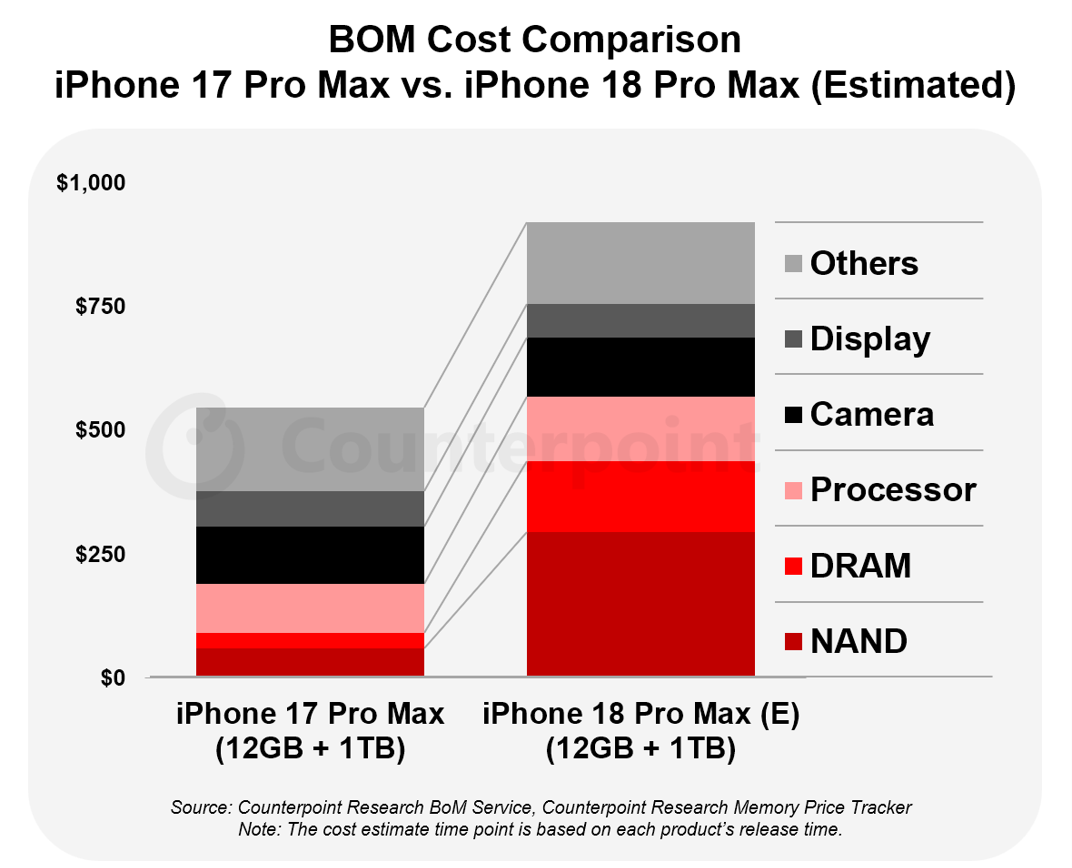
The world of technology is constantly evolving, bringing us innovations that were once considered science fiction. However, this progress often comes with a price, and it appears the highly anticipated iPhone 18 Pro Max is set to be a prime example. Fresh analysis from Counterpoint Research suggests that the bill of materials (BoM) for the upcoming flagship device could jump by nearly $300 when compared to its predecessor, the iPhone 17 Pro Max. This significant increase signals a challenging landscape for both manufacturers and consumers, driven by a confluence of technological advancements and market dynamics.

This projected cost surge is not merely a trivial adjustment; it reflects fundamental shifts in the global supply chain and the escalating demands of cutting-edge technology. For the average consumer, this means that the sticker price for Apple's top-tier smartphone is likely to climb, potentially pushing the boundaries of what many are accustomed to paying for a mobile device. Understanding the factors behind this increase is key to comprehending the future trajectory of premium smartphones.
The Memory Crunch: AI's Impact on Your Next iPhone
At the forefront of these rising costs are memory components, critical elements that power every modern smartphone. Specifically, the analysis points to a dramatic increase in the cost of NAND flash and DRAM. For the 1TB storage model of the iPhone 18 Pro Max, NAND flash costs alone are expected to exceed $250. To put this into perspective, this single component's cost would cover roughly half of the entire estimated component cost for the current iPhone 17 Pro Max. This is an unprecedented jump and a clear indicator of the immense pressure on memory suppliers.
Understanding NAND Flash and DRAM
Let's break down what these memory types are and why they're so vital. NAND flash is the type of non-volatile memory used for your phone's storage. It's where your apps, photos, videos, and all your data are permanently stored, even when the phone is turned off. As phones become more powerful and users capture more high-resolution content, the demand for larger and faster NAND flash storage skyrockets.
DRAM (Dynamic Random-Access Memory), on the other hand, is your phone's primary working memory. It's where the operating system and currently running applications store data they need quick access to. When you switch between apps, browse the web, or play a game, DRAM is constantly at work. More DRAM generally means smoother multitasking and better performance, especially for demanding applications.
The AI Revolution's Ripple Effect
The sharp increase in both NAND flash and DRAM pricing isn't an isolated event; it's a direct consequence of a broader memory chip shortage. This shortage is inextricably linked to the meteoric rise in demand for AI hardware across various industries. Artificial intelligence, particularly advanced machine learning models and large language models, requires colossal amounts of data processing and storage. Data centers worldwide are undergoing massive expansions and upgrades to accommodate the intense computational needs of AI training and inference. These AI data centers consume vast quantities of high-performance memory chips, creating an unprecedented strain on the supply chain.
When demand for a critical component far outstrips its supply, prices naturally surge. Memory manufacturers, who produce chips for everything from smartphones to servers, are allocating a larger portion of their production capacity to meet the lucrative and insatiable demand from the AI sector. This prioritization inevitably leads to tighter supplies and higher prices for consumer electronics manufacturers like Apple. The ripple effect means that the advanced AI capabilities you experience in an iPhone, while powerful, are now part of a larger global market struggle for essential components.
The Heart of Innovation: Apple's 2nm Chip and Its Premium Cost
Beyond memory, another significant driver of the increased bill of materials is Apple's relentless pursuit of processing power. The company's expected transition to a cutting-edge 2nm chip architecture is described as the second-largest contributor to the overall cost increase. The iPhone 18 Pro is rumored to debut the A20 Pro chip, which will likely be manufactured on TSMC's advanced N2 process. This new process node represents a monumental leap in semiconductor technology, promising unprecedented levels of performance and power efficiency.
What Does 2nm Mean?
The "nm" (nanometer) figure refers to the size of the transistors on the chip. A smaller nanometer number indicates that transistors are packed more densely, allowing for more processing power and greater energy efficiency within the same physical space. Moving from the current N3P node (3nm) used for the A19 Pro to N2 (2nm) is not just an incremental step; it's a fundamental engineering challenge. Developing and refining such advanced manufacturing processes requires colossal investments in research, development, and specialized equipment.
Consequently, the N2 process reportedly carries a steep premium in wafer pricing compared to its predecessor. A "wafer" is a thin slice of semiconductor material on which hundreds or thousands of individual chips are fabricated simultaneously. When the cost of these raw wafers increases, so does the cost of each chip produced from them. This isn't just about the raw materials; it's about the precision, complexity, and sheer intellectual capital involved in creating silicon at this microscopic scale.
The Challenge of Early Yields
Furthermore, early in the production cycle of any new, advanced process node, manufacturers often face what are known as "early yield ramp costs." "Yield" refers to the percentage of functional chips produced from each wafer. When a new technology is introduced, the manufacturing process is still being perfected, and the yield of good chips can be lower than with mature processes. This means more wafers need to be processed to achieve the same number of usable chips, effectively adding to the per-unit chip pricing. As the process matures, yields improve, and costs typically stabilize, but for the initial batches of the iPhone 18 Pro Max, these early production challenges will undoubtedly contribute to the higher manufacturing expenses.
Apple's strategic decision to adopt such a bleeding-edge chip underscores its commitment to innovation and maintaining a performance lead in the smartphone market. However, this leadership comes at a significant financial cost, which will ultimately be reflected in the device's retail price.
Balancing Act: Offsetting Factors and Other Component Trends
While memory and the core processor are driving costs up, not every component is following the same trajectory. Counterpoint's analysis indicates that some areas might see cost reductions, partially offsetting the more substantial increases. This reflects the dynamic nature of the electronics supply chain, where certain technologies mature and become more cost-effective over time.
Display Costs: A Potential Silver Lining
According to the research, display costs and other miscellaneous components may actually decline compared to the iPhone 17 Pro Max. This is a common trend in the display industry, where fierce competition among manufacturers, improved production techniques, and economies of scale often lead to lower per-unit costs for mature technologies. Even as display technology continues to advance, the underlying manufacturing processes for high-quality OLED panels become more efficient over several generations, allowing for potential cost savings. These savings, while not enough to negate the memory and chip increases, provide a slight buffer.
Camera Innovations Drive Modest Increases
On the camera front, costs are expected to rise slightly. This increase is attributed to the introduction of new technology, likely a reference to the rumored variable-aperture main camera for the Pro models. A variable-aperture lens system allows the camera to dynamically adjust the size of its lens opening, much like a traditional professional camera. This capability can significantly enhance photography in various conditions, offering better low-light performance by letting in more light, and more control over depth of field (the blurring of backgrounds) for artistic effects. Such advanced camera systems involve complex mechanical and optical engineering, justifying a slight increase in their component cost. Given that camera quality is a major selling point for premium smartphones, Apple's investment in this area is expected.
The Broader Picture of Miscellaneous Components
Beyond these major categories, a smartphone comprises hundreds of smaller components: batteries, haptic engines, speakers, antennas, various sensors, and the device's chassis. The overall trend for these "miscellaneous" parts can vary. Some, like simpler sensors or connectivity modules, might see slight cost declines due to standardization and high-volume production. Others, especially those incorporating new materials or advanced miniaturization techniques, could see minor increases. The net effect, as Counterpoint suggests, might lean towards a slight reduction, helping to cushion the impact of the memory and processor hikes.
Apple's Recent Price Hikes: A Precedent for the iPhone 18 Pro
The prospect of a more expensive iPhone 18 Pro Max does not come as a complete surprise. The Counterpoint report arrives merely weeks after Apple raised prices on 14 of its products across its lineup. This included every Mac model, most iPad models, the Apple TV, HomePod, HomePod mini, and even the Vision Pro headset. This widespread adjustment in pricing was a clear signal from Apple about the increasing pressures it faces on its supply chain.
The "Supply-Demand Imbalance" Explained
Apple directly attributed these earlier price increases to the very same memory chip shortage cited in the Counterpoint report. The company explicitly stated that a "supply-demand imbalance" driven by AI data center buildouts had made further price adjustments necessary. This explanation underscores the pervasive nature of the AI boom's impact on hardware costs. It's not just a niche market; it's a fundamental shift in how memory chips are prioritized and priced globally.
While iPhone, Apple Watch, and AirPods pricing was left unchanged in that previous round of hikes, industry analysts and leakers widely expect the iPhone 18 Pro lineup to be the next to see an adjustment. The strategic delay could have been to manage public perception, or perhaps to finalize the precise cost implications for the highly anticipated new generation of iPhones. Regardless, the writing appears to be on the wall.
Market Predictions and Analyst Insights on iPhone 18 Pro Pricing
The consensus among industry analysts and financial publications points strongly towards a significant price increase for the upcoming iPhone 18 Pro models. These predictions provide a broader context and further solidify the likelihood of a higher entry point for Apple's next premium smartphone.
The Wall Street Journal's Outlook
For instance, The Wall Street Journal previously reported that the iPhone 18 Pro could start as high as $1,399. This would represent a substantial jump from previous Pro models. The Journal's estimates for specific component costs are equally striking: they projected that Apple's DRAM cost per unit could climb from $39 to $145, and its flash storage cost from $13 to $51. These figures, while different in their exact breakdown from Counterpoint's, tell the same story: memory components are becoming dramatically more expensive.
Adding weight to these concerns, Apple CEO Tim Cook himself told the outlet that the company is "still working through" which devices will see price increases. This statement, while carefully worded, strongly implies that price adjustments are indeed on the table for unannounced products, and the iPhone is undoubtedly Apple's most critical device.
Other Industry Estimations
Further reinforcing this narrative, IDC has estimated a $200 increase specifically for the Pro and Pro Max models. This figure aligns closely with the overall component cost increase identified by Counterpoint Research. Separately, Weibo leakers have suggested that Apple could raise its Chinese starting price for the lineup by approximately 11%. Given the typical pricing strategies in different regions, an 11% increase in a major market like China would translate to a significant dollar increase globally. The convergence of these various sources – research firms, financial publications, and industry insiders – creates a strong consensus that the next generation of Pro iPhones will carry a higher price tag.
Apple's Strategy: Managing Higher Costs and Maintaining Margins
Faced with these significant cost increases, Apple is not expected to simply pass on the full $300 component hike directly to consumers with a flat price raise across all models. Instead, the company is likely to employ a more nuanced strategy to manage higher costs without entirely sacrificing its notoriously healthy profit margins.
Tiered Pricing for Storage Models
Apple is expected to apply different retail price increases across its storage tiers rather than a uniform increase across the entire iPhone 18 Pro lineup. This strategy would concentrate the impact on higher-capacity models. For instance, the entry-level 128GB or 256GB models might see a smaller price increase, or even no increase, to keep the barrier to entry somewhat manageable. However, the 512GB, 1TB, and potentially new higher-capacity models could see more substantial price jumps. This approach is intelligent for several reasons:
- Consumer Psychology: It keeps the "starting price" competitive, even if the higher-end configurations become significantly more expensive. Many consumers are drawn in by the entry price point.
- Margin Protection: Higher-capacity models inherently carry better profit margins for Apple because the cost of additional storage often doesn't scale linearly with the retail price difference. By increasing prices more sharply on these models, Apple can recoup a larger portion of the rising component costs.
- Market Segmentation: It caters to different segments of the market. Users who need maximum storage are typically power users or professionals who are more willing to pay a premium for capacity.
Even with an average $200 retail price rise – which could be distributed unevenly across storage tiers – Counterpoint still expects the iPhone 18 Pro Max to land at a slightly lower gross margin than the iPhone 17 Pro Max achieved in 2025. Gross margin is the profit a company makes after deducting the costs associated with making and selling its products. A slightly lower gross margin, even with a higher retail price, underscores just how much the underlying component costs are eating into Apple's profitability. It highlights the immense pressure Apple is under to innovate while battling increasing supply chain expenses.
Anticipated Launch and the Future of Apple's Lineup
The iPhone 18 Pro and iPhone 18 Pro Max are widely expected to make their debut alongside Apple's highly anticipated first foldable iPhone in the fall. This simultaneous launch could be a pivotal moment for Apple, showcasing its commitment to pushing the boundaries of smartphone design and technology.
The Arrival of the Foldable iPhone
The introduction of a foldable iPhone would mark a significant expansion of Apple's product portfolio and a direct challenge to competitors already in the foldable market. While details about Apple's foldable device remain speculative, its simultaneous launch with the iPhone 18 Pro series could have interesting implications. It might allow Apple to showcase its premium "Pro" traditional smartphone while also signaling its future vision for mobile form factors. It also creates a premium tier above the traditional flagship, potentially making the higher price of the iPhone 18 Pro Max seem less shocking in comparison to a potentially even more expensive foldable device.
Concluding Thoughts: A New Era for iPhone Pricing
In essence, the upcoming iPhone 18 Pro Max is shaping up to be a technological marvel, featuring cutting-edge memory, a revolutionary 2nm processor, and advanced camera systems. However, these innovations come at a substantial cost, amplified by a global memory chip shortage driven by the burgeoning demand for AI hardware. Apple is navigating a complex landscape where the desire to push technological boundaries clashes with rising production expenses.
For consumers, this means preparing for a potentially higher price point for the next generation of Pro iPhones. Apple's strategy of tiered pricing will likely focus the most significant increases on higher-capacity models, aiming to balance profitability with market accessibility. How well Apple manages this delicate act will not only determine the success of the iPhone 18 Pro lineup but also set a precedent for future smartphone pricing in an increasingly technologically advanced and cost-sensitive world. The era of continually innovative, yet potentially more expensive, flagship smartphones appears to be firmly upon us.
This article, "iPhone 18 Pro Max Component Costs Could Rise Nearly $300" first appeared on MacRumors.com
Discuss this article in our forums
from MacRumors
-via DynaSage

Post a Comment