
Apple Tops Global Smartphone Market for First Time in a Q1
Apple Makes History: Crowned World's Number One Smartphone Brand in Q1 2026 for the First Time Ever
In a truly landmark achievement for the technology giant, Apple has seized the top spot as the world's leading smartphone brand by shipments in the first quarter of 2026. This isn't just another quarterly win; it marks an unprecedented milestone for the company, as it's the very first time Apple has ever led the global market in a Q1. The fresh insights, unveiled by leading market research firm Counterpoint Research, paint a compelling picture of Apple's strategic prowess and enduring consumer appeal in a challenging market.

Navigating a Contracting Market: Apple's Remarkable Growth
Apple's ascent to the pinnacle of the smartphone world is made even more impressive when viewed against the backdrop of the overall market. While the global smartphone market actually shrank by 3 percent year-over-year in Q1 2026, Apple defied this downward trend, demonstrating a robust 9 percent growth in its shipments. This contrasting performance underscores the company's resilience and its ability to capture a larger slice of a smaller pie.
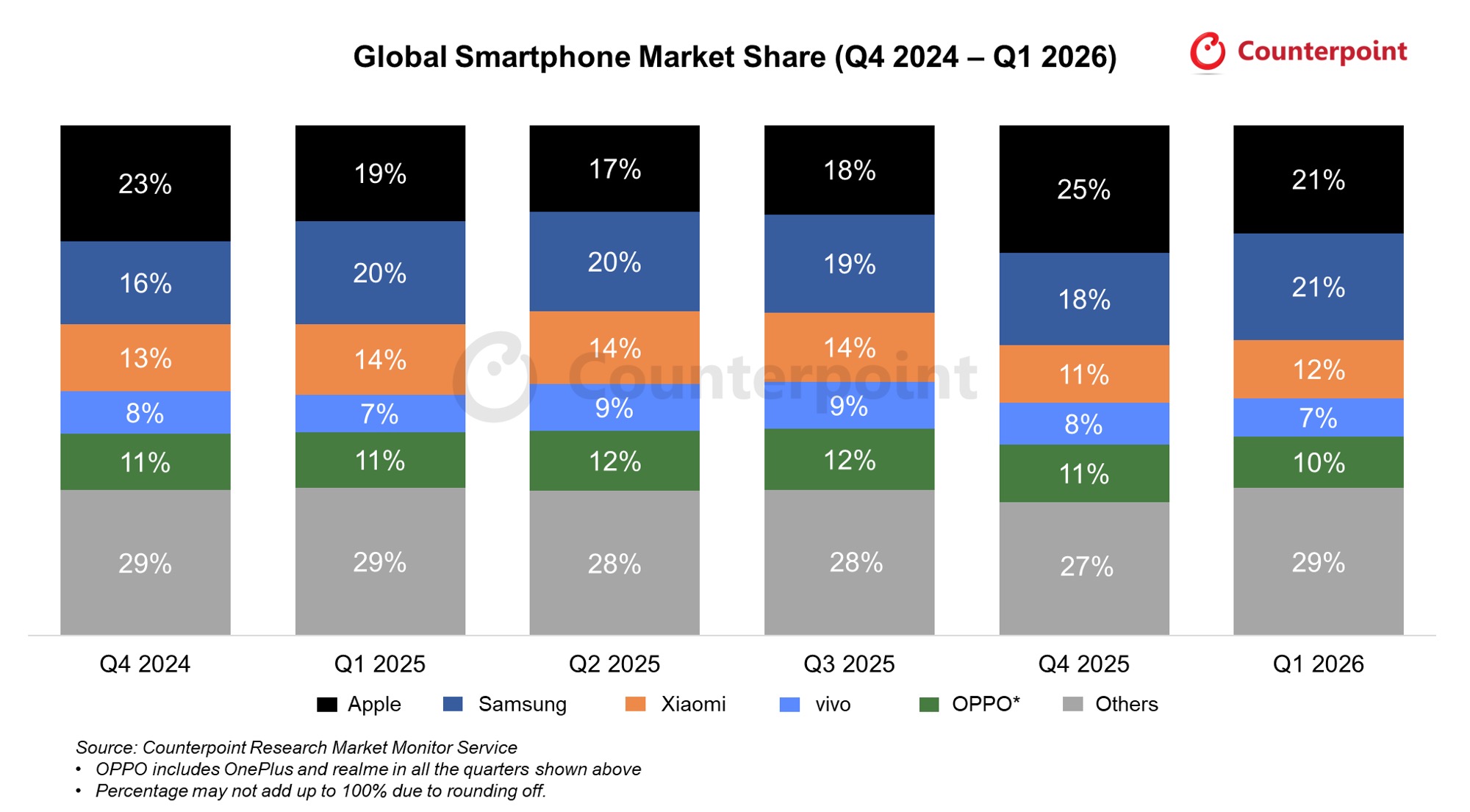
The numbers from Counterpoint Research show Apple commanding a significant 21 percent of global smartphone shipments. Remarkably, Samsung, a perennial powerhouse in the smartphone space, trailed closely, also securing 21 percent of the market share, though its shipments remained roughly flat compared to the previous year. This indicates a fierce battle at the top, but Apple's growth trajectory is what truly sets it apart.
Further down the list, other major players experienced varying degrees of decline. Xiaomi, another global contender, saw its shipments fall by a substantial 19 percent year-over-year, settling at 12 percent market share. OPPO and vivo, both significant forces particularly in Asian markets, also faced contractions, with OPPO declining 4 percent (to 10 percent market share) and vivo seeing a 2 percent drop (to 7 percent market share). These figures highlight the intense competitive pressures and the difficult economic climate that affected many brands, making Apple's growth all the more exceptional.
The Undeniable Power of the iPhone 17 Series
A significant driver behind Apple's record-breaking performance is the phenomenal success of its latest flagship lineup, the iPhone 17. Counterpoint's earlier findings had already hinted at this dominance, revealing that the iPhone 17 was not just a popular model, but the best-selling smartphone model in the world in Q1. This incredible demand wasn't limited to a single variant; the entire iPhone 17 series swept the top three spots in Counterpoint's Global Handset Model Sales Tracker, a clear indication of its widespread appeal and market acceptance.
The iPhone 17's success can be attributed to a combination of factors, ranging from innovative features and superior performance to Apple's robust ecosystem and brand loyalty. In a world increasingly driven by seamless digital experiences, the iPhone 17 likely offered enhancements in areas critical to modern users – perhaps in its camera capabilities, processing power, battery life, or new software functionalities that leveraged artificial intelligence. Consumers, it seems, were willing to invest in a device that promised reliability, cutting-edge technology, and a premium user experience, even amidst economic uncertainties.
This sentiment was echoed directly by Apple's CEO, Tim Cook, during the company's April 30 earnings call. Cook proudly declared that the iPhone 17 family was the most popular lineup in Apple's history. This statement is not merely hyperbole; it represents a significant achievement for a company that has consistently launched groundbreaking products for decades. To achieve "most popular ever" status speaks volumes about the iPhone 17's resonance with the global consumer base, affirming Apple's continued ability to innovate and excite its market.
Apple's Strategic Edge: Beyond Just Product Appeal
While the iPhone 17's allure is undeniable, Counterpoint Research points to several other crucial factors that cemented Apple's brand-level performance. These strategic advantages demonstrate Apple's comprehensive approach to market dominance, extending far beyond just product design and marketing.
Proactive Supply Chain Management: A Shield Against Disruptions
One of the most significant contributors to Apple's success, particularly in volatile times, is its highly effective and proactive supply chain management. In an era marked by global logistics challenges, component shortages, and geopolitical uncertainties, Apple's ability to anticipate, mitigate, and respond to disruptions is unparalleled. This involves a multi-faceted approach:
- Deep Supplier Relationships: Apple cultivates strong, long-term relationships with its component suppliers, often investing in their manufacturing capabilities or securing exclusive deals. This provides a level of preferential access to critical components that many rivals simply cannot match.
- Diversified Sourcing: While Apple has key partners, it also maintains a diversified supplier base for many components. This strategy reduces dependence on any single source, offering flexibility to pivot if one supplier faces issues.
- Inventory Optimization: Apple meticulously manages its inventory levels, balancing the need to have enough components to meet demand with the desire to avoid excess stock. Their advanced analytics and forecasting models allow them to make highly informed decisions about purchasing and production schedules.
- Logistical Efficiency: From raw materials to finished products, Apple's logistics network is incredibly sophisticated. They often use multiple transportation methods and strategically located distribution centers to ensure components arrive at assembly plants and products reach markets efficiently.
- Early Warnings and Risk Assessment: Apple's supply chain team is renowned for its ability to spot potential disruptions far in advance, whether they are related to natural disasters, political events, or raw material shortages. This allows them to implement contingency plans proactively, minimizing impact.
This robust supply chain infrastructure allowed Apple to ensure that enough iPhone 17 units were available to meet the surging demand, even when competitors struggled with manufacturing bottlenecks and component scarcity. It's a testament to years of strategic investment and operational excellence.
Improved Sales in China: A Critical Growth Engine
Another key factor highlighted by Counterpoint is Apple's improved sales performance in China. The Chinese market is not just vast; it's also incredibly competitive and strategically vital for any global tech company. Historically, while Apple has had a strong presence in China, it has also faced stiff competition from formidable local brands. Therefore, an improvement in this market segment is a significant win.
Several elements could have contributed to Apple's enhanced standing in China:
- Premium Brand Appeal: Despite economic slowdowns, there often remains a strong appetite for premium brands among affluent consumers in China. Apple's brand cachet continues to be a powerful draw.
- Targeted Marketing and Localization: Apple may have implemented more localized marketing strategies or features that resonated specifically with Chinese consumers.
- Strong Retail Presence: Expanding its retail footprint, both physical stores and online channels, could have improved accessibility for Chinese buyers.
- Competitor Challenges: While Apple surged, some Chinese brands faced declines. This could have presented an opportunity for Apple to capture market share from local rivals who might have struggled more with supply chain issues or shifting consumer preferences.
- Ecosystem Integration: The Apple ecosystem, including services like the App Store, Apple Pay, and integration with other Apple devices, continues to be a powerful differentiator that appeals to users seeking a cohesive digital experience.
Securing stronger sales in China is not just about revenue; it's about maintaining relevance and influence in one of the world's most dynamic and trend-setting tech markets. Apple's success here demonstrates its adaptability and strategic focus on key international regions.
Premium Pricing and Margin Protection: Weathering the Economic Storm
Finally, Counterpoint credits Apple's ability to maintain premium pricing and protect its profit margins as a crucial element that allowed it to weather the ongoing memory chip shortage far better than its rivals. This strategy is a cornerstone of Apple's business model:
- High Perceived Value: Apple products are consistently positioned at the higher end of the market. Consumers are often willing to pay a premium for what they perceive as superior design, build quality, software experience, and brand status. This creates pricing power.
- Strong Profit Margins: By selling devices at higher prices and maintaining strict cost controls, Apple typically enjoys healthier profit margins than many of its competitors, especially those focused on budget or mid-range devices where margins are razor-thin.
- Flexibility During Component Shortages: When component costs (like memory chips) inevitably rise due to shortages, companies with wider profit margins have more room to absorb these increased costs without significantly impacting their profitability or having to pass on drastic price hikes to consumers immediately. Brands operating on tight margins have little buffer and are forced to either cut into their profits significantly or raise prices, potentially losing customers.
This financial resilience allows Apple to maintain stability and continue investing in R&D, marketing, and supply chain improvements, even during periods of economic strain and supply chain instability. It's a virtuous cycle that reinforces its market leadership.
The Persistent Shadow of the Memory Chip Shortage
Despite Apple's impressive performance, the global smartphone market continues to grapple with a significant challenge: persistent shortages of DRAM and NAND memory chips. These components are the unsung heroes inside every smartphone, crucial for everything from running apps smoothly (DRAM) to storing photos, videos, and operating systems (NAND).
What are DRAM and NAND, and Why are They Critical?
- DRAM (Dynamic Random-Access Memory): This is the "working memory" of your smartphone. It's used to store data that the processor needs to access quickly. The more DRAM your phone has, the more apps you can run simultaneously without slowdowns, and the faster it can switch between tasks. Without sufficient DRAM, a phone's performance can become sluggish and frustrating.
- NAND (Negative-AND) Flash Memory: This is the "storage memory" where all your data – your operating system, apps, photos, videos, and documents – resides. It's non-volatile, meaning it retains data even when the power is off. The capacity of NAND memory determines how much content you can store on your device.
Both types of memory are fundamental to the operation and performance of modern smartphones. A shortage in either directly impacts manufacturers' ability to produce devices and can lead to increased costs.
AI Data Centers: The New Memory Hogs
The current memory shortage is exacerbated by an unprecedented demand from another booming sector: AI data centers. The rapid advancements in artificial intelligence, particularly large language models (LLMs) and complex machine learning algorithms, require enormous amounts of high-performance DRAM and NAND memory. These data centers are the backbone of cloud computing and AI services, and their need for memory far outstrips that of individual smartphones.
Chipmakers, facing limited production capacity and higher profit margins from these enterprise customers, are naturally prioritizing AI data center clients over smartphone manufacturers. This strategic shift means that less memory is available for phone production, driving up prices and creating bottlenecks for the entire smartphone industry.
Impact on the Broader Market and Apple's Future Outlook
The consequences of this prioritization are already being felt across the market. Cook himself acknowledged that memory shortages and rising costs would have a more significant impact on Apple later in 2026. While Apple's proactive supply chain management and strong margins provided a buffer in Q1, even a company of its scale cannot entirely escape the long-term effects of a widespread component shortage.
Counterpoint Research expects the rest of 2026 to be challenging for most brands, with the memory crisis potentially stretching all the way into late 2027. This prolonged period of scarcity has several implications:
- Price Increases: Manufacturers may be forced to pass on increased component costs to consumers, leading to higher smartphone prices.
- Supply Constraints: Even popular models might face longer wait times or limited availability if production is hindered by memory shortages.
- Innovation Slowdown: With focus shifting to securing basic components, some manufacturers might reduce investment in cutting-edge features or experimental designs that require new or specialized memory configurations.
- Uneven Impact: Brands with less financial flexibility and weaker supply chain relationships are likely to be hit harder, potentially losing market share or struggling to meet demand.
For Apple, while its strong position offers some protection, a persistent shortage could still impact its ability to meet peak holiday demand, potentially affecting its financial results in subsequent quarters. It highlights that even the most dominant players are not immune to global supply chain pressures.
Looking Ahead: The Evolving Smartphone Landscape
Apple's historic achievement in Q1 2026 is a clear indicator of its enduring strength, strategic foresight, and the continued appeal of its ecosystem. The success of the iPhone 17 series, coupled with robust supply chain management and strong performance in key markets like China, allowed Apple to not only defy a contracting market but to lead it for the first time in a Q1.
However, the road ahead remains fraught with challenges, primarily the looming and prolonged memory chip shortage. The industry will need to adapt to these new realities, with companies like Apple having to leverage their financial might and operational efficiency to navigate the scarcity. The coming quarters will reveal whether Apple can sustain its lead or if other brands can regroup amidst these global headwinds.
The smartphone market is a dynamic arena, constantly shaped by technological innovation, economic shifts, and supply chain complexities. Apple's Q1 2026 performance serves as a powerful reminder that in this highly competitive landscape, strategic planning, product excellence, and operational resilience are paramount to achieving and maintaining leadership.
This article, "Apple Tops Global Smartphone Market for First Time in a Q1" first appeared on MacRumors.com
Discuss this article in our forums
from MacRumors
-via DynaSage
