Apple Tops 2025 Smartphone Market With 20% Share, 10% Growth
Apple Dominates the Global Smartphone Market in 2025: A Deep Dive into Its Record-Breaking Year
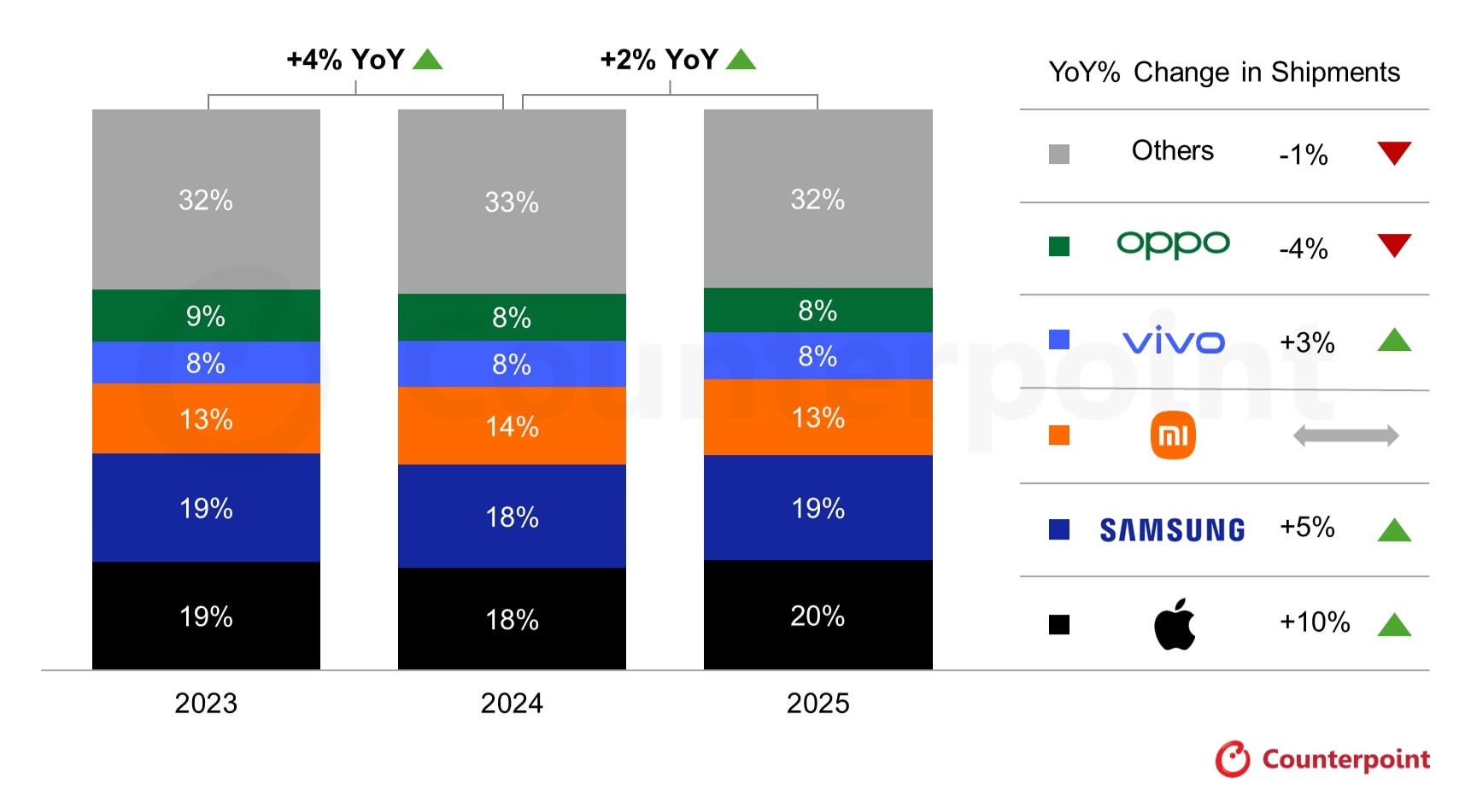
In a significant turn of events for the technology world, Apple has ascended to the pinnacle of the global smartphone market in 2025. Data released by Counterpoint Research today confirms that the Cupertino giant captured an impressive 20% market share, showcasing a robust 10% year-over-year shipment growth. This remarkable growth rate was the highest among the top five leading smartphone brands, solidifying Apple's leadership position and underscoring its strategic successes in an increasingly competitive landscape.
The year 2025 itself marked a period of renewed vitality for the global smartphone market. After periods of stagnation and even decline, worldwide smartphone shipments collectively grew by 2% compared to the previous year. This positive shift signaled the second consecutive year of growth, indicating a healthy recovery and evolving consumer behaviors. Counterpoint Research highlighted several key factors driving this market resurgence. Firstly, a growing number of consumers leveraged attractive financing options, making it more feasible to upgrade to premium, high-end devices. Secondly, there was a noticeable acceleration in the adoption of advanced 5G technology, particularly within burgeoning emerging markets across the globe.
The Competitive Landscape: Apple's Peers and Their Performance
While Apple celebrated its top spot, the competitive field remained vibrant. Samsung, a long-standing rival, secured the second position just behind Apple, with a 19% market share. Samsung also experienced positive momentum, recording a modest yet respectable 5% shipment growth. Following closely, Chinese technology powerhouse Xiaomi maintained its third-place standing, holding a 13% share of the global market. These figures paint a clear picture: while the market showed overall growth, Apple managed to outperform its nearest competitors by a significant margin in terms of year-over-year growth, indicating a successful strategic execution.
What Fueled Apple's Unprecedented Growth?
According to Varun Mishra, a senior analyst at Counterpoint Research, Apple's outstanding performance in 2025 was not a mere stroke of luck but a culmination of deliberate and effective strategies. Mishra pointed out that "Apple's growth in 2025 was driven by its expanding presence and rising demand across emerging and mid-size markets, supported by a stronger product mix." This statement encapsulates several critical elements that contributed to Apple's success, which we will explore in detail.
One of the primary drivers was Apple's increasing focus on and success within emerging and mid-size markets. For many years, Apple's stronghold was predominantly in developed regions like North America and Western Europe. However, recognizing the immense potential in growing economies, Apple intensified its efforts to penetrate these new territories. This expansion wasn't just about selling more phones; it involved understanding local market dynamics, adapting distribution strategies, and making its premium devices more accessible to a wider demographic. The "rising demand" in these regions can be attributed to several factors: increasing disposable incomes, a growing aspiration for premium brands, and Apple's consistent efforts to build brand loyalty and expand its ecosystem in these areas. By tapping into these previously underserved or under-penetrated markets, Apple unlocked substantial new revenue streams and customer bases.
Furthermore, Apple's "stronger product mix" played a pivotal role. This refers to the effective combination and performance of its various iPhone models. Specifically, the analyst highlighted the overwhelming success of the iPhone 17 series following its launch in Q4 2025. New flagship launches often provide a significant sales boost, and the iPhone 17 evidently resonated strongly with consumers, likely due to its cutting-edge features, design innovations, and performance enhancements. The anticipation surrounding a new iPhone launch is always high, but the 2025 release evidently exceeded expectations, translating into substantial sales figures globally.
Beyond the latest flagship, the report also noted the exceptional continued performance of the previous generation, the iPhone 16. This model continued to demonstrate remarkable strength, particularly in key markets such as Japan, India, and Southeast Asia. The sustained demand for the iPhone 16 suggests that consumers in these regions valued its capabilities and perhaps its more accessible price point after the launch of its successor. This strategy of offering a range of compelling devices, from the very latest to slightly older but still highly capable models, allows Apple to cater to different budget segments and preferences, ensuring a broader appeal and sustained sales momentum across multiple product cycles.
The Inflection Point: Pandemic-Era Upgrades
Adding another layer to Apple's impressive performance was the timing of what analysts refer to as the "pandemic-era upgrade cycle" reaching an inflection point. During the initial phases of the global pandemic, many consumers deferred non-essential purchases, including smartphone upgrades, due to economic uncertainties or simply reduced opportunities to visit stores. As global economies stabilized and consumer confidence returned, millions of users who had held onto their devices for longer than usual were now "due for device replacement."
An "inflection point" in this context signifies a moment where a significant shift occurs after a period of accumulation. It means that the pent-up demand for new smartphones, which had been building for years, finally started to release in a major way. Apple, with its highly desirable premium devices and effective marketing, was perfectly positioned to capitalize on this wave of delayed upgrades. Consumers who were finally ready to replace their aging phones often opted for premium devices, seeing them as long-term investments that offered superior performance, camera capabilities, and ecosystem benefits. This confluence of delayed upgrades and a strong product lineup created a fertile ground for Apple's sales explosion.
The impact of these factors was particularly evident in Q4 2025, which saw Apple achieve its highest-ever quarterly share of global smartphone shipments. During this three-month period, Apple accounted for a staggering one-quarter of all smartphones shipped worldwide. This extraordinary achievement underscores the strength of the iPhone 17 launch, the continued success of older models, and the effective realization of the upgrade cycle, all contributing to a historic quarter for the company.
Navigating External Challenges: The U.S. Tariff Situation
It wasn't all smooth sailing for the industry in 2025. Early in the year, concerns about potential U.S. tariffs on imported goods, particularly electronics from certain regions, loomed large. Such tariffs could significantly increase the cost of manufacturing and ultimately the price of smartphones for consumers, potentially dampening demand. In anticipation of these tariffs, many manufacturers adopted a strategy of "front-loading shipments" in the first half of the year. This meant accelerating production and shipping more devices earlier than planned to avoid higher costs if tariffs were indeed implemented.
However, the actual impact of these tariff concerns proved milder than many had anticipated. While manufacturers prepared for the worst, the resulting tariffs or their enforcement were less severe or widespread, limiting their disruptive potential. Consequently, the effects on second-half shipment volumes were also limited. This outcome allowed the market to maintain a relatively stable trajectory without major tariff-induced disruptions, contributing to the overall 2% growth for the year. The industry's proactive measures, combined with a less severe-than-expected policy environment, helped to mitigate a potentially significant headwind.
Looking Ahead: A More Conservative Outlook for 2026
Despite the positive momentum of 2025, Counterpoint Research's outlook for the global smartphone market in 2026 is notably more conservative. Tarun Pathak, a research director at Counterpoint, cautioned that "The global smartphone market is set to soften in 2026 amid DRAM/NAND shortages and rising component costs, as chipmakers prioritize AI data centers over smartphones." This forecast indicates that the favorable conditions of 2025 might not fully extend into the new year, presenting new challenges for smartphone manufacturers and consumers alike.
Understanding the Looming Challenges: DRAM/NAND Shortages
At the heart of the 2026 forecast are significant supply chain concerns, specifically "DRAM/NAND shortages." DRAM (Dynamic Random-Access Memory) and NAND (Not AND) flash memory are crucial components in virtually every modern electronic device, including smartphones. DRAM acts as the temporary working memory for the phone's processor, enabling multitasking and smooth operation. NAND flash memory, on the other hand, is the persistent storage where your apps, photos, videos, and operating system reside.
Shortages in these critical components mean that manufacturers may struggle to acquire enough memory chips to build their devices at the desired scale. This scarcity typically leads to two major consequences: reduced production volumes (fewer phones can be made) and "rising component costs" (manufacturers have to pay more for the limited supply). These increased costs can then be passed on to consumers in the form of higher smartphone prices, or they can eat into manufacturers' profit margins, potentially impacting innovation and investment.
The Rise of AI: A New Competitor for Chip Supply
A significant factor contributing to these component shortages is a paradigm shift in the semiconductor industry: "chipmakers prioritize AI data centers over smartphones." The demand for artificial intelligence (AI) technologies has exploded across industries, driving massive investments in AI data centers. These data centers require specialized, high-performance chips, including advanced CPUs, GPUs, and vast quantities of high-bandwidth memory (HBM), which is a type of DRAM optimized for AI workloads.
Chip manufacturers, seeing the immense growth and profitability in the AI sector, are naturally allocating a larger portion of their production capacity and research & development efforts towards these high-margin AI chips. This redirection of resources means less capacity and fewer resources are available for manufacturing components traditionally used in smartphones. While smartphones remain a massive market, the rapid expansion and technological intensity of AI data centers are creating a competitive pull on semiconductor supply, directly impacting the smartphone industry's ability to secure the components it needs.
In response to these anticipated headwinds, Counterpoint Research has already revised its 2026 smartphone market forecast downward by 3%. This revision reflects a more cautious outlook on overall shipment volumes, acknowledging the tangible impact of these supply chain constraints and shifting industry priorities.
Resilience Amidst Adversity: Apple and Samsung's Advantage
Despite the broader market softening, Apple and Samsung are expected to demonstrate remarkable resilience. This anticipated strength stems from their "stronger supply chain capabilities." What does this entail? Both companies operate on an immense global scale, which grants them significant advantages:
- Scale and Negotiating Power: Their sheer volume of orders gives them immense leverage with component suppliers. They can secure larger, long-term contracts and potentially negotiate better pricing or guaranteed supply allocations than smaller competitors.
- Strategic Partnerships: Both Apple and Samsung have deep, long-standing relationships with key component manufacturers, often investing in their suppliers or entering into exclusive agreements.
- Diversified Supply Chains: They often work with multiple suppliers for the same component, reducing reliance on a single source and providing alternatives in case of disruptions.
- Financial Strength: Their robust financial positions allow them to make upfront payments, invest in new technologies, or even absorb higher component costs more easily than their smaller rivals.
- Vertical Integration (especially Samsung): Samsung, being a conglomerate, manufactures many of its own components (like displays, memory chips, and processors). This vertical integration provides a degree of control and insulation from external supply chain shocks. While Apple is not vertically integrated in the same way, it heavily co-develops chips and components with its partners, giving it significant influence over design and production priorities.
These capabilities mean that while all smartphone manufacturers will feel the pinch of DRAM/NAND shortages and rising costs, Apple and Samsung are better equipped to navigate these challenges. They are more likely to secure the necessary components, albeit potentially at a higher cost, allowing them to maintain production levels and market presence more effectively than their less robustly supported competitors. This could further consolidate their market share in 2026, even as the overall market experiences a slowdown.
Conclusion: A Year of Triumph and Future Caution
The year 2025 will be remembered as a landmark year for Apple, where it not only captured the global smartphone market leadership but also demonstrated impressive growth in a recovering industry. Its strategic focus on emerging markets, a compelling product mix led by the iPhone 17 and sustained by the iPhone 16, and effective capitalization on the pandemic-era upgrade cycle all contributed to its historic success. While the global smartphone market as a whole showed positive signs of growth, driven by financing options and 5G adoption, Apple truly outshone its rivals.
However, the horizon for 2026 presents a more complex picture. The looming challenges of DRAM/NAND shortages and rising component costs, exacerbated by the booming demand from AI data centers, signal a period of market softening. Yet, in the face of these potential headwinds, the inherent strengths of industry giants like Apple and Samsung, particularly their formidable supply chain capabilities, are expected to provide a crucial buffer. This resilience suggests that while the overall smartphone market may face a tougher year, these dominant players are well-positioned to weather the storm, potentially reinforcing their market leadership even further.
This article, "Apple Tops 2025 Smartphone Market With 20% Share, 10% Growth" first appeared on MacRumors.com
Discuss this article in our forums
from MacRumors
-via DynaSage

Post a Comment