The Magic Touch: A 555 Touch Switch
Building a Simple Touch Switch with a 555 Timer
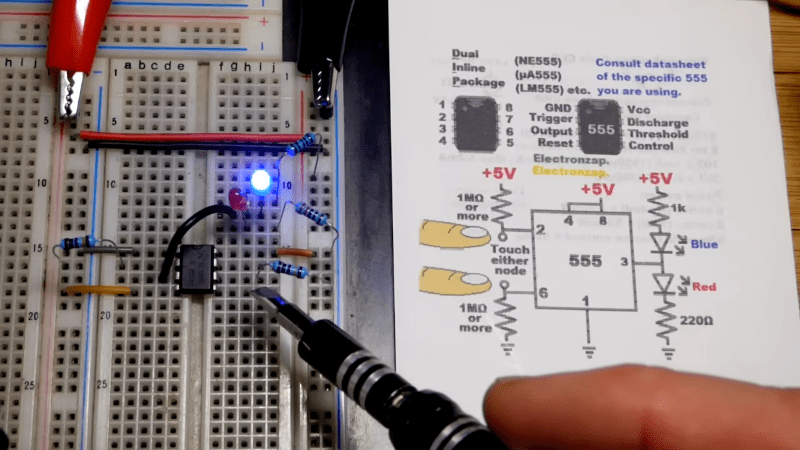
The ubiquitous 555 timer IC is known for its incredible versatility. It seems like there's nothing it can't do! This article explores a clever application of the 555: creating a simple touch switch. As demonstrated by [electronzapdotcom], you can build a functional touch switch with a 555 timer and just a handful of other components, all assembled on a breadboard.
How the 555 Touch Switch Works
The key to this circuit lies in the use of high-value resistors connected to the trigger and threshold pins of the 555. These large resistors make the circuit sensitive to the tiny electrical noise generated by your body. When you touch the designated point in the circuit, this noise is enough to overcome the logic level on these pins, triggering the 555 and activating the switch. The video below provides a visual demonstration of the circuit in action.
The circuit operates as a bistable multivibrator, also known as a flip-flop. In this configuration, the 555 switches between two stable states. Each touch acts as a pulse, toggling the circuit from one state to the other. This simple yet effective mechanism provides a reliable touch-activated switching action.
Environmental Considerations and Reliability
While this circuit is ingenious in its simplicity, it might not be suitable for all environments. We suspect that the ambient electromagnetic noise, such as the 50 or 60 Hz hum from power lines, plays a role in its operation. This noise, coupling through your finger, could be what triggers the sensitive input pins. Therefore, in quiet environments, the switch might not function reliably.
The reliability of the switch is also an open question. Since the switching action relies on the body's electrical noise, variations in this noise could affect performance. Further testing would be needed to determine the long-term stability and consistency of this design.
Alternative Touch Switch Solutions
Of course, this DIY 555 touch switch is just one way to achieve touch-activated control. If you need a more robust and reliable solution, there are plenty of other options available:
- Dedicated Touch Sensor Modules: Pre-built modules like the TTP223 offer a simple and readily available solution for integrating touch functionality into your projects. These modules are compact, affordable, and easy to use. Learn more about the TTP223 in this article: ttp223-brings-simple-touch-controls-to-a-led-lamp.
- Direct Skin Resistance Measurement: Another approach involves directly measuring the resistance of your skin. This method offers greater precision and control compared to the 555 timer approach. Explore this technique further here: flip-flops-make-great-soft-switches.
Conclusion
The 555 timer continues to amaze with its versatility. Building a touch switch with a 555 is a fascinating demonstration of its capabilities and a great introduction to basic circuit principles. While it may not be the most robust solution for all applications, it offers a simple and inexpensive way to experiment with touch-sensitive electronics. For more demanding applications, dedicated touch sensor modules or direct skin resistance measurement offer more reliable alternatives.
from Hackaday
-via DynaSage

Post a Comment