Printed Robotic Arm Pumps Up With Brushless Motors
Building a Powerful 3D-Printed Robotic Arm: The dARM Project
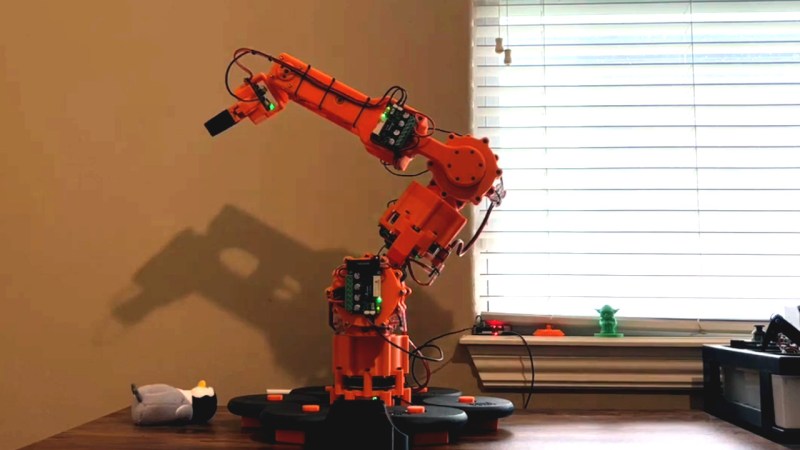
Jesse Darr recently shared their impressive "dynamic Arm for Robotic Mischief" (dARM) project. This 3D-printed robotic arm boasts six degrees of freedom (6DOF), offering a level of strength and dexterity rarely seen in DIY robotic arms.
Powering the dARM: Brushless Motors
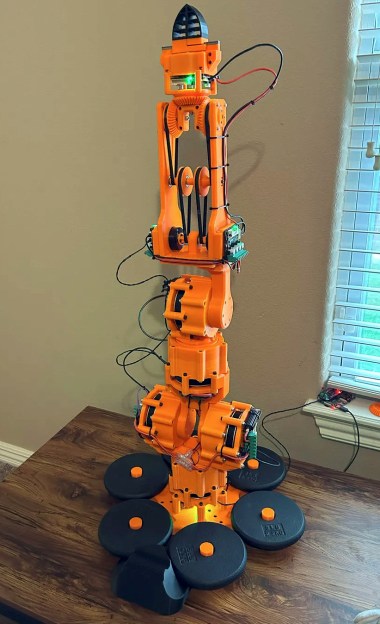 The key to dARM's power lies in its use of brushless DC (BLDC) motors, controlled by ODrive S1 controllers, instead of traditional servos. This approach, inspired by robotics experts James Bruton and Skyentific, offers significant advantages in terms of performance and control. Regular Hackaday readers might recognize these names as pioneers in using BLDC motors for robotics projects. Their work demonstrated the power and versatility of this motor type, influencing Jesse Darr's design choices for the dARM project.
Controlling the Arm: A Networked Approach
Eight ODrive controllers govern the dARM's movements. These controllers communicate with each other over a CAN bus network, which is then connected to a Raspberry Pi 4B computer via an RS485 CAN Hat. This networked setup simplifies wiring and maintenance, as the controllers are daisy-chained together using standard twisted pair wire. This modular approach makes the arm easier to assemble and modify.
Motor Selection and Lifting Capacity
The dARM utilizes three different types of BLDC motors, strategically placed to optimize performance. Three powerful Eaglepower 8308 motors serve as the primary actuators, while two GB36-2 motors are located in the forearm. A GM5208-24 motor powers the gripper. This combination of motors and gearboxes gives the dARM impressive lifting capabilities, allowing it to lift approximately 5 pounds (2.2 kilograms) when fully extended horizontally.
Building Your Own dARM: Documentation and Resources
The dARM project is well-documented, offering resources for anyone interested in building their own. The documentation includes assembly instructions for the 3D-printed components, a comprehensive Bill of Materials listing all necessary parts, and guidance on setting up the software environment on the Raspberry Pi. While not a complete step-by-step guide, the available information is substantial and caters to those serious about replicating the project. You can find the project's GitHub repository here.
Exploring Other Robotic Arm Projects
If you're new to robotics and looking for a less complex starting point, several other simpler robotic arm projects are available. These offer a gentler introduction to the world of robotic arm construction.
dARM in Action
from Hackaday
-via DynaSage

Post a Comment