Tiny Bubbles in the Memory
The Curious Case of Bubble Memory: A Retro Tech Deep Dive
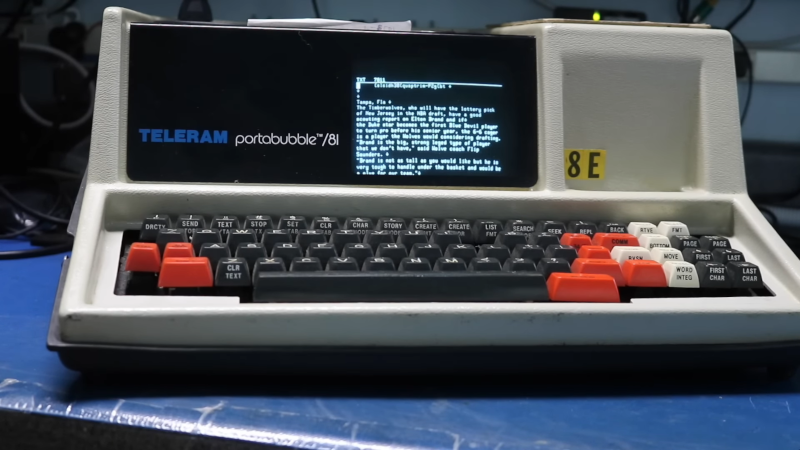
Bubble memory. It sounds like something out of a science fiction novel, doesn't it? Back in the late 1970s, this technology held immense promise, touted as the future of data storage. While it didn’t quite live up to the hype, bubble memory remains a fascinating piece of computing history.
The Rise of Bubbles: A New Hope for Storage
In a time when data storage primarily relied on bulky tape drives and delicate disk drives, bubble memory offered a compelling alternative. It provided non-volatile storage, meaning data was retained even when the power was off. This was a significant advantage, making it a viable option for various devices.
One such device was the Teleram word processor with a built-in acoustic coupler modem. This vintage piece of technology showcased the practical application of bubble memory. While the keyboard on this particular machine was initially non-functional, it was later repaired, highlighting the repairability of these older systems.
How Did Bubble Memory Work?
Bubble memory operated on a surprisingly sophisticated principle. Imagine a thin film of magnetic material. Within this film, tiny magnetic domains, or "bubbles," could be created and manipulated. These bubbles represented data – the presence of a bubble could signify a "1" and its absence a "0".
A rotating magnetic field propelled these bubbles along predefined paths on the film, much like a microscopic conveyor belt. A read-write head, strategically positioned along these paths, could then detect the presence or absence of bubbles, effectively reading the stored data. This same head could also create and destroy bubbles, allowing for data writing and erasure.
The Fall of Bubbles: Why Didn't It Take Off?
Despite its initial promise, bubble memory ultimately lost the race against another emerging technology: the hard drive. As hard drive technology rapidly advanced, storage capacity increased dramatically while costs plummeted. Improved read/write heads and more efficient data recording methods allowed hard drives to achieve densities far beyond what bubble memory could offer.
Hard drives also proved to be more rugged and reliable, further cementing their dominance in the market. Although bubble memory found niche applications in environments with high vibrations, where traditional hard drives were susceptible to failure, its overall market share remained limited.
Bubble Memory's Legacy: A Niche Player
Despite its commercial failure, bubble memory left its mark. It found its way into specialized devices like certain oscilloscopes and even video games. This technology also paved the way for further advancements in magnetic storage. In fact, bubble memory evolved from an earlier technology known as twistor memory, another fascinating precursor to modern hard drives. These technologies, while largely forgotten today, represent important stepping stones in the evolution of data storage.
Rediscovering Bubble Memory Today
Although bubble memory is rarely encountered today, enthusiasts and collectors occasionally stumble upon these vintage components. Some integrate these relics into modern projects, breathing new life into old technology. Others meticulously preserve these devices as historical artifacts, reminding us of the ingenuity and innovation that shaped the digital world we live in today.
If you're interested in exploring this fascinating technology further, here are some resources:
- Read about several pre-disk technologies: Thanks for the Memories: Touring the Awesome Random Access of Old
- Discover a project using surplus bubble memory: Magnetic Bubble Memory Farewell Tour
from Hackaday
-via DynaSage

Post a Comment