This Week in Security: XZ, ATT, and Letters of Marque

The xz backdoor is naturally still the top story of the week. If you need a refresher, see our previous coverage. As expected, some very talented reverse engineers have gone to work on the code, and we have a much better idea of what the injected payload does.
One of the first findings to note is that the backdoor doesn’t allow a user to log in over SSH. Instead, when an SSH request is signed with the right authentication key, one of the certificate fields is decoded and executed via a system() call. And this makes perfect sense. An SSH login leaves an audit trail, while this backdoor is obviously intended to be silent and secret.
It’s interesting to note that this code made use of both autotools macros, and the GNU ifunc, or Indirect FUNCtions. That’s the nifty feature where a binary can include different versions of a function, each optimized for a different processor instruction set. The right version of the function gets called at runtime. Or in this case, the malicious version of that function gets hooked in to execution by a malicious library.
Who is Jia Tan?
One of the more intriguing mysteries is the real identity of the programmer or programmers behind the Jia Tan identity. I’m of the opinion that it’s more than one developer, we’ll get into why in a bit. The first clue is the timezone on the Jia commits, which is UTC +8. That’s the timezone of China, Mongolia, part of Russia, Western Australia, and the island nations in-between. East Asian name, East Asian timezone, so it must be an East Asian hacker, presumably Chinese. Except, the commit times don’t make any sense.
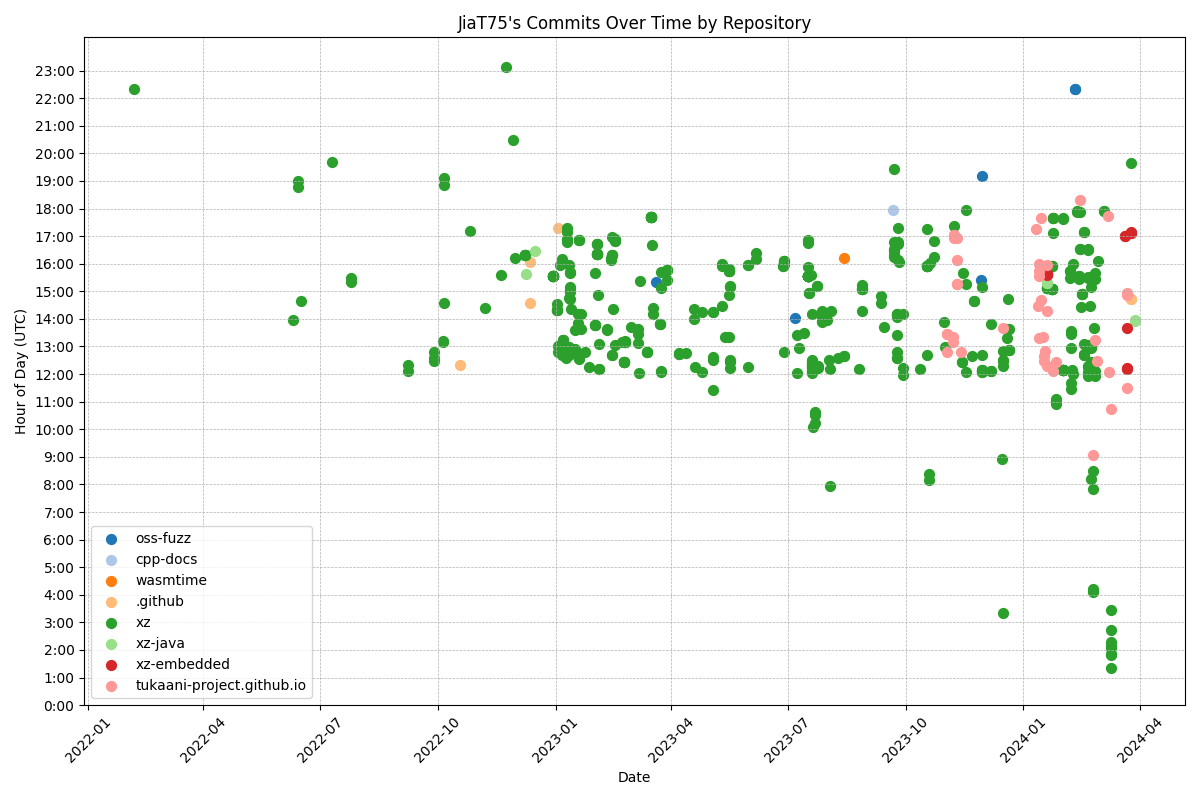
I’ve seen some theories that Jia was committing in a +2 or +3 timezone. Nope. Check the git log for yourself, and see the graph. There’s an obvious pattern here, starting at 12:00 noon UTC. Now which time zone would that correspond to an office worker starting work at 8:00 AM? UTC -4 is the Eastern US — but only during half the year. What’s notably missing from that chart is the twice-a-year time change for Daylight Savings Time that the US endures. It’s also worth noting that git commit times are easy to change before making a push.
And then there’s the series of changes with oddball times towards the end of the graph. Of interest are the version bumps to 5.6.0 and 5.6.1, and also the Valgrind “fix”. Which may possibly suggest a second programmer controlling the Jia Tan puppet account. There is a notable gap in commits right around the Christmas/New Year holiday each year, too. But all things considered, there is no smoking gun pointing at a specific country. Just a few hints. But the complete lack of information about Jia Tan in any other venues is a good sign that it’s a fabricated persona, and using pretty good opsec at that.
So What Now?
The next question is, what can we do to keep this from happening again? Developers and distro maintainers are definitely thinking through this question right now. One conclusion is that tarballs cannot be thoughtlessly trusted. Checking tarball contents against git tags, and regenerating the autotools output are good, too. Several developers are looking hard at moving away from hard-to-understand tools like gnulib and autotools altogether.
The Debian policy of requiring in-person meetings before GPG attestation suddenly seems like a good policy. Perhaps this should become an industry standard practice to gain maintainership in any existing open-source project.
An interesting point was made at about 37 1/2 minutes into this week’s FLOSS Weekly interview, where Joshua explained that only two or three people have commit access to the Asterisk codebase, and only Sangoma employees are permitted to be project maintainers. Will more corporate sponsorship of individual Open Source projects be part of the solution? Time will tell.
AT&T Finally Owns Up
We now know that back in 2019, customer data from AT&T customers was grabbed in a breach. What’s notable here is that it took until this March for AT&T to publicly acknowledge that it was indeed data leaked from their customer records. The way this was confirmed is particularly impressive.
Credit goes to [Sam Croley] for figuring this out. Each account record included address, phone number, birthdays, and Social Security number. And then for each account, a numeric passcode was encrypted and included. That encryption is strong enough to prevent properly cracking it. (We’d bet it’s actually a hashing function.) But [Sam] is particularly clever. He took just the encrypted values, sorted, and de-duplicated them. The result? just about 10,000 unique records, pretty much what you would expect if 70 million users all picked a 4 digit pin. The hashing or encryption algorithm used here wasn’t keyed or salted per entry.
And as a result we get part two of the world’s greatest crossword puzzle — the numeric edition. To put it simply, every time a customer chose 1337 as their PIN, the value in the leak was the same. All it takes is a few users out of 70 million with a phone number, birthday, or social security number ending in 1337 to figure out that’s what a given hash value corresponds to. And even if you picked that number completely randomly, it still gets figured out with all the rest.
Hackers’ Letters of Marque
There is a fascinating saga playing out, along side the ground war in Ukraine: Hackers have been given a sort of Letter of Marque from the Ukranian government, and now some physical letters have been sent out as well. Drawing on my knowledge of history gained from early computer games like Sid Meier’s Pirates!, I know that a Letter of Marque is authorization from a government given to a private citizen to attack and claim foreign ships and assets. So what we have here is a modern, digital take on the idea. It may be worth noting that Ukraine is not a signatory to the treaty that banned the practice.
Typosquatting Adds AI Hallucinations
It seems like we need to add another entry to the standard list of warnings given to Linux users. Don’t run code copied directly from a website, and now, don’t run code copied directly from ChatGPT. Apparently there’s a commonly hallucinated pip package, huggingface-cli, referring to part of the huggingface project. That package doesn’t exist, but the command has sneaked into a few online guides anyways.
And that’s where the typosquatting comes in. Thankfully this time it’s by a security researcher rather than a malware author. [Bar Lanyado] grabbed that package name as a test, and scored 15,000 download attempts in a mere three months. So far there isn’t a real attack using this technique, but it’s likely just a matter of time.
But you don’t need AI for traditional typosquatting: PyPI finds itself again in the cross-hairs. This is a collection of 566 fake packages, in an automated campaign. The uploads happened in a pair of bursts over a couple days, and ended when PyPI maintainers suspended both new project and new user creation.
Bits and Bytes
The DOMPurify project is intended to take “dirty” HTML and turn it into a string of sanitized, XSS-free HTML. There was a little catch, in that HTML code is a bit different from XML. XML is much stricter in what it considers parseable tags, but will pass the contents of those tags, even if it contains valid HTML. The takeaway is that researchers found several DOMPurify bypasses that took advantage of this parsing gap. Patches have been applied, so the up-to-date DOMPurify package should be good to go.
Filed in the “awkward” category, the OWASP foundation was accidentally hosting some very old member resumes available to the public. It’s awkward because OWASP is the foundation dedicated to improving open source security. The upside is the information leaked is so out of date, most of the people affected can’t even be contacted. So we get a public announcement.
Microsoft has received a reaming from the Cyber Safety Review Board over the 2023 hack of hosted Exchange accounts. It appears there are still unanswered questions, like exactly which crash dump contained the key used in the final attack. Still, it’s not a good day when your actions are described as a “cascade of … avoidable errors.”
from Hackaday
-via DopeSatan

Post a Comment